WeChat: (+86)13978873330 Email: 381784025@qq.com

WeChat: (+86)13978873330 Email: 381784025@qq.com

The place in a columbarium that blackens fastest is the tablet area. The reason is simple: a tablet is an upright plane facing the burner and smoke rises straight at its face. Over ten years a white-faced wooden tablet turns deep brown. Whether to offer incense is essentially a trade-off between the sense of ritual and the life of the face.
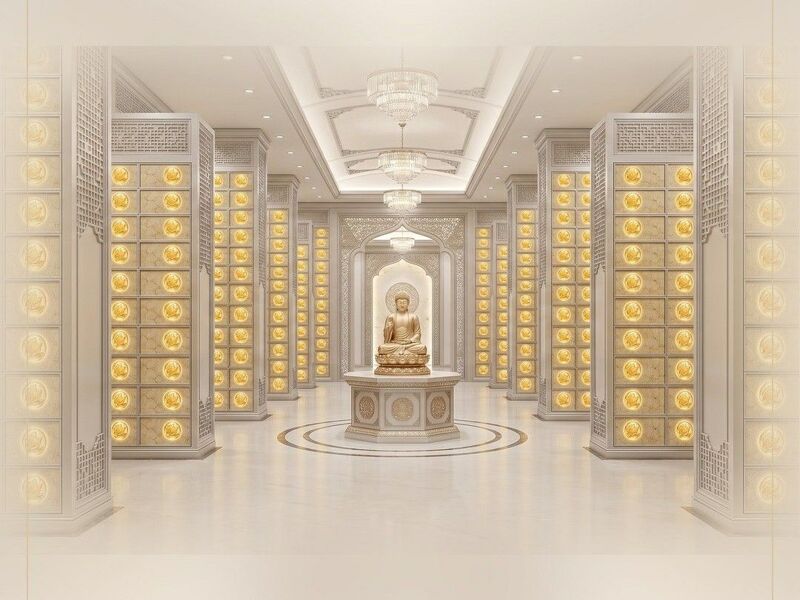
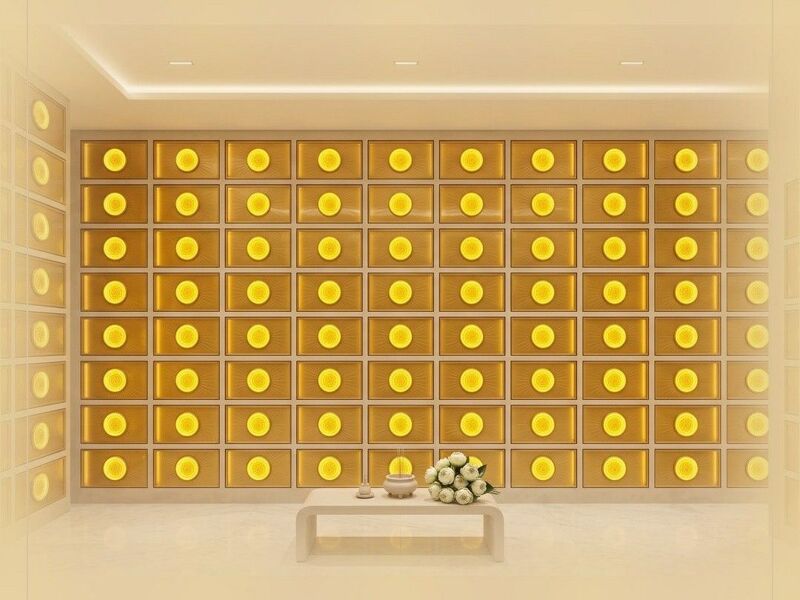
The tablet areas of most new columbaria have banned open-flame incense outright, using electronic sticks, lotus lamps and fresh flowers instead. This is not laziness; it is the result of twenty years of experience.
Three reasons all quantifiable.
- Deposition. One coil burning for 40 minutes lifts particulate into the air, and in an enclosed space it rises with the airflow; the upper third of the tablet face takes the heaviest deposit. Discolouration shows in three years and turns deep brown in ten. - Tar. Burning incense produces tar, which lands on the face and attracts more dust, forming a film that is hard to remove. The film cannot be wiped with water — water smears it. - Heat. The tip of a stick reaches 700–800 °C; tablet faces within 100 mm of the burner are heated for long periods, the timber loses moisture and crazes, and acrylic deforms slightly.
Close the door of a niche and smoke cannot get in; a tablet is a vertical plane with its face fully exposed. The same amount of smoke has almost no effect on a niche and a direct effect on a tablet.
This is the most widespread practice.
The standard arrangement: a bunch of plain flowers (white chrysanthemum, lily, orchid), a perpetual lamp (LED, 3–5 W, 2700 K), and three cups of clear water.
Use dried or silk flowers. Fresh flowers wilt within two days in an enclosed space and the fallen petals block the drainage holes Choose a low colour temperature for the lamp; cold white above 4000 K makes the characters on the face look greenish, which does not read as an offering.
The cost is low: a bunch of silk flowers runs a few tens of yuan and lasts three years, and an LED lamp uses under 20 kWh a year. Most tablet areas come pre-fitted this way, and families need add nothing.
Some halls keep a "incense on set days" practice: at Qingming on anniversaries and around the New Year, an incense table is set in a communal burner area outside the tablet area, families offer there and only flowers go before the tablet.
The logic is to separate the ritual of incense from the protection of the tablet: incense is still offered, just not directly in front of the tablet.
If a hall does allow incense before the tablet, three limits apply: one stick only (a tenth the smoke of a coil), a time limit (extinguish within ten minutes, do not let it burn out), and a distance limit (burner at least 300 mm from the face, offset 15–30 degrees, never directly in front).
Electronic incense has spread over the past decade: an LED stick in a small holder, glowing red at the tip when powered, some with misting.
The advantage is no smoke, no open flame, no staining. The drawback is no smell — for elders used to joss sticks, the sense of ritual is diminished.
Judge an electronic stick on two things: whether the head is replaceable (replaceable ones last longer), and whether it is battery or mains powered (mains means no battery changes, but the cable must be concealed; exposed wiring looks disreputable in a columbarium).
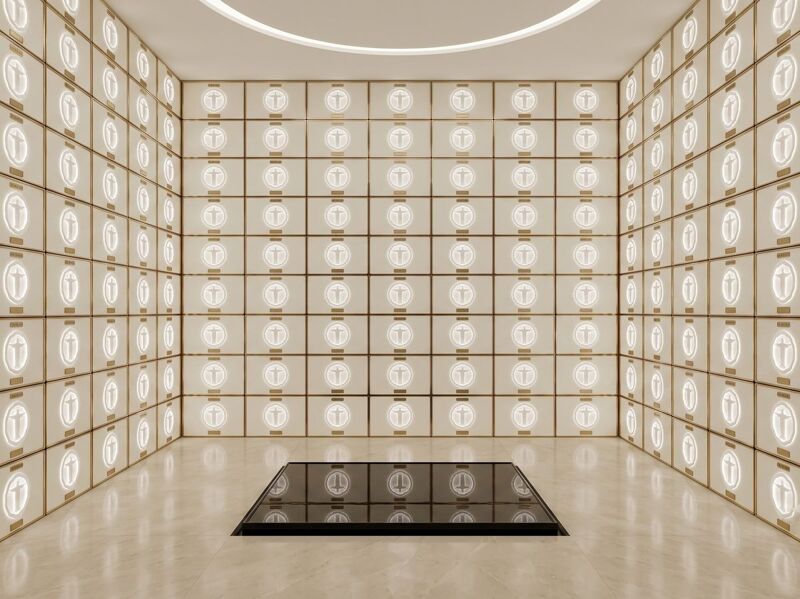
Light discolouration (yellowing). Dry-brush with a soft brush; do not use water. Water drives the tar into the grain.
Moderate deposit (brown, tacky). Professional restoration only: soften the tar layer with a specialist cleaner, then lift it with acid-free paper. Families doing it themselves will nine times out of ten dull the finish.
Heavy carbonisation (black, with fine cracks). Unrecoverable; the tablet must be remade, priced as new, with a change of registration.
Of the three, only the first can still be saved So the real solution is prevention, not cleaning — especially since once a tablet is finalised, replacing it means going through the installation process again.
In the same hall, the niche area may allow electronic sticks while the tablet area bans everything. The reason lies in spatial ratios.
A niche is a horizontal box; close the door and smoke cannot enter A tablet is a vertical plane, fully exposed. The other reason is density: a square metre of tablet area holds 20–30 tablets with a walkway only 1.2 m wide, while a square metre of niche area holds only four to six niches The same smoke produces several times the concentration in the tablet area.
So "no incense in the columbarium" is enforced far more thoroughly in the tablet area than in the niche area. That is not double standards; the spatial conditions differ.
1. Ask before interment whether incense is allowed in the tablet area and whether there is a communal burner. That answer determines how you will pay respects for the next twenty years. 2. Avoid positions directly facing the communal burner. A tablet within 3 m of the burner will be smoked by others even if you never light anything 3. Wipe once a year with a dry cloth. It is the only routine action that slows discolouration. Do the niche at the same time.
Q: Is it disrespectful that the tablet area allows no incense?
A: No. Flowers, water and light are all offerings The sense of ritual comes from arriving, setting out and reciting — not from whether there is smoke.
Q: We burn incense at home but cannot in the tablet area. Is that inconsistent?
A: No. Home is private; a tablet area is public space, and different rules are normal. Most families burn at home and offer flowers in the tablet area.
Q: Does the misting function on electronic incense stain the face too?
A: Yes, though less. Misting uses water or essential oil, and long use leaves water marks and an oil film. If you use one, run the light without the mist.
Whether to offer incense in a tablet area depends on two things: the hall's rules, and what you want that tablet to look like in twenty years. A ban with flowers is the mainstream, electronic is the compromise, and open flame requires one stick, a time limit and a distance. A blackened tablet cannot be saved, only remade — and on that point, prevention is far cheaper than remedy.