
WeChat: (+86)13978873330 Email: 381784025@qq.com

WeChat: (+86)13978873330 Email: 381784025@qq.com

Two urns in one niche saves the price of a second place, and it is one of the questions families ask most often. The answer is not "yes" or "no" but three numbers: clear width, clear height clear depth Meet all three and one niche two urns works; fail one and the consequences of forcing it in will be carried for twenty years.

Start with the urn. Urns common in southern Fujian and Taiwan run 180–220 mm outside diameter and 200–260 mm high, with another 20 mm for lid and base combined. Take a medium φ200 × 230 high as the example.
There are only two ways to fit two urns: side by side, or stacked.
The width sum for side by side. Two urns side by side: clear width = 200 + 200 + 40 mm centre gap + 20 mm each side = 460 mm. The 40 mm centre gap is not waste; it is the minimum space for fingers to reach in and straighten an urn. Below 30 mm you can only push, not steady, and pushing tips it.
The depth sum. Clear depth ≥ 480 mm. The urns are round, so after placing them side by side you still need 40–60 mm behind the door for the inner gasket and the hinge swing.
The height sum. Clear height ≥ 300 mm. Urn 230 high plus 20 mm base leaves 40–50 mm of hand room above; without that 50 mm, every handling scrapes the back of your hand on the shelf above.
Stacking looks like it saves width: run the clear height to 520 mm and put one urn on top of the other. In a niche this causes three problems.
First, load. An upper urn with ashes weighs about 6–9 kg, all of it bearing on the lid of the lower one. The lid rim is the thinnest part of any urn, and under sustained load the wax or silicone seal fails first. Niche shelves are designed for distributed load, but the contact area of an urn base is about the size of a palm — a point load.
Second, the order of handling. To take out the lower urn you must first move the upper one. Lifting and shifting an urn at the graveside is the single riskiest step in the whole procedure.
Third, the centre of gravity. Stacking raises it. Where a niche has been seismically designed, the shelf was calculated for distributed load; stacking is a concentrated load, and actual stress exceeds design values by more than 40%.
I generally advise against stacking. If it must be done, add an intermediate carrier board so that the upper urn's weight goes into the side panels rather than onto the lid below.
For the same two urns, a double niche and two single niches have completely different cost structures:
Double niche: one carcass one door, one management fee. You save a divider, a door panel, a lock and one opening.
Two single niches: two carcasses two doors, two management fees, but each independent and separable later.
On typical pricing, a double niche costs 15%–25% less than two singles, and the management fee is charged once — which saves more over time. Across twenty years the fee difference usually exceeds the price saved at purchase.
The price is flexibility. Once a double niche holds two urns, moving either one involves the other. Once a niche number is registered, changing it means paperwork — that is the real cost of a double niche.

To convert in an existing hall there is usually one route: remove the divider between two adjacent niches.
Whether that is possible depends on the frame. With an upright system the divider is a removable part, and removing it gains only 20–30 mm of clear width — often not enough. A monocoque carcass cannot be dismantled, only replaced as a set. Establish the frame type before discussing price; many columbarium quotations have no line item for "structural alteration" at all.
In practice the more common approach is to set out the module for double niches at design stage in a new hall, rather than convert afterwards. In a hall already built ask "can it take two urns" and the answer is usually "yes" — but follow up with: side by side or stacked, and is there an intermediate carrier board?
Take a tape measure and do three measurements and three checks:
1. Clear width: between the inner faces of the side panels, with the door open. 2. Clear height: from the shelf surface to the underside of the shelf above. 3. Clear depth: from the inside of the door to the back panel. 4. Check the opening: if the diagonal of the door opening is smaller than the diagonal of the cavity the urn will go into the cavity but not through the door. 5. Check for a carrier board: without one, stacking is not on the table. 6. Check the base: the height the base occupies must be deducted from clear height.
Give the three numbers to the operator and get written confirmation. That is far more reliable than a verbal "two urns will fit".
Q: If the urn is not bought yet, do I buy the niche or the urn first?
A: Fix the urn specification, then choose the niche. The urn is fixed and the niche is selectable; doing it the other way round means making the niche accommodate the urn.
Q: One urn large, one small — can they share a niche?
A: Yes, but calculate the width from the larger one. The centre gap must be set to the large urn's diameter, or the small one slides into the middle.
Q: Is the management fee for a double niche really charged once?
A: Most halls charge per niche, not per urn. But put "double niche charged as one place" in the contract; without that wording it may be charged as two.
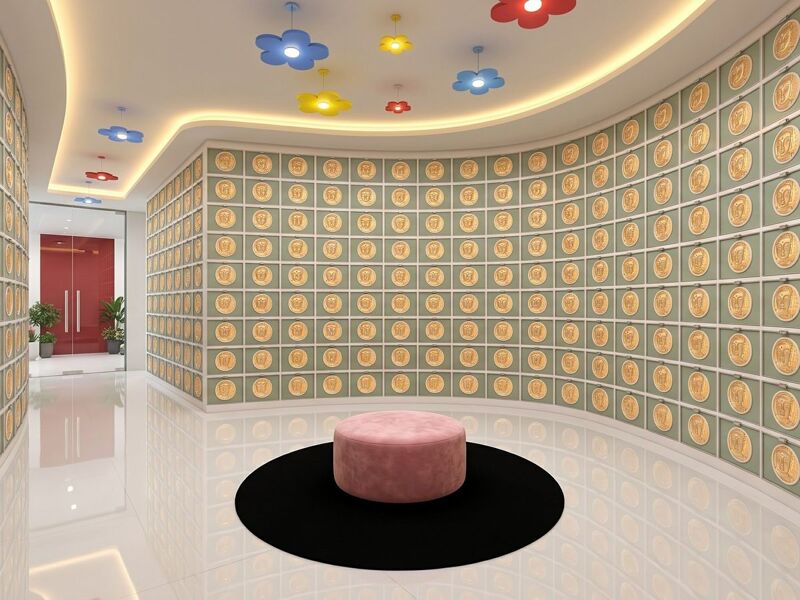
Whether a niche takes two urns is answered by three numbers: 460 clear width, 300 clear height, 480 clear depth. Side by side works, stacking needs a carrier board, and converting beats re-planning only rarely. A columbarium that holds two urns was designed to, not squeezed to. Niche dimensions are never "probably enough" — they are only known once measured, so pull out the tape before you ask the operator the question.






