WeChat: (+86)13978873330 Email: 381784025@qq.com

WeChat: (+86)13978873330 Email: 381784025@qq.com

The word "taboo" makes people tense, as if one wrong step will bring disaster. In practice, almost every taboo inside a columbarium is a rule of order: it lets dozens of families share the same floor the same incense burner and the same walkway without getting in each other's way Once you see that layer, the eleven rules at a columbarium niche are easy to remember — you no longer have to memorise them.

One: do not step over offerings. Walk around a set of offerings laid out on the ledge; never step across them. Stepping across means "passing over someone's head", which is disrespectful in folk custom — and in practice you will knock something over, and a single overturned plate of fruit means the whole row has to be cleared.
Two: do not turn your back on the tablet. Stand facing the tablet while offering incense or reciting. This is about presenting yourself squarely, and it also keeps the standing positions in order.
Three: no noise in the hall. That includes phone ringtones, video played out loud, children running. Reverberation time in a columbarium hall is usually 1.5–2 seconds; one sentence carries across the entire floor.
Four: do not open anyone else's niche. Only your own. Opening the wrong door is the gravest discourtesy, and it is a safety matter too.
Five: do not photograph other people's niches. Your own is fine, but keep other families' number plates out of frame. This is privacy, not superstition.
Six: do not put offerings straight on the floor. The floor has mop water on it and grit from shoe soles. Use the offering table, or a cloth you brought.
Seven: no meat or fish in a vegetarian zone. Some halls designate one; read the notice before you walk in.
Eight: no eating or drinking in the hall. Water included. Bin capacity in a columbarium is limited, and drink cups are a heavy load for waste collection.
Nine: no slippers, no tank tops. Plain trousers and closed shoes are the baseline. It is not about formality; it is about not looking casual.
Ten: do not hurry anyone. If someone is still paying respects, do not stand beside them waiting, do not sigh, do not check your watch That patch of floor in front of a niche is used in turn.
Eleven: do not take away or scatter incense ash or paper ash. The hall clears the burner; do not dig into it yourself.
Space. Rules one to six all say the same thing: do not occupy the shared parts of the hall — do not block the walkway, do not cross the boundary, do not make noise, do not intrude on someone else's position. A single floor may hold two thousand niches. If every family takes one extra metre, the walkway disappears.
Hygiene. Rules six to eight, and eleven, are all cleaning problems. What a columbarium fears most is not disrespect but insects, mould and odour — once those three arrive together, every niche on the floor loses value.
Psychology. Rules nine and ten govern dignity. Families arrive emotionally fragile; one person in a tank top taking a loud phone call makes the entire floor uncomfortable.
The first: ash falling on the offerings. The cause is standing too close and lifting the incense too high. The right method is to turn 45 degrees to the side and insert the stick with the burner at your front flank.
The second: offerings on the floor. The cause is that the offering table is full. The ledge in front of a niche is only 40 cm deep, so anyone who brings too much has nowhere to put it. Bring less and the problem disappears.
The third: children running in the walkway. The cause is that nobody is minding them, and also that a columbarium has "nothing to look at" from a child's height Give the child a job — carry the flowers, hold the fruit plate — and the running stops.
These three come up constantly. The answer has two layers.
The customary layer. Some regions hold that women who are menstruating, pregnant, or in mourning should not enter the hall. Every family says something different.
The practical layer. The real risks are crowding, poor air and steps. A pregnant visitor at peak season is at risk of being jostled, of standing too long, of low oxygen — not of any metaphysical clash.
My advice: follow the family elders on custom, and on the practical side avoid peaks, shorten the stay and bring someone along. The two do not conflict.

Having listed the prohibitions, here is what is allowed.
- Bring food the deceased liked, in small quantities. - Read a letter aloud, or play a piece of music (through headphones, or ask the hall to play it). - Take photographs, keeping other families' niches out of frame. - Bring children, provided you explain beforehand what kind of place this is. - Stand at the niche a little longer, provided you do not hold others up.
A columbarium is not a place of "what you must not do". It is a place of "look after the next person".
Look at three notices.
1. Does the entry notice list prohibited items clearly? 2. Is there a "please do not remove ash" sign beside the burner? 3. Is there a "service in progress, please walk around" board in the walkway?
A hall with all three has had its rules designed. A hall with none relies on everyone's self-discipline, and Qingming there will be chaos.
Q: I accidentally stepped over some offerings. Do I need to do something to make up for it?
A: Say "my apologies" and that is enough. No ritual is required The rules in a columbarium are about not repeating the mistake.
Q: Can I visit while in mourning?
A: Most families permit it; the only restriction is not joining other people's celebratory occasions. Entering a columbarium carries no taboo in itself. If the elders object, follow the elders.
Q: May I offer a stick of incense at the neighbouring niche as well?
A: Better not. That niche belongs to another family, and offering incense without permission is itself the discourtesy. If you want to express something, join your palms inwardly.
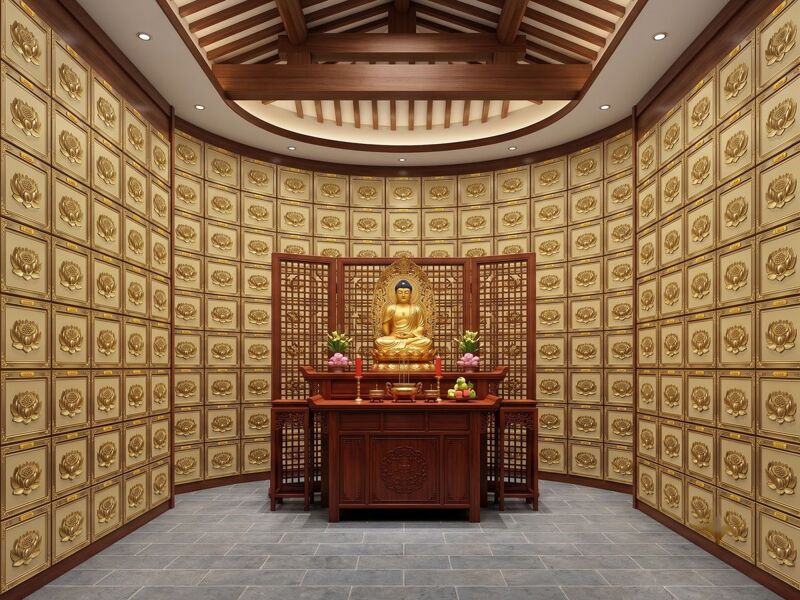
Taken one at a time, the taboos at a columbarium niche are rules. Taken together they are a code for shared space: do not cross the line do not make a mess, do not make noise. Everyone wants a little longer on that patch of floor in front of the niche — and the eleven rules protect exactly that turn-taking.