
WeChat: (+86)13978873330 Email: 381784025@qq.com

WeChat: (+86)13978873330 Email: 381784025@qq.com

In one hall, what exactly separates a thirty-thousand niche from a ninety-thousand one?

I have sorted the differences I have seen over the years into two categories: what can be changed, and what cannot. What can be changed is not worth paying a premium for. What cannot be changed is the basis for any premium.
One, position. Tier height, daylight face, distance from the Buddha, distance from the aisle. All four are fixed once the niche is handed over and cannot be adjusted later.
Two, internal chamber dimensions. A cheap niche may measure 400 × 400 × 450 mm inside; an expensive one 450 × 450 × 500 mm. That determines whether an urn over 240 mm in diameter will fit.
Three, shelf load capacity. Cheap units use 1.2 mm single-fold sheet, carrying 20 to 25 kg; expensive units use 1.5 mm double-fold with stiffening, carrying 35 to 40 kg. A stone urn weighs 8 to 12 kg, and that is where the difference shows.
Four, door frame tolerance. Cheap: a 3 to 5 mm gap. Expensive: 2 to 3 mm. A wider gap lets dust and moisture in more easily.
Five, positional stability. Expensive niches tend to be in mature zones where numbering is fixed and will not change; cheap ones may be in a later development zone where numbering and layout can still be adjusted.
Of those five, position and internal dimensions matter most. On a limited budget, sacrifice door panel specification rather than these two.
Door panel material. Aluminium composite, solid aluminium, stainless steel — all replaceable later. As long as the frame dimension is standard, changing panels does not affect structure.
Locks. Swapping a cam lock for a leaf-tumbler cylinder costs tens to just over a hundred yuan. The least worth spending on in advance.
Lining. Fabric lining can be added afterwards for one or two hundred yuan.
Strip lighting. Internal lighting can be retrofitted, but it needs wiring, so raise it before handover if possible.
Number plates. Etched stainless costs more than screen printing, but replacement is cheap.
Together those five are worth at most 15 per cent of the niche price. If the dearer tier's gap comes mainly from these, it is not worth it.
Look at two niches, one dear and one cheap. Stand in front and ask yourself four questions:
1. Can I raise my hand and open the door? (height difference) 2. Can I see the urn face? (sightline difference) 3. How many people can stand in front? (space difference) 4. With my urn inside, can I still reach in to adjust it? (size difference)
If all four answers are the same, the price gap bought only appearance. If one answer differs clearly, that item is the real difference.
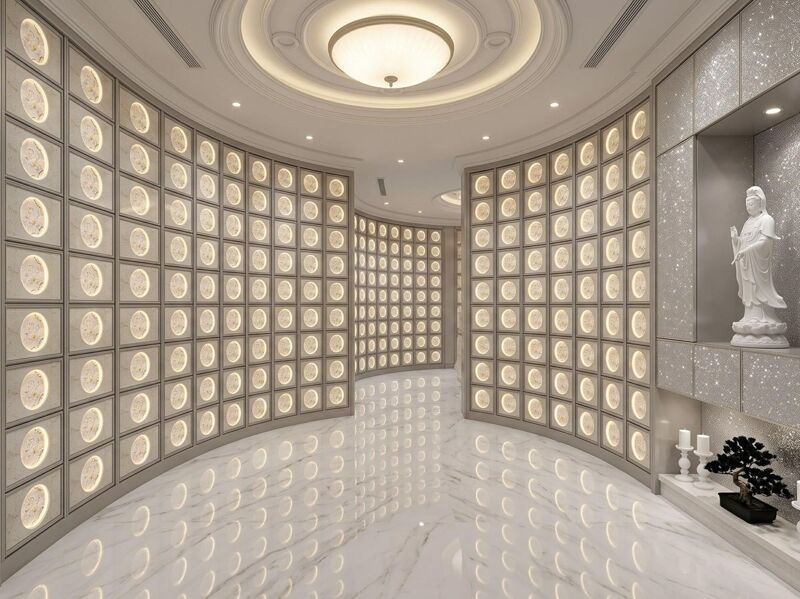
Not every cheap niche is cheap for a good reason. These three are common.
Next to equipment. Beside the dehumidifier, the toilets, the lift shaft. Noise and airflow affect the experience.
At the end of a run. End of an aisle, behind a column, around a corner. Hard to find, cramped for standing.
In a development zone. Cheap because the zone is unfinished, with an uncertain handover date.
Of the three, the first is the worst — noise is present every day, not only during visits.
Conversely, the expensive ones have hollow components too.
The "celebrity neighbour". A notable person is also in this zone. Nothing to do with the niche itself.
The "feng shui endorsement". Someone has inspected it and attached a label, and the price goes up thirty per cent. There is no verifiable basis for this whatsoever.
How much of the premium those two account for is answered by one question: "what would the price be without that item?"
Q: Can a cheap niche be improved by changing the door panel?
It improves appearance and sealing, but cannot change position or dimensions.
Q: Are expensive niches always drier?
No. Humidity depends on floor level, whether the niche is on an exterior wall, and dehumidification provision — not on price.
Q: Of a thirty-thousand gap, how much is reasonable?
Position and internal dimensions explain fifteen to twenty thousand; the rest is specification and packaging.
Q: Will people look down on me for buying a cheap niche?
No. Nobody in a columbarium hall compares prices. They only care whether they can find the position.
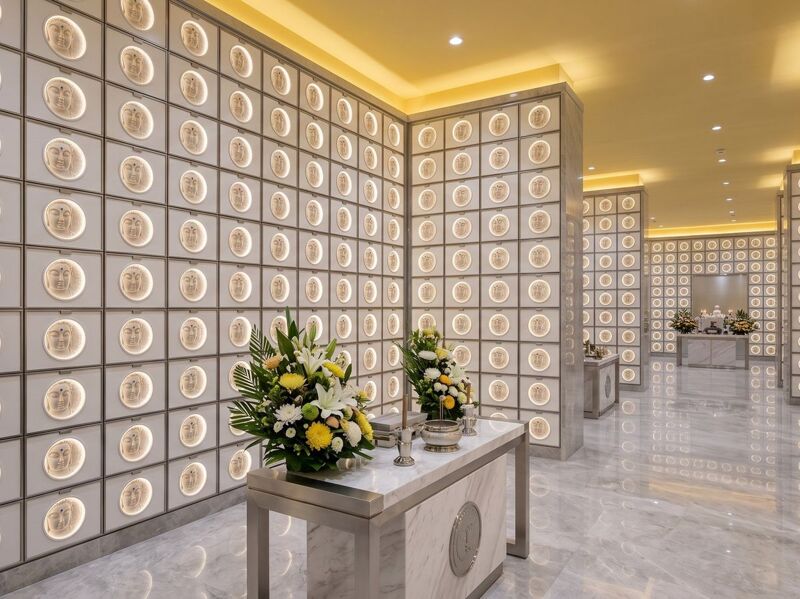
The difference between a cheap and an expensive niche comes down to five things that cannot be changed and five that can. Paying more for the unchangeable is investment; paying more for the changeable is consumption. A niche is used for thirty years, so the family should put money where it will still be working in thirty years — in the niche itself, not in the panel wrapped around it.






