WeChat: (+86)13978873330 Email: 381784025@qq.com

WeChat: (+86)13978873330 Email: 381784025@qq.com

Around the Ghost Festival, footfall at a columbarium is often more concentrated than at Qingming — and many families only discover at the door that self-service offerings at the niche are not open that day. This is not the hall refusing worship. "Universal salvation" and "ancestor veneration" are two different things institutionally. Grasp the three rules — public rite, private rite, booking — and you will not make a wasted trip.
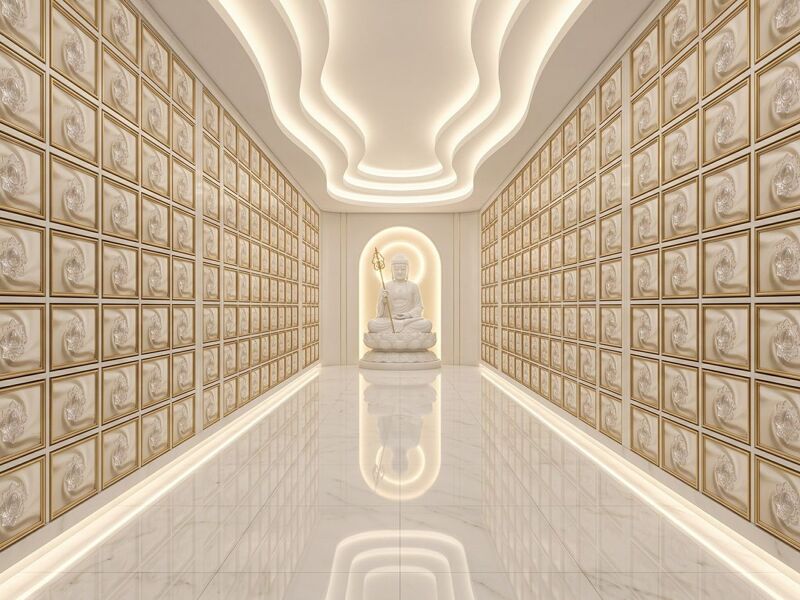
At Qingming the object is your own ancestor, one to one. At the Ghost Festival the object is "unattended spirits", one to many — closer in nature to a public ceremony.
That difference determines the method. At Qingming you can carry offerings to the niche, set them out, recite and clear them yourself. Not at the Ghost Festival: if every household lit incense and burned paper at its own niche, several thousand niches on a floor would be alight at once and the smoke detectors would alarm across the whole building within ten minutes.
So most columbaria concentrate worship in a public area around the festival, and the niche area is used only for "opening the door in respect", with no burners and no offering tables Space determines this, not attitude.
The public rite is a collective ceremony hosted by the hall with families registering to attend. The usual specification:
- One day chosen around the fifteenth of the seventh lunar month, usually 1 p.m. to 5 p.m., running 90–120 minutes. - Held in a public area outside the hall or in the main hall, with long offering tables and positions assigned in registration order. - Three sections — chanting, feeding, completion — which families may attend throughout or join for the latter part. - A registration fee usually in the hundreds of yuan, covering one portion of offerings and one tablet.
The core value is collective practice: dozens or hundreds of households reciting together, the ritual complete, presided over by clergy. For families living away who cannot come often, this is the least effortful occasion in the year.
Note that a public rite is not directed at a particular niche. The registration form records "the ancestral line of the X family", not a niche number To have one specific person recommended, you need a private rite.
A private rite is a small observance arranged by the family for a specific niche. It differs from Qingming in only two ways: time is centrally controlled, and the venue is designated.
In practice it usually works like this.
1. Book with the service desk 7–15 days ahead, giving the niche number and the number of people. 2. The hall assigns a slot, typically 30–40 minutes per household, with 20–30 households per slot. 3. The observance takes place in a designated private-rite area, not in the walkway before the niche. 4. Offerings may be brought or ordered from the hall; joss paper is handed to the hall for central handling.
Booking is where things go wrong most often. Many people assume the Ghost Festival works like Qingming, when you can simply turn up, and are told on the day that it is full. A mid-sized hall can take around 200 private-rite households in a day, and the popular 9–11 a.m. slot fills first.
My advice: once you have decided to go, fix the slot before the first day of the seventh lunar month. Do not wait until after the tenth.
By custom the fifteenth is the day proper, but for a columbarium it is the worst day to open private rites: crowds, fire risk and traffic all peak at once.
So most halls spread the load: private rites from the first to the fourteenth, a single public rite on the fifteenth, and normal visiting from the sixteenth. This cuts the single-day peak by about sixty percent.
If all you want is ten quiet minutes before the niche choose a weekday morning in the first week of the seventh month, when it is emptiest.
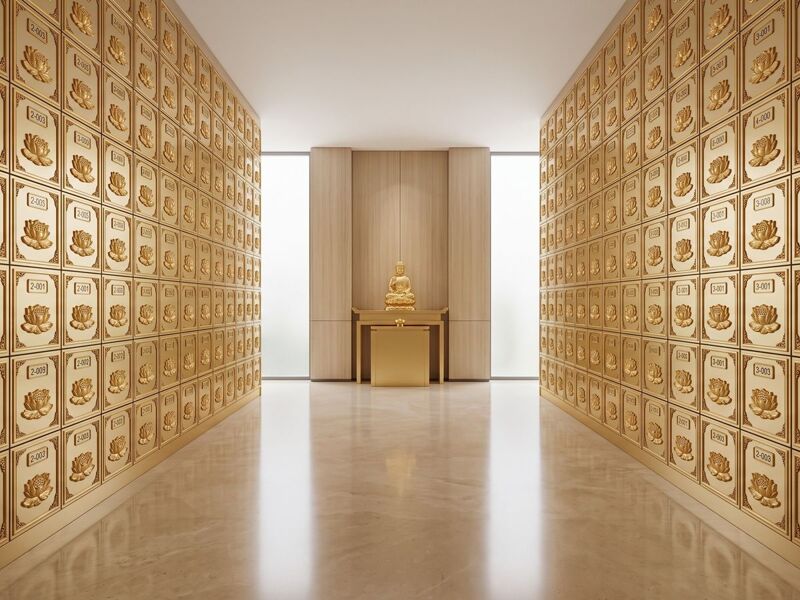
At Qingming you offer what the ancestor liked. At the Ghost Festival you offer for universal giving, where quantity and order matter not refinement.
A typical public-rite configuration: seven vegetarian dishes, one pot of plain rice, three kinds of fruit, one bottle of rice wine, one plate of cakes, one portion of dried goods, one bunch of flowers Counts are odd, and the arrangement is squared off, because what is being offered is "many", not "one".
A private rite is far simpler — halve the Qingming standard: three fruits, one vegetarian dish, three cups of tea, one bunch of flowers. The ledge before a niche is only 40 cm deep; anything more goes on the walkway, which is where accidents happen in a columbarium.
One caution: do not include a whole blood sacrifice among Ghost Festival offerings. Most halls' indoor environment does not permit it; blood seeps into the floor, cleaning costs are very high, and it attracts insects.
Traditionally a separate table is set at the entrance for the Lord of the Rite, who oversees the ceremony and is kept distinct from those being fed.
In a columbarium the line is usually drawn like this: the public area is divided into a main table and an offering table. The main table, set towards the interior and facing out, is for the Lord of the Rite; the offering table, set towards the exterior and facing in, is for the ten directions. A walkway of at least 1.5 m separates them, and they are never mixed.
Families do not need to manage this boundary, but they should know it exists. Every year someone sets the family offerings straight onto the main table and is asked to move them.
To find out the arrangements, three questions suffice.
1. "Which day is the public rite this year, at what time, and when does registration close?" 2. "Does a private rite need booking? How many households per slot, and how long each?" 3. "Is joss paper burned by us or handled centrally? Is there a register for central burning?"
After three questions the arrangements are clear. The Ghost Festival at a columbarium tests not how lavish the offerings are, but whether you follow the order.
Q: If we do not go at the Ghost Festival, is that bad for the ancestors?
A: By custom the festival is universal giving, not family veneration. Family veneration falls on the death anniversary and Qingming. As long as you have been at Qingming or on the anniversary nothing is missing ritually.
Q: May we just leave a bunch of flowers at the niche without incense?
A: Most halls allow it. Flowers produce no open flame or smoke and are the most readily accepted expression. Take care not to block the number plate or place them on the walkway side.
Q: We have registered for the public rite. Do we still need a private one?
A: It depends what you want. The public rite is collective practice with broad coverage but no specific niche; the private rite names one. To have both, register for the public rite and book a private slot on a weekday, rather than cramming both into one day.
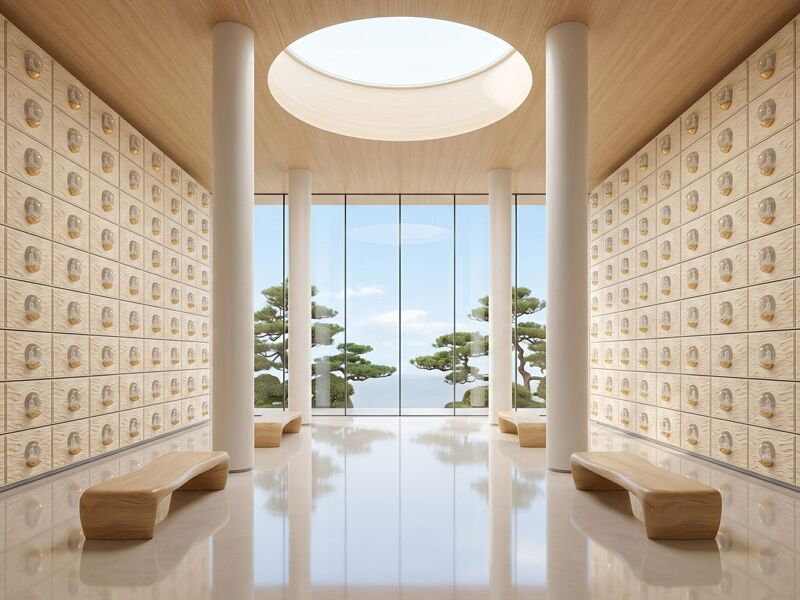
The Ghost Festival in a columbarium essentially converts "every household making its own offerings" into "one hall making them together". The public rite provides coverage, the private rite provides specificity, and booking provides order. Separate the three and you will not be stopped at the door — nor left uneasy that nothing was done.