WeChat: (+86)13978873330 Email: 381784025@qq.com

WeChat: (+86)13978873330 Email: 381784025@qq.com

Eight kilograms does not sound much. But what a niche shelf takes is not that 8 kg. It is the 8 kg at the instant of placement. A slip of the hand, a drop of the urn, and the instantaneous impact reaches two to three times the static weight.
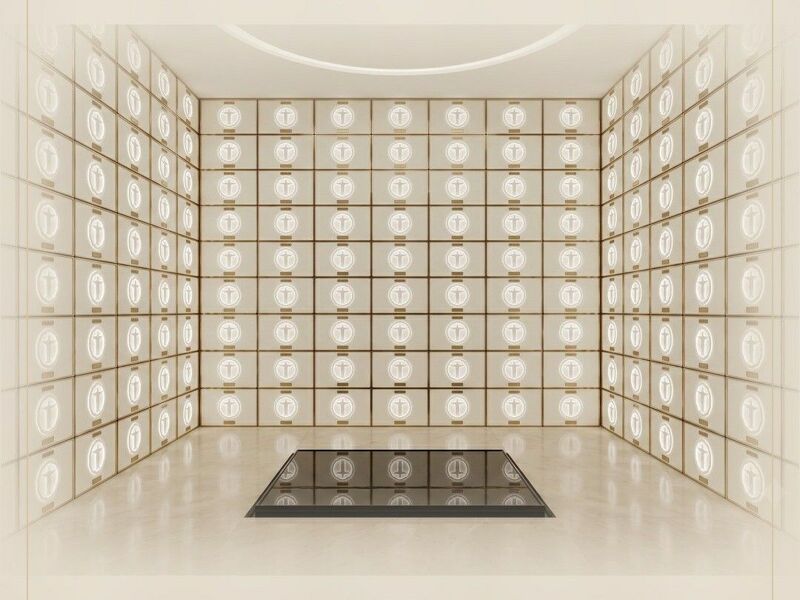
Shelves in columbarium niches rarely fail because they were crushed. They fail because of how the urn was set down.
Setting an urn into a niche has three phases: lift, carry across, lower. On the final movement most people think they are "placing it and then letting go", but in practice they "let go and let it drop". A 10 mm free fall produces an impact factor of about 1.5; 30 mm produces about 2.5.
Which means an 8 kg urn can deliver 20 kg of force to the shelf at the moment of landing. The shelf's safe load is 25 kg. Once or twice is nothing; over decades and hundreds of repetitions, that is where permanent deflection comes from.
It is also why the shelves of older niches always sag in the middle Not because the urn is too heavy, but because every placement is done the same way.
An urn base is usually not flat. It has a foot ring. A common ring is 10 mm wide and 160 mm in diameter, giving about 50 cm² of contact area. Eight kilograms on that gives an average pressure of 16 kPa — 160 grams per square centimetre in plain terms.
That figure is not large. But the shelf is thin sheet, 0.5 to 0.6 mm, gaining stiffness from being folded into a channel. What thin sheet fears is not total weight but local pressure: the foot ring lands exactly on the fold line which is a stress concentration, and under sustained load a shallow depression forms.
Once the shelf is dented, the urn no longer sits level, and an unlevel urn shifts more easily when the door is closed. "The urn is always crooked" in a niche usually starts with that one ring.
The shelf rests on uprights at both ends with a free span between There are two unfavourable positions: mid-span, where deflection is greatest, and the edge, where support is thinnest.
An urn placed at the shelf edge loads only half the area, which is equivalent to putting 16 kg on half the board. Wall-side niches are most prone to this, because families habitually push the urn all the way in. Niche shelf spans are mostly 500 to 600 mm, and mid-span is the softest section.
The correct position in a niche is within 150 mm of an upright, and at least 50 mm clear of the front and rear shelf edges. That is where the shelf's bending capacity is best, and where the urn is least likely to be struck by the door.

A 3 to 6 kg ceramic urn: place normally, centred or slightly towards the upright. Low centre of gravity, good stability.
An 8 to 15 kg stone urn: two people, one supporting the base and one steadying, lowering slowly. Do not let go and drop. After placement, push the urn body gently; it is only stable if it does not move.
A 2 to 4 kg timber urn: light but easily knocked. The centre of gravity sits high (timber urns are often waisted at the base), and even the airflow from closing a door can shift it slightly. Add a non-slip mat.
Partly. A niche tray spreads the foot ring's pressure over a 300 × 300 plane, cutting local pressure to a third, and allows the whole tray to be drawn out, avoiding deep reaches into the chamber.
The cost is clear height Trays are usually 15 to 25 mm thick, so a 450 clear-height niche drops to 425 — tight for a 340 mm urn. The second cost is that the tray must have a non-slip surface; a smooth tray slides during handling, which increases risk.
My advice: fit a tray if the urn exceeds 10 kg, or if visitors are mainly elderly. If the urn is light and clear height was tight to begin with, skip the tray and use a non-slip mat instead.
Q: Will a 15 kg urn collapse the shelf?
Not immediately. The safe load is 25 kg and 15 kg is within it, provided it sits centrally. The long-term risk is gradual deflection, not sudden fracture.
Q: Two urns in one niche — will the weight exceed the limit?
Two 8 kg urns plus grave goods is about 20 kg, still within 25. The real problem is not total weight but that both urns get pushed towards the outside.
Q: The shelf has already dipped slightly. Can it still be used?
Under 2 mm, monitor it. Over 3 mm, replace the shelf. A deflected shelf widens the door gap, and dust and moisture follow.
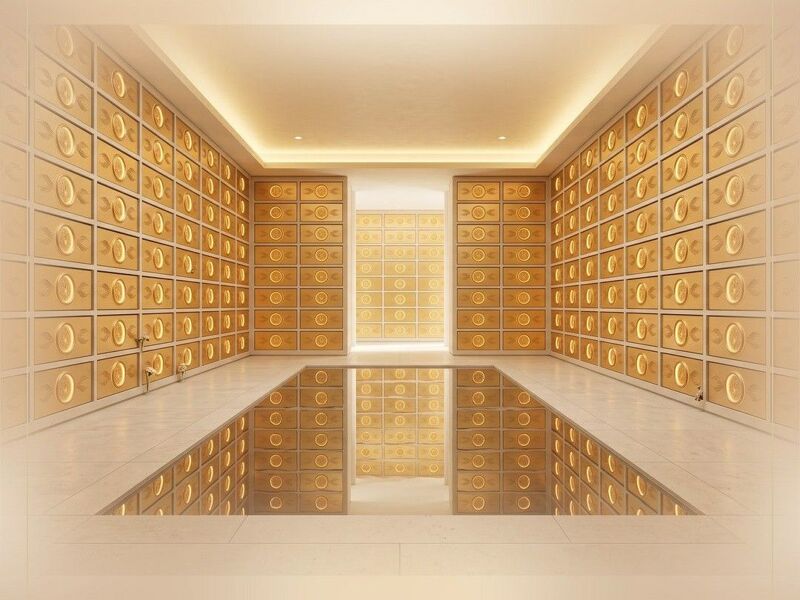
The effect of urn weight on a niche is not about whether the shelf can bear it, but about how the urn is set down. Eight kilograms static becomes 20 kg at the moment of landing, and the pressure under the foot ring decides whether the shelf takes its first dent. Shelves are measured in kilograms and urns in grams; what lies between them is technique. Take three extra seconds setting the urn down, and the shelf lasts ten more years.