
WeChat: (+86)13978873330 Email: 381784025@qq.com

WeChat: (+86)13978873330 Email: 381784025@qq.com

Colour temperature is the most argued-about and most often mishandled parameter in niche lighting 2700 K is warm yellow and looks like a living room; 4000 K is neutral and looks like an office There is no single right answer, but there is one definitively wrong one: using both along the same row.
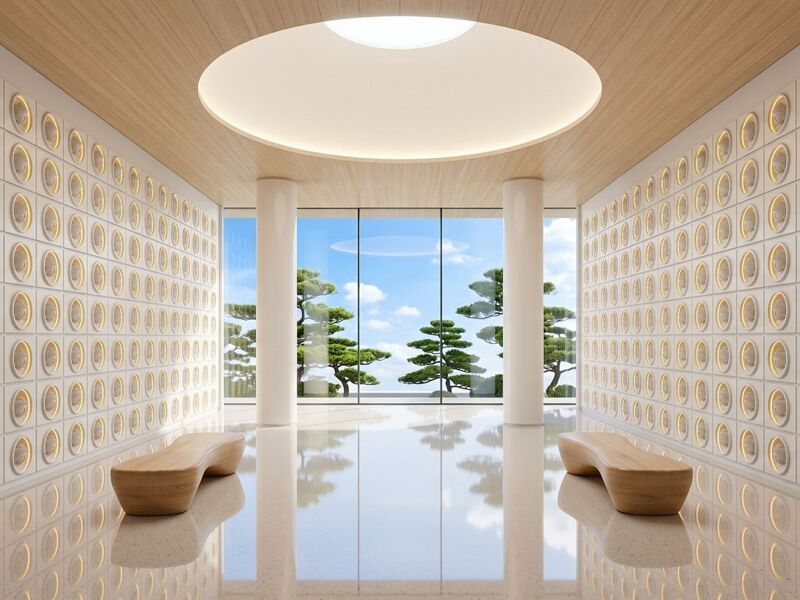
2700 K: the light skews orange. On white porcelain it yellows, on jade it reads warm and mellow. The advantage is human warmth; the drawback is that it dirties pale stone and turns gold number plates copper.
3000 K: slightly warm, with minimal colour shift. White jade still reads white, timber still reads timber, gold still reads gold. This is the most stable setting in a columbarium.
4000 K: neutral to cool. The urn face is clean and detail is crisp, but the space reads as a public facility — especially across a large wall of niches, where cool white makes people unwilling to linger.
The lighting duration in a niche is usually "three minutes at the door", and what matters in those minutes is reading the inscription, not being moved by atmosphere. Functionally, 3000 K is the compromise; emotionally, 2700 K is better; for not getting it wrong, 3000 K throughout.
Many people choose a colour temperature and ignore the colour rendering index (Ra). Below Ra 80 in a niche, reds go dark, wood grain goes grey, and gilding on the urn looks dirty.
Niche strips should be Ra 90 or above, with the special index R9 (red) at 50 or above. Packaging usually states only Ra; ask the supplier for a test report for R9.
One more: keep colour tolerance (SDCM) within 5 steps. A batch at 7 steps will visibly read as "this one yellow, that one white" once installed.
A columbarium wall is continuous — thirty niches form one surface. A 500 K difference between adjacent groups is immediately visible as "this patch warm, that patch cool", and the wall looks patched.
Mixing arises in three common ways: bought in separate batches, from different manufacturers, or from different production runs. Strips carry a factory tolerance of ±200 K, and once lumen depreciation diverges, even a single batch starts to separate after two or three years. On one wall, a difference over 500 K is visible at a glance, and the long walls of a columbarium are where it shows most.
So niche strips should be bought in one purchase, with 5%–10% held as spares. That matters far more than choosing 2700 K or 4000 K.
LED depreciation is not uniform. The phosphor ages faster than the chip, so a strip drifts blue over time — a 3000 K strip after three years may read as 3500 K.
Niche strips burn constantly, so the drift is faster. The criterion: compare with a neighbouring niche at installation; if a difference is visible, replace the whole group, never a single strip.
Replace one strip alone and that niche becomes a bright patch on the wall.
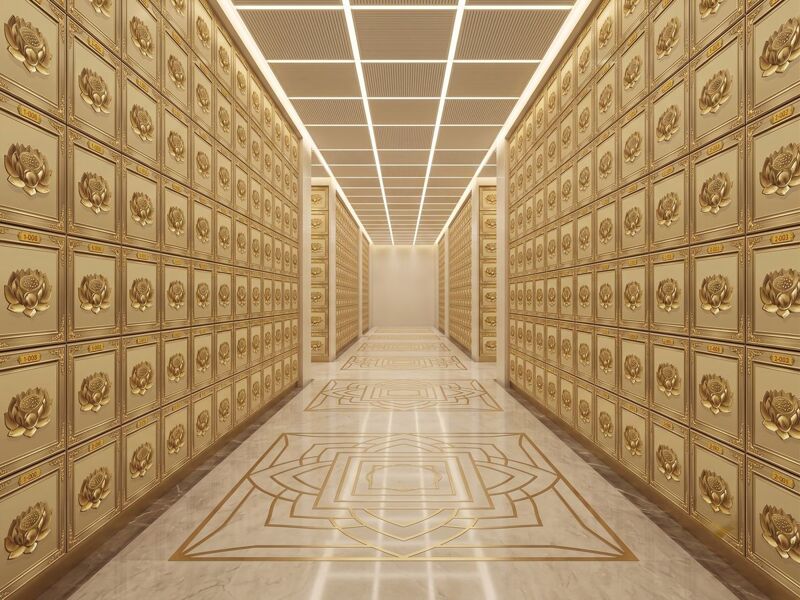
White jade and white porcelain: at 2700 K they yellow, above 5000 K they go cyan. 3000 K is closest to true colour.
Timber urns and timber pedestals: 2700 K pushes timber orange-red, 4000 K greys the grain. Again, 3000 K is the stable choice.
Gilding and gold leaf: gold needs warm light to look valuable, so 2700 K beats 4000 K. This is why columbaria are willing to use 2700 K for accent lighting.
Photographs and portraits: these need high rendering and a neutral-warm tone; 3000 K with Ra 95 is the closest to "clear without distortion".
At low illuminance the eye's perception of colour temperature shifts: the same 3000 K looks yellower at 100 lux than at 300 lux.
Columbarium aisles typically run 100–150 lux while niche strips give 150–300. Use the same temperature for both and the aisle looks yellower.
A reasonable approach: aisles at 3500–4000 K, niches at 3000 K, using the difference to create a "warmer as you approach" layering. Keep that difference under 1000 K, or it reads as two separate spaces.
Uniform 3000 K, Ra ≥ 90, SDCM ≤ 5, bought in one purchase with 10% spares.
Accent positions (family niches, in front of Buddha images, main walls) can drop to 2700 K, but must be consistent within one visual plane.
Not above 4000 K. A columbarium is not a showroom, and cool white makes the whole hall feel like a warehouse. Not below 2200 K either: too yellow turns a white urn beige, and families will think the urn has aged.
Q: Does colour temperature affect the life of the urn?
A: Temperature itself does not; UV and heat do. Choosing a low-UV, low-heat strip is more meaningful than agonising over colour temperature.
Q: Can tunable-white strip be used?
A: Technically yes, but a niche does not need tuning. Tunable strips have complex drivers and higher failure rates, and once someone adjusts one, the row is spoiled.
Q: What if the wrong ones are already installed?
A: Replace the whole group, not single strips. Niche strips are powered in groups, and a single replacement creates a colour difference worse than the original.
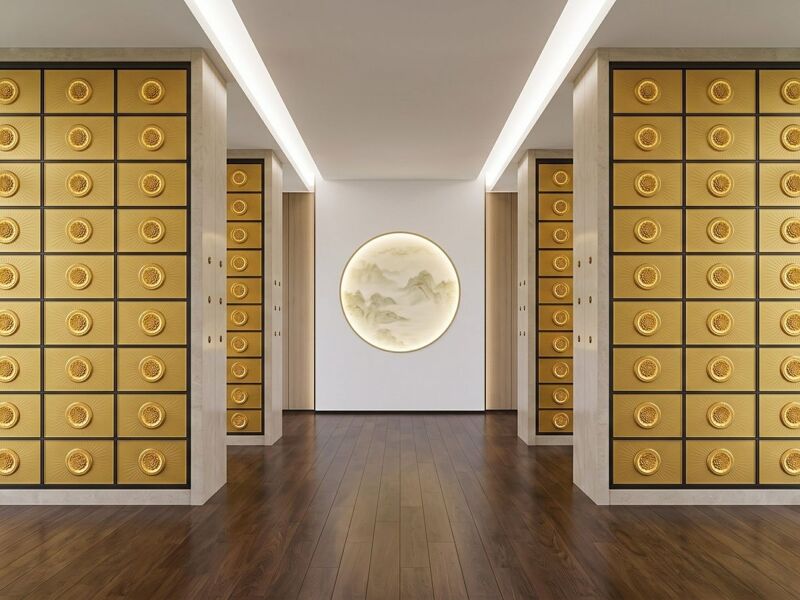
The answer on colour temperature is not complicated: 3000 K is the number that cannot go badly wrong. What actually decides the result are the three things not printed on the packaging — colour rendering index, colour tolerance, and buying the whole batch at once. Whether a columbarium's lighting was done well is visible from the end of the aisle: just look at whether the wall has patches.






