WeChat: (+86)13978873330 Email: 381784025@qq.com

WeChat: (+86)13978873330 Email: 381784025@qq.com

The brocade box usually comes free when you buy an urn — red velvet face, gold piping, a square body with a carry handle. Most families assume it is a protective layer. It is not. It is packaging. The box genuinely does three things: it cushions, it blocks light, and it carries ceremony. It fails at three others: it does not stop moisture, it does not seal, and it does not take load. Separate those two lists and you know when to use it and when to take the urn out.
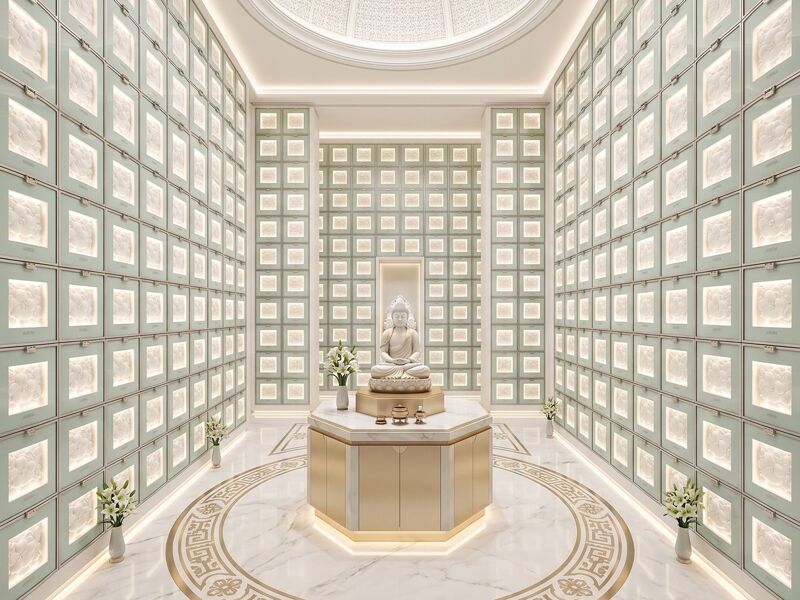
Cushioning. Between the box wall and the urn there is usually 20–30 mm of padding. That gap absorbs knocks during transport and handling. It is real protection, especially on the road from home to the hall or from one hall to another.
Light blocking. Glazed and jade surfaces change colour under long exposure to light. The box keeps light out Inside a niche there is a door panel anyway, so light matters little there; during temporary storage and transport, the box earns its place.
Ceremony. This one should not be dismissed. At the enshrinement the family carries the box, not the urn. The visual gravity of the moment comes from the box. Many families keep it for exactly this reason.
It does not stop moisture. Brocade boxes are mostly cardboard, velvet cloth and foam, and all three absorb water. Through the plum-rain season the humidity inside the box tracks the room, and because velvet absorbs and then slowly releases, the box interior can sit consistently wetter than the surrounding air. Treating it as a moisture barrier is a misunderstanding.
It does not seal. Most lids are magnetic or latched, not airtight. Insects get in. Water vapour gets in.
It does not take load. The walls have limited compressive strength. Stacked or left under pressure it deforms, the internal volume shrinks, and the urn ends up bearing uneven force.
Keep it during transport, during temporary storage at home, during the enshrinement ceremony, and where the niche cavity is clearly larger than the urn so the box acts as a spacer that stops movement.
Remove it where the cavity is already tight and the urn itself has to locate the position, or where the local climate is humid and the niche has no independent dehumidification.
One detail when you do remove it: do not stuff the box and its padding in alongside the urn. Velvet padding inside a closed niche keeps absorbing and releasing moisture — effectively a wet sponge parked next to the urn. In columbarium niches that smell musty, lifting the brocade box usually reveals padding that has already gone damp.
Cotton and linen. Breathable, and able to release what they absorb. Relatively safe.
Short pile and long faux fur. Looks good, absorbs a lot, dries badly. Not recommended in humid regions.
Foam and EVA. Good cushioning. Closed-cell EVA does not take up water and is the better choice; ordinary foam absorbs water and sheds crumbs as it ages.
Plastic film and bubble wrap. Completely non-breathable. Acceptable for short transport; in long storage condensation forms inside the film. The worst option for permanent use.
One quick test: press the padding into your palm for ten seconds. If a clear damp patch remains after you let go, it does not belong in a niche long term.

This is the practical problem. A brocade box typically runs 40–60 mm wider than the urn, while the niche cavity is dimensioned to the urn, not the box. A niche with a 400 mm internal width takes a 260 mm urn comfortably; add the box at roughly 320 mm outside diameter and only 40 mm of clearance remains, so you are lifting it in and out by the pull strap.
The clear width of a niche opening is often 20–30 mm narrower than the cavity, and that is exactly where a boxed urn jams. Before buying a box, measure the niche opening, then measure the box outside diameter. Compare the two numbers and you know whether the box can go in at all.
If you want the ceremony without leaving the box inside the niche permanently, do this: carry the box in at the enshrinement, take the urn out once the ceremony is over, place the urn in the niche on its own, and take the box home.
The box then does the part it is good at — ceremony and transport — and avoids the part it is bad at, long-term storage. The niche holds only the urn and an anti-slip pad, and both space and humidity stay manageable.
Q: Can a brocade box keep moisture out?
A: No. Cardboard and velvet both absorb water. Moisture control depends on the dehumidification of the niche and the sealing of the urn itself.
Q: Should the desiccant inside the box stay?
A: Keep it for transport and temporary storage, take it out for long-term storage. Once saturated, a desiccant releases moisture back.
Q: If the niche is too small for the box, can I place only the urn?
A: Yes, and it is the better arrangement. The box plays no part in sealing, and the space you save is worth more for handling.
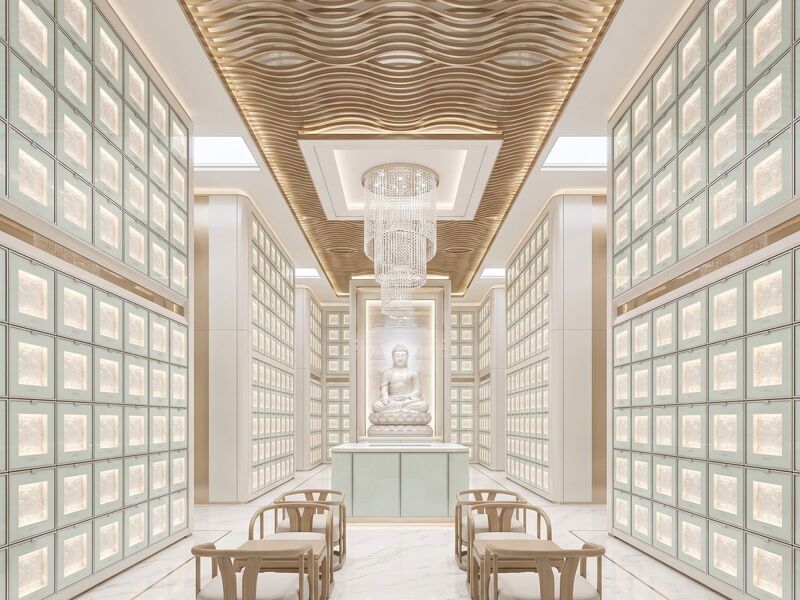
The brocade box is packaging, not protection. It handles transport, light and ceremony; it cannot handle damp or sealing. Space inside a columbarium niche is already calculated to the urn, and every extra box is one more source of moisture. If you want to use it, use it on the road in. Once inside the hall, let the urn stand in the niche by itself.