
WeChat: (+86)13978873330 Email: 381784025@qq.com

WeChat: (+86)13978873330 Email: 381784025@qq.com

Two niches of the same kind, one 450 deep and one 550, can differ in price by twenty per cent. This is not arbitrary. The two figures represent two spatial logics: 450 is the answer to "save space", 550 is the answer to "handle easily". Which to choose depends on where you want that 100 mm to go.
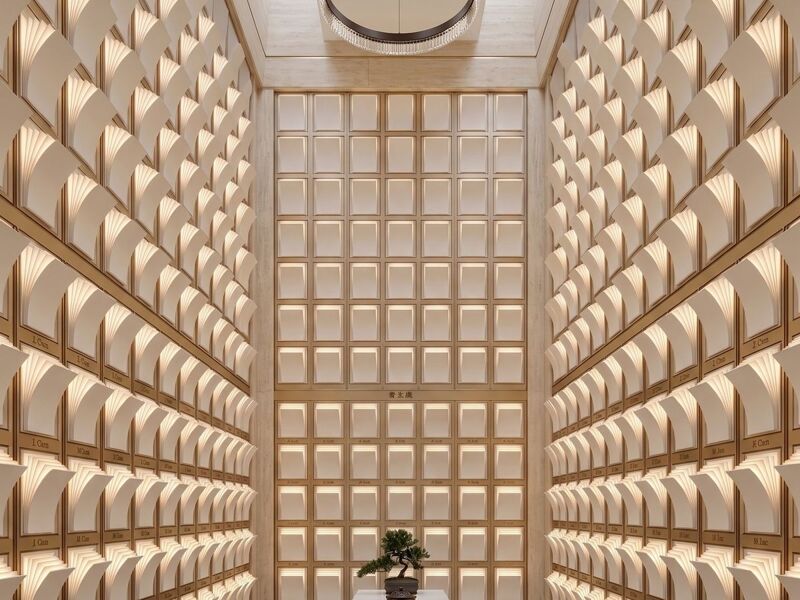
At 450 mm of depth, with a 260 mm urn inside, you have 95 mm left front and back. Fingers can reach in and touch the urn body, but to lift it out the wrist must fold inside. Comfortable handling in practice needs 600 mm or more. So with a 450 niche, the usual method is "push the urn forward to the door first, then lift".
At 550 mm of depth, you have 145 mm front and back. Of that front 145 mm, 80 mm is effective hand clearance — the palm can lie flat against the urn body and lift it directly from position, with no need to push first. That is the "80 mm of hand clearance" people talk about.
450 is not "bad design". It has clear applications.
First, shallow-depth niche banks: where a wall run limits depth, building 550 would encroach on the aisle. Second, single niches with small urns (200 to 220 mm diameter), where 450 is entirely adequate. Third, budget products, where reducing depth cuts sheet consumption and floor area.
In a columbarium 450-deep niches are typically found in early-generation banks and in corner positions at the end of corridors or beside columns. Those positions are cheaper, and there is a reason.
The first layer of value is easier handling. The second is tolerance: if the urn is slightly larger (over 280 mm diameter), at 450 it must go in at an angle, and an angled urn has an unstable centre of gravity — the vibration of closing the door slowly shifts it. At 550 it sits upright.
The third is heat dissipation and dehumidification. In a deeper niche there is an air layer between the urn and the back panel, so condensate on the panel does not touch the urn directly. This matters in the humid south: in a 450 niche, when the back panel condenses, the back of the urn is wet.
The fourth is grave goods. If you want to place letters, prayer beads or clothing, a 450 niche has essentially no space left after the urn; a 550 still has 100 mm spare.
This is the key calculation. A hall 12 m deep with banks on both sides leaves 6 m each. If every run is 550 deep, the two banks take 1.1 m, leaving 4.8 m of aisle — ample. At 600 or more, the aisle tightens and the 1.5 m baseline for the main aisle gets squeezed.
Conversely, at 450 the aisle gains 200 mm and the space reads noticeably more open. Niche depth, in essence, borrows space from the aisle. Borrow too much and people have to give way to each other during visits; borrow too little and a hand will not fit in.
My recommendation: make banks flanking the main aisle 450 to 500 deep for the sake of the space, and make banks behind the commemoration area 550 deep, since those are opened most often. One single depth everywhere leaves both ends uncomfortable.

Three traps.
First, you are measuring external depth; internal depth deducts the back panel and door panel, usually 20 to 30 mm less. Second, stiffening ribs consume part of it — ribs sit in the lower third, costing roughly 15 mm of usable depth. Third, if there is a lock tongue or seal on the inside of the door, the first 10 mm is dead space.
So a nominal 550 external depth often measures 505 to 515 internally. Take a tape on site measure, then deduct — do not calculate from the nominal figure.
Width determines whether two urns can sit side by side; depth determines how easily they come out. From a use standpoint, depth can be economised and width cannot — two urns side by side need width, not depth, while easy handling comes from depth.
But structurally, depth has a bigger effect on shelf span. If the shelf spans in the depth direction 550 depth means a 550 span, requiring stiffening above 500; 450 sits inside the no-stiffening threshold. That is the real reason many manufacturers default to 450.
Q: Can a 450-deep niche hold a stone urn?
Up to 260 mm diameter, yes, but you must push before lifting. Above 280 mm is not advisable; an angled urn shifts.
Q: Is 550 too much space taken?
For one run it is 100 mm extra; for two walls, 200 mm. But if that run is the main commemoration face, the 200 mm is worth spending.
Q: Can depth be increased later?
No. Depth is set by the cabinet and back panel and cannot be changed after installation. It is a number that must be fixed before purchase.

450 and 550 are not good and bad. They are an exchange between saving space and saving effort. Once set, depth is written into the structure and cannot be altered. Before choosing settle one question: is this run for people to look at, or for people to use.






