WeChat: (+86)13978873330 Email: 381784025@qq.com

WeChat: (+86)13978873330 Email: 381784025@qq.com

0.9 m is the standard figure in a great many columbaria. It is enough for one person to kneel, but not enough for two people to pass each other — which is why somebody always gets pushed in front of the neighbouring niche on Qingming This article separates the depth values and works them out individually.

For the worship depth in front of a niche, 0.9 m is enough for one person to kneel through a full bow. For two people to be present at the same time — one bowing, one handing things over — you need 1.2 m.
This is not a comfort question; it is a question of body dimensions Kneeling, the distance from knee to toe is about 400 mm, you need 300 mm behind you for standing up again, and the ledge adds 200 mm — exactly 900.
Breaking it down: the offering table or ledge is 350–400 mm deep, the person kneels with the knee 100 mm from the ledge edge, body depth 400 mm, and 100–150 mm left behind.
Total: 950–1,050 mm. So strictly speaking, 0.9 m is "just enough," not "generous." If the ledge in front of the niche is built 400 mm deep, a 0.9 m niche area will feel cramped.
Two people kneeling side by side, each with a 450 mm shoulder width plus a 100 mm gap, need 1,000 mm. Standing angled to each other, they still need 1,100–1,200.
1.2 m is the usable figure for two. That is also why family sections and the areas in front of double niches are usually built at 1.2 m rather than 0.9 m.
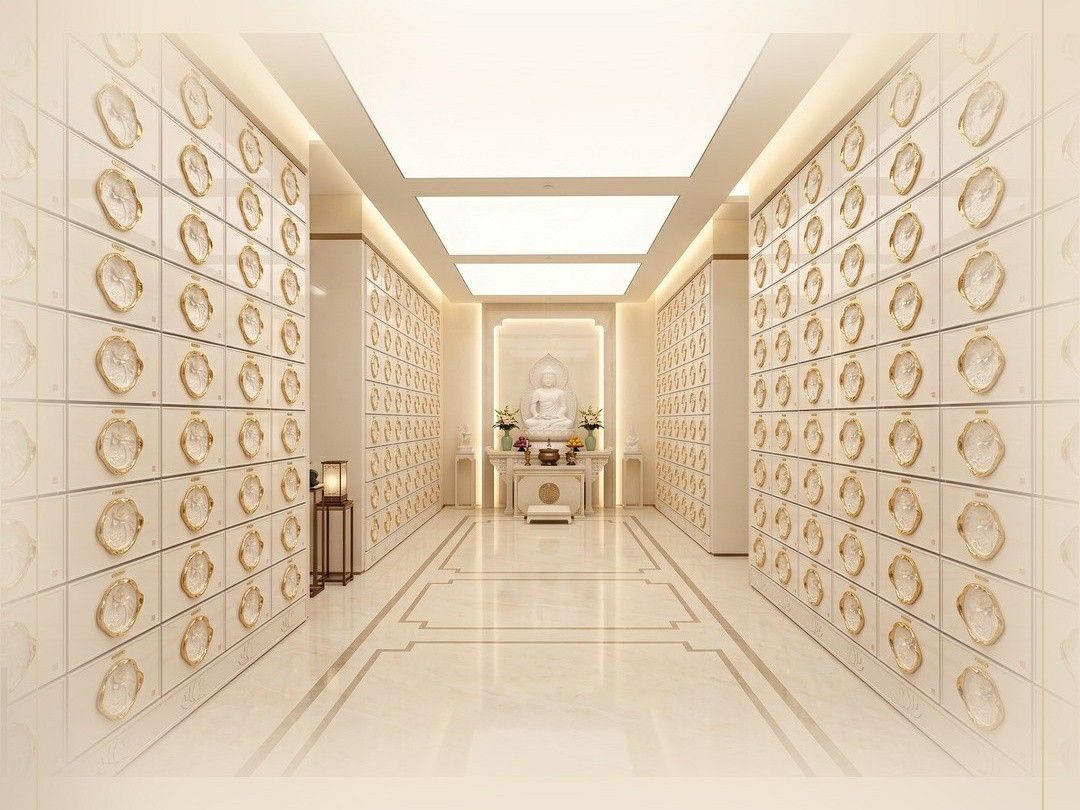
Two rows of niches face each other with an aisle between them Row spacing = 2 × worship depth + aisle width.
Using the standard values: 2 × 0.9 + 1.2 = 3.0 m.
If the worship area is built at 1.2 m, row spacing has to be 3.6 m. On the same plot of land you lose a whole row, and capacity drops 20–25%. This is why "a bit wider" is easy on a drawing and expensive in construction cost.
The layout of a columbarium is, in essence, this 3.0 m replicated over and over.
A wheelchair needs a 1.5 m turning circle. To turn around in front of a niche, the worship depth has to be 1.5 m — or the user backs out sideways.
The latter requires an aisle width of at least 1.2 m and no steps in front of the niche. Most columbaria do this: main aisle at 1.5 m, 0.9 m in front of the niche, wheelchair exits sideways.

Make the ledge fold down. With the ledge folded away you gain 350 mm of depth bringing the kneeling space to 1.25 m.
Move the offering table to one side. A double niche can have a ledge on one side only, leaving the other side clear.
Stagger the times. A 0.9 m niche area is fundamentally "one family at a time." Scheduling slots at Qingming is cheaper than changing the structure.
My advice: do not add fixed seating or flower stands to a 0.9 m niche area. Put those two things in and only 0.6 m is left for standing — not even enough for one person to kneel.
If the ledge in front of the niche is 400 mm deep, the actual usable depth drops to 500 mm. Kneeling, your knees have to go under the ledge edge.
This is the usual cause of "measured 0.9, uses like 0.8": the 0.9 on the drawing is measured from the door panel but the person stands measured from the ledge edge.
For columbarium acceptance, measure two numbers: the distance from the door panel to the opposite row, and the distance from the ledge edge to the opposite row. The 400 mm difference between them is exactly whether this niche is usable or not.
Beyond depth there are two more numbers.
Floor flatness: 3 mm under a 2 m straightedge If the area in front of the niche is dusty or hollow, the knee takes uneven load when kneeling and an elderly person can lose balance getting up.
Sightline height: eye height kneeling is about 1.1 m, standing about 1.6 m. If the centre of the niche door panel sits between 1.2 and 1.4 m, the inscription is legible even when kneeling — and that height has to be fixed together with the niche layout.
Q: Can you put a cushion down in 0.9 m?
A: Yes, but a cushion is 50–80 mm thick and makes standing up harder. For families with many elderly members, use a thin mat.
Q: Is worship depth measured to the ledge or to the door panel?
A: To the outer edge of the door panel. Any part the ledge projects must be deducted separately.
Q: Can 1.0 m count as double occupancy?
A: Barely. Two people have to be perfectly side by side and cannot bend down at the same time; in practice it feels much the same as 0.9 m.

For the worship area in front of a niche, 0.9 m is the lower limit for one person kneeling, 1.2 m is the usable value for two, and a wheelchair needs 1.5 m. Row spacing of 3.0 m = 2 × 0.9 + 1.2, and this equation decides how many rows a columbarium can fit. The space budget of a columbarium is multiplied out one number at a time — if you want 300 mm more width, you lose a row somewhere else.