
WeChat: (+86)13978873330 Email: 381784025@qq.com

WeChat: (+86)13978873330 Email: 381784025@qq.com

Nobody looks at the floor in a niche zone. But if it is out of level the whole rack leans: door gaps wide at the top and narrow at the bottom, drawers that will not go in, a line of number plates that runs downhill. Flatness is a form to sign at handover, and twenty years of irritation afterwards.

Lay a 2 m straightedge on the floor and the maximum gap beneath it must not exceed 3 mm. The figure comes from the building floor acceptance code's high-grade screed/self-levelling class, and it is also the installation precondition given by rack manufacturers.
What it means in practice: a row of six niches across 1.8 m, tilting at 1.5 per mille, is only 2.7 mm out — the eye cannot see the slope, but the door gaps are already unequal. That sounds lenient and is not: ordinary cement mortar screed rarely achieves it, so self-levelling compound is normally required.
The number is not arbitrary with respect to the rack. Niche uprights are rigid, and the levelling bolts in the base have only 15–20 mm of adjustment. Beyond that, the bolts run out and the base is still hanging, so packers are the only answer.
Uneven door gaps. The rack leans, so upper gaps widen and lower gaps narrow. The standard is 2–3 mm; 2 mm of tilt puts it out of range and the door looks badly shut.
Sticking drawers. In bottom-tier drawer units, an uneven floor loads the runners asymmetrically, so they grind on one side and float on the other.
Sloping number plates. Across ten niches, plates installed level individually will read as a declining line. It is the most immediate impression of quality.
There is a hidden one too: a gap between base and floor lets mop water in, it never dries, and the base rusts. This is the most frequent line item on old halls' repair sheets.
Three bands by amount:
Within 3 mm: install directly, the levelling bolts absorb it.
3–15 mm: steel packers. They must be full-bearing under the base, never small point packers, which create point loading. Fit an anti-slip pad between packer and floor.
Above 15 mm: self-levelling compound or local grinding. Grind the high spots, fill the hollows with self-levelling, cure 24 hours, then install.
Do not force it with longer levelling bolts. The longer the bolt, the more flexible the unsupported length, the worse the rack's lateral stiffness — and in an earthquake that is the first thing to buckle.
Flatness is only one of three criteria; the other two are just as hard:
Strength: not less than C25. A rack full of urns imposes 400–600 kg/m², and an under-strength floor will be dented by the bases.
Moisture content: not more than 8% by mass. New cement floors need 28 days of curing and must fall below 8% before sealing A floor with high moisture content will condense under a vapour barrier and eventually drive damp up through the base of the niche.
Test all three together. Testing flatness and skipping moisture content is the most common omission, and the most hidden cause of damp in a columbarium.
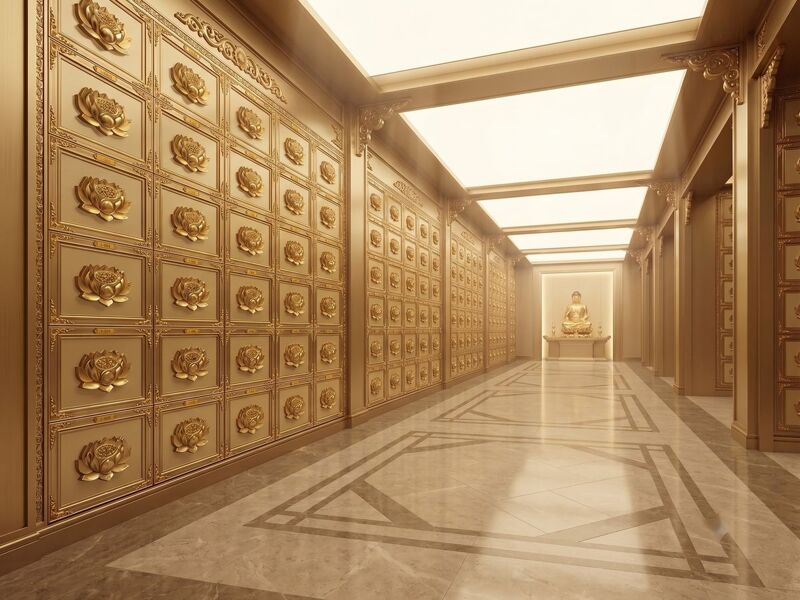
In ground-floor or basement halls the floor must have a vapour barrier, and it must turn up the wall at least 150 mm.
The sequence is: structural slab → screed → vapour barrier → protection layer → finish. Skip any layer and the floor of the columbarium will give trouble. If the barrier goes under the screed, the screed itself holds moisture and releases it upward for years.
The rack base must sit on the finish, never penetrate the barrier. Penetrate it and you have opened a channel for vapour.
Take three things: a 2 m straightedge, a feeler gauge and a coin.
1. Lay the straightedge down and measure the largest gap with the gauge at five points — four corners and the centre. 2. Stand the coin on edge and push it: if it rolls there is a slope; if it will not, it is flat. 3. Put your palm on the floor and feel for cold spots — those are usually where moisture content is high. 4. Look at the bases of racks already installed: are there packers, gaps, rust?
The fourth is the most practical. In an older hall, the quality of the floor is written entirely in those 20 mm under the base.
Q: The floor is already tiled — is self-levelling still needed?
A: It depends on flatness. Tiles are flat in themselves, but lippage between tiles is often 1–2 mm. If the total is within 3 mm, install directly; beyond that, grind or use packers.
Q: Can plastic packers be used?
A: Not advised Plastic creeps under sustained load and the rack settles within two years. Steel packers with an anti-slip pad are the standard.
Q: Can the rack's own levelling feet solve an uneven floor?
A: Only within 15 mm, and the further they extend the less stable the rack becomes. Beyond 15 mm the floor has to be dealt with.

A rack asks three things of a floor: 3 mm flatness, C25 strength, 8% moisture content. The one most often skipped is moisture content, and it is precisely the source of damp in a niche Half the quality of a columbarium is in the sheet metal and hardware; the other half is buried in this floor that nobody sees.






