
WeChat: (+86)13978873330 Email: 381784025@qq.com

WeChat: (+86)13978873330 Email: 381784025@qq.com

Installation is the rite in which the urn is placed in the niche and the door formally sealed. It is plainer than a consecration and shorter than a ceremony but it is the one step in the interment sequence that cannot be repeated — once the door closes, the next opening waits for a relocation. This sets out the five movements, the standing order and the timing.
This distinction first, because many families conflate them.
Interment is the administrative process: check in, verify documents, open the niche place the urn, seal the door, take leave Paperwork, 20–30 minutes.
Installation is the rite: the set of movements performed around the placement — purifying the niche seating incense recitation, dedication. Intention, 15–30 minutes.
They can be combined or separated: complete the interment procedure first, then hold the installation rite on a chosen day. Most halls permit separation, because the family's availability may not match administrative hours.
One, purify the niche. After the door is opened, wipe the base panel and both sides with a dry cloth, then lay a sheet of acid-free paper. This is actual cleaning, not symbolism — a new niche carries metal swarf and dust from construction.
Two, seat the urn. Place it in the cavity centred and towards the back, with a non-slip mat between the urn and the base. The face of the urn towards the outside, square to the door. Leave at least 10 mm clear on each side — without clearance later handling will scrape the urn.
Three, offer incense. Offer before the niche, or set out an electronic stick. Most halls prohibit open flame; use electronic or flowers This stick is a greeting, not an offering.
Four, recite. A passage of the Buddha's name, or a remembrance text Three to five minutes. The family stands in order of generation; no kneeling is required.
Five, dedicate and seal. When the recitation ends, an elder or monastic makes the dedication, then the door is closed, locked and sealed with a strip The strip carries the date; the family looks at it before leaving.
The order cannot be reversed. Incense comes after seating because the body is placed before the position is announced; sealing comes last because once the door closes, any adjustment means reopening.
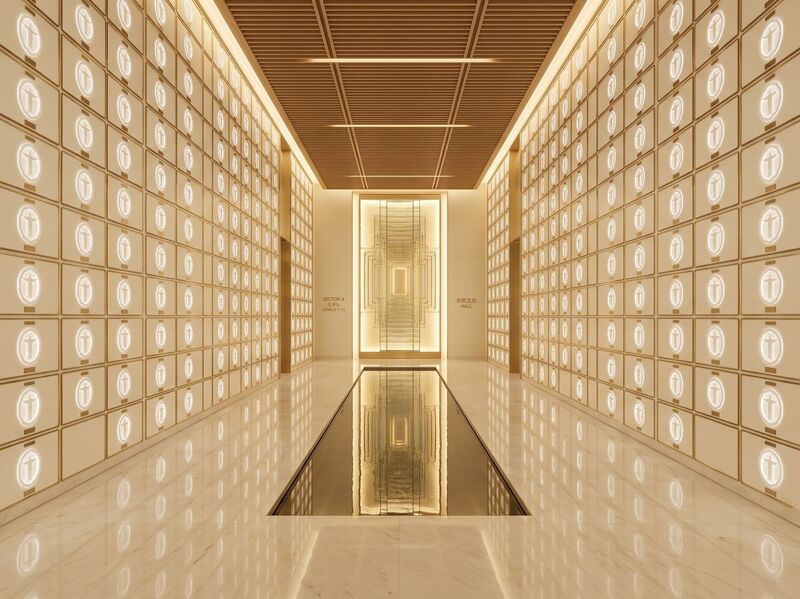
The walkway before the niches is usually only 1.2–1.5 m wide; three rows of people block it entirely.
The correct arrangement is two columns.
- The chief celebrant (eldest son or spouse) stands directly in front of the niche, 40–50 cm from the door. - The family forms two columns by generation, at most three per column, offset half a pace. - Everyone else stands to the rear and side of the walkway, without crossing the line.
If there are more than eight people, most halls suggest holding the ceremony in the main hall first, then sending three to five representatives to complete the seating and sealing at the niche. This is not simplification; it is a safety requirement — a blocked walkway is an evacuation problem.
The time budget on the day:
- Check-in and document verification, 10 minutes (cremation or relocation certificate applicant's identification, use-right certificate). - Walk to the niche, 5 minutes (over 80 m in a large hall, slower with elderly visitors). - Purify and seat, 10 minutes. - Incense and recitation, 5–10 minutes. - Seal and take leave, 5 minutes.
Total 35–45 minutes. Add 20 minutes if a monastic is present.
One easily overlooked constraint: most halls schedule installations only on weekday mornings, because staff must accompany throughout. Weekend and holiday installations usually require a month's notice.

Bring: the applicant's identification, the cremation or relocation certificate, the use-right certificate, the urn with its brocade box and base, three fruits, three cups of tea, one bunch of plain flowers, wet wipes and dry tissues, a reusable bag.
Do not bring: joss paper (banned), a full spread of dishes (the ledge is 40 cm deep), large ritual implements (no room to turn in the walkway), candles (open flame).
One more thing worth bringing: a soft tape measure. Measure the gap between the urn and the uprights when seating it; it is more reliable than the eye. The commonest rework in a columbarium is discovering, after placement, that the door will not close.
One, whether to remove the brocade box. The box is transit cushioning; does it stay inside? Both practices exist: keeping it costs space but protects the urn; removing it saves space but leaves the urn bare. Below 450 mm internal width, remove it.
Two, whether to add a base. A base under the urn lowers the centre of gravity, but adds 20–30 mm in height If the tier clear height is 300 mm, adding a base leaves only a dozen millimetres above the urn, and handling will knock it.
Three, what goes on the seal strip. Date, niche number, handler. Three items are enough. Do not write "sealed forever" — relocation and shared interment both require opening, and the words become awkward.
Q: Must a monastic be invited for installation?
A: Not necessarily. A family completing the purification, seating, incense, recitation and dedication themselves holds equally. A monastic's value is liturgical completeness, not efficacy.
Q: Can installation happen first and the paperwork follow?
A: No. The rule is documents before opening; without a certificate the niche cannot be opened. Procedure first, rite second — the order cannot be reversed.
Q: Can combining be done the same day?
A: Yes, but register in advance Combining moves the tablet and installation moves the niche; they are two registrations and must be booked separately.
Installation has five fixed movements: purify, seat, offer incense, recite, dedicate and seal. Two columns of people, eight or fewer, 45 minutes allowed — get those three right and the rite will not go wrong. What genuinely needs care is the detail: 10 mm beside the urn, box in or out, base on or off. Those decide whether the door closes in the next minute, not whether the rite looks good.






