
WeChat: (+86)13978873330 Email: 381784025@qq.com

WeChat: (+86)13978873330 Email: 381784025@qq.com

A number plate is a few centimetres of metal on a niche whose job is to let someone recognise "that is my family's place" from three metres away. Made too small, it cannot be read; made too large, it fights the sightline; fitted crooked, the whole row looks careless. Both size and position have defined ranges, and neither is arbitrary.

At a reading distance of 3 m, character height must be at least 8 mm to be legible — about 1/375 of the distance. A 60 mm plate carrying five digits gives each digit about 9 mm of width and 10–12 mm of height, which lands exactly in the readable band.
One size down, a 40 × 20 plate allows only 6 mm characters, which blur at 3 m. A columbarium's main aisle is 1.5 m and the standing space at a niche 0.9 m, so the distance from which people read a plate is typically 2.5–4 m — where a small plate is simply not enough.
One size up, at 80 × 40, the visual weight rises noticeably. Fill a whole row with large plates and you get a dense array of blocks that breaks up the surface of the doors. So standard niches take 60 × 30; family niches take 80 × 40 or 100 × 50.
Two constraints govern vertical position: alignment with eye level (1.4–1.6 m), and a fixed distance from the door edge.
The usual practice is the lower right corner of the panel with the plate's bottom edge 15 mm up from the panel bottom and 15 mm in from the right edge. Looked at along a row, the plates form a rhythmic line tracking the door heights.
The alternative is a fixed absolute height — every plate on one horizontal line. That is tidiest where all doors are the same size, but where sizes vary the plates end up floating or crowding the door gap.
Do not centre the plate horizontally. Centring makes it compete with the viewing window and the handle, and a row reads like a line of buttons. Where there is a window, put the plate below it on the same side — never window one side, plate the other.
Double-sided tape is the easiest, and the adhesive fails in two to three years Temperature in a niche fluctuates, so the tape lives a shorter life than it would indoors.
Tape plus one screw is the mainstream. The tape locates, the screw insures; the drawback is that the drilled hole breaks the coating and rust spots appear at the hole within two years.
Rivets are the most secure and non-removable. Changing a plate means drilling them out, which damages the door.
A groove insert looks best and is replaceable, but requires the door to be slotted at production.
I recommend tape plus a screw, using a stainless self-tapping screw, with a dab of anti-rust paint on the hole. That small action saves a row of rust spots later.
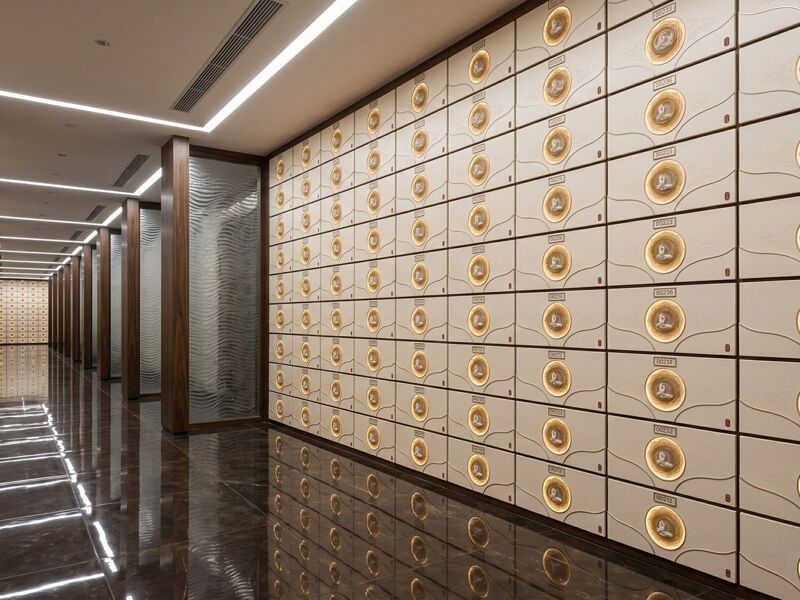
Character height no less than 8 mm, stroke width no less than 1.5 mm — thin strokes disappear at 3 m. Use a sans-serif face; never a serif face, whose thin horizontals break up at distance.
The numbering rule must be consistent across the whole building. Whether it is "Building 3 Zone A, Row 12, No. 08" or "A-12-08", if each zone writes its own version the families cannot remember it. The most common problem in a columbarium is not a badly made plate; it is an inconsistent numbering scheme.
Three processes: screen printing fades in three to five years; laser marking is durable but low in contrast; etched and paint-filled gives a deep character with a red fill and lasts longest. For a component that will not be replaced in twenty years, only etching is trouble-free.
The surface should be matte or brushed. A mirror polish reflects the whole strip light and the number becomes unreadable. 1.5 mm thickness beats 0.8 mm: the edge can take a small chamfer and the plate looks inset into the door.
The number plate is the component most likely to go missing: adhesive fails, housekeeping knocks it off, a trolley catches it. Replacing one has three traps.
Colour difference. Anodising varies by batch, so a plate made two years later skews red or yellow in the gold, and it is obvious in a row.
Character size. If the numbering rule has changed — a floor prefix added, say — old and new plates differ in character count, and the plate width has to change with it.
Hole position. If the original was screwed on, the replacement must hit the same hole, or the door ends up with two empty holes.
So at handover a columbarium should retain 5% spares from the same batch, and archive one page recording the numbering rule, typeface, character size and hole spacing. In a columbarium that has changed management several times that single page is often the line between a plate that can be replaced and one that cannot.
Q: Can the number be screen-printed onto the door instead of a plate?
A: Yes, and cheaper But printing cannot be changed: renumbering or a transfer means redoing the whole door. A separate plate exists to leave room for change.
Q: What material for the plate?
A: Stainless or aluminium brushed or matte anodised. Not bright plating — it dulls within two years and shows every scratch.
Q: Should we let a family change the position of their plate?
A: I would not. A columbarium's order comes from uniformity; one household moves and the row is disrupted. Differentiate by colour or size instead never by position.

A niche number plate is a 60 × 30 mm decision that determines whether a family can find their own place from three metres. Hold these three lines — 8 mm characters, 15 mm from the edge, one numbering scheme for the whole building — and no columbarium will ever see visitors asking the administrator every single time. The experience of a columbarium is, very often, held up by small plates like this.






