
WeChat: (+86)13978873330 Email: 381784025@qq.com

WeChat: (+86)13978873330 Email: 381784025@qq.com

A dozen relatives going together sounds lively, but in practice they cannot fit in front of the niche. This works through walkway width standing rows and time, and gives a number you can act on.
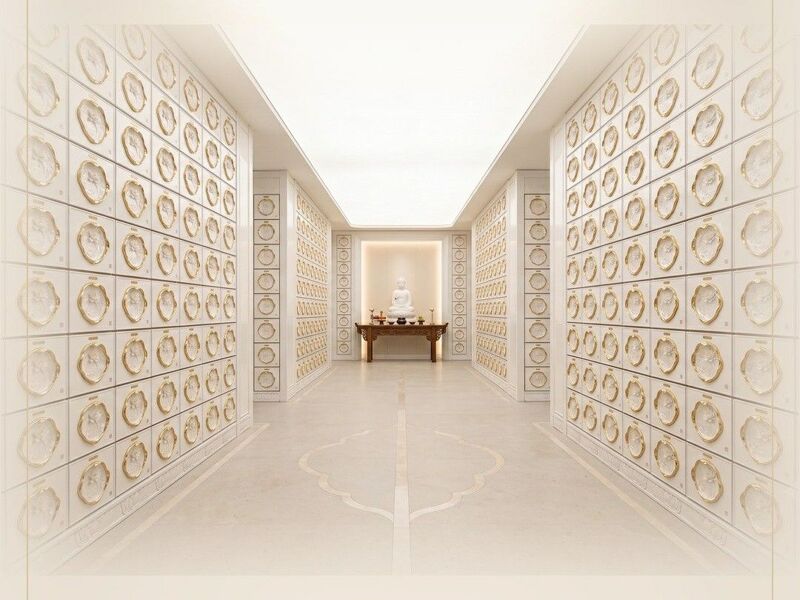

My recommendation is three to five. That number is not custom; it is calculated. The standing area before a niche is 900 mm deep with a walkway of 1.2–1.5 m, and two columns of three is already the ceiling.
Beyond eight, most halls suggest holding the ceremony in the main hall first and sending three representatives to complete the seating and incense at the niche. A columbarium does not suffer from too few people; it suffers from people jammed in the walkway.
On a 1.2 m walkway: the chief celebrant stands square in front, 400–500 mm from the door, occupying 500 mm of depth The family forms two columns to either side, three per column, offset half a pace, each taking 450 mm.
That occupies 1.1 m across and 1.2 m lengthwise, filling the walkway exactly. The seventh person can only stand at the end of it; the eighth is standing in front of somebody else's niche.
A 1.5 m zone holds up to ten, but by then nobody can move — including the second person who wants to offer incense.
Three reasons each more practical than the last.
Safety. Egress width is calculated at 0.65 m per hundred people, so a 1.2 m walkway has a theoretical capacity of about 180 people a minute. But that is flowing movement; a stationary crowd evacuates at a third of the rate.
Time. One person offering incense, bowing and stepping back takes about 40 seconds. Eight people take five minutes a round; fifteen take ten. Split into batches of fifteen minutes each, two batches take half an hour — no slower than crowding in.
Courtesy. Whoever stands at the back cannot actually see the door panel Letting them stand at the front for 20 seconds means more than standing at the back for 20 minutes.
Light. Illuminance is 300–500 lux, from wall-washing and skylights. With many people, shadows fall across the panel and the engraving becomes unreadable.
Sound. Reverberation time is 1.2–1.8 seconds. Five people talking is a murmur; fifteen is a hum, and the recitation cannot be heard.
A columbarium only feels like a place you can be still in when there are few people. That is not mysticism; it is acoustics and optics.
By generation: elders and the chief celebrant first, the younger generation second. The drawback is that the second batch disperses easily.
By household: two representatives per household, rotating. Suits a large clan, with every household represented.
By ritual: the first batch offers incense and offerings the second recites and dedicates. The most time-efficient, but it requires both batches to be punctual.
I usually recommend the second. The reason is simple: fairness keeps a family from quarrelling better than efficiency does.
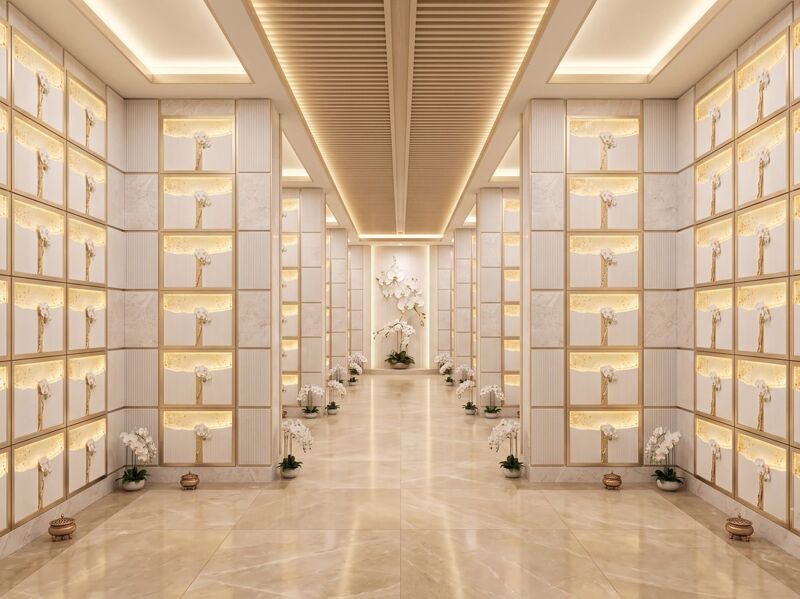
Keep three at the niche: the chief celebrant, an attendant, and whoever is photographing or handing things over. Everyone else waits at the end of the walkway.
The reason is concrete: the door panel is 300–500 mm wide and three people abreast bring it fully into view; from the fourth, the angle is oblique and the engraving cannot be read.
The core action of a visit is seeing that name clearly, and the standing arrangement exists to serve it.
The moment a visit ends is when things get disordered: five people turn at once and the 1.2 m walkway jams.
The order should be: the chief celebrant steps aside first, the family steps back two paces in turn before turning, and nobody pivots on the spot in front of the niche. The skirting is 80–100 mm high, and that is what people trip over going backwards.
Let the eldest go first — not out of courtesy They walk slowly, and the rest keep pace.
A car carries about three. Fifteen people means five cars. Parking is often provided at one space per three niches which is nowhere near enough at Qingming.
Check-in takes about a minute per person, so fifteen people take fifteen. Split into batches and the first goes in while the second checks in, and the desk does not queue.
Should come: the chief celebrant (eldest son or spouse), an elder who lived with the deceased, and the handler (to sign and to note the payment date).
Need not come: elderly with limited mobility pregnant women, children under three, anyone currently ill.
Paying respects is not a roll call. Making an 85-year-old stand 40 minutes in 24 °C air conditioning is too high a price for "being there". A video call is more filial than forcing it.
Q: Is going alone acceptable?
A: Yes, and very common Alone, you can stay longer and say what needs saying.
Q: Do children count?
A: Yes. A child takes no less space than an adult, and more when running.
Q: If we split, does the second batch check in again?
A: No. The same pass is valid for the day; go out to collect them and come back in.
The answer is not "the more the more filial": three to five is smoothest, eight is the ceiling, and beyond that you split. A 1.2 m walkway, two columns, fifteen minutes per batch — fix those three and a visit will not go wrong. Fewer people is not a lack of warmth; it is giving the space back to the rite itself.






