
WeChat: (+86)13978873330 Email: 381784025@qq.com

WeChat: (+86)13978873330 Email: 381784025@qq.com

Whether to put chairs in front of a niche looks like a small matter but it directly affects the aisle One chair takes 350 mm; two side by side take half an aisle. This article sets out when to provide seating, what kind, and where.
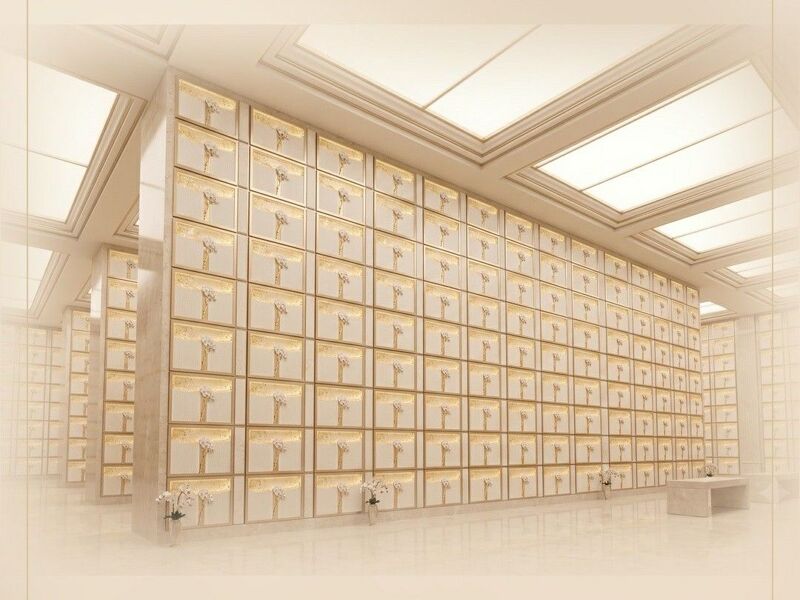
Fixed bench: built into the wall or the central island of the niche area, occupying permanent space immovable.
Movable stool: stored in a corner normally, brought out for worship put away afterwards.
Nine cases out of ten in a columbarium should use the latter. A fixed bench suits only two situations: a family worship room, and a widened area with a depth of 1.5 m or more.
This is not an arbitrary number A seat height of 420–450 mm lets 95% of adults sit with feet flat and knees at about 90 degrees.
Below 400, you have to push up with your hands; above 470, the feet dangle and the calves take pressure. Past 70, both problems are amplified.
Stools in niche areas have one extra requirement: no armrests. With armrests, an elderly person rising sideways is blocked by them, and the chair is less stable than one without.
A niche aisle is 1.2 m. Put in a chair 350 deep and 850 is left; put in two side by side and 500 is left — the aisle is effectively dead.
A fixed bench is worse: 400 deep and 1,200 long takes 0.48 m² at a stroke, permanently.
At Qingming peak, a 1.2 m aisle has to carry 60–80 people an hour. Lose 350 mm and throughput drops 30%.
Three situations where a chair is essential:
Elderly worship. Past 80, ten minutes of standing can bring on dizziness. Letting them sit and look matters more than standing to bow.
Long rites. Chanting Dharma assemblies installation — routinely 40–60 minutes. Here the chair is not "comfort," it is "can you last to the end."
Waiting. A family goes in in turns; those waiting outside need somewhere to sit.
Otherwise ordinary incense and offerings take 5–10 minutes and need no seat.
Dimensions: 350 × 350 mm, seat height 430. Smaller is unstable; larger takes space.
Weight: 2–3 kg. Only if an elderly person can carry it themselves does it count as "movable."
Material: aluminium frame with upholstery, or solid timber Plastic stools turn brittle in the low temperatures of a columbarium and crack within two years.
Quantity: two to three per zone A 2,000-niche columbarium with 20 zones needs about 50.
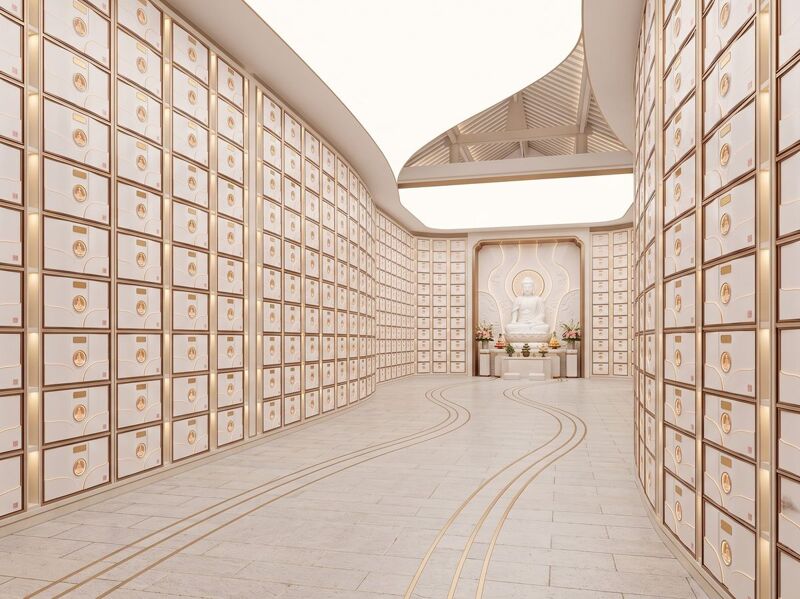
Do not put them directly in front of a niche. Put them at widened points in the aisle, at corners, or at the end of a zone.
Columbarium aisle corners usually have a 1.5 × 1.5 m surplus, which fits two stools exactly.
One location is often overlooked: in front of the bottom tier of niches Those positions are usually cheaper and less asked for, so the space in front of them is actually more generous.
Design stools for 100 kg; test them to 150 kg.
Floor requirement: 3 mm under a 2 m straightedge On an uneven floor one of four legs hangs free and the stool rocks when sat on — and elderly people are extremely sensitive to rocking.
For stools in niche areas, add anti-slip feet. Columbarium floors are often polished, and a stool slides as soon as it is pushed.
If columbarium stools are numbered, they can be managed as temporary seating: signed out checked back in. Unnumbered stools will be half gone within three years.
Object management in niche areas runs entirely on numbering: niches are numbered offering tables are numbered, stools should be too.
For a columbarium genuinely short of space, a fold-down wall bench works: folded flat against the wall it takes 80 mm; folded down it is 350 deep.
The weakness is limited load capacity (typically 80–100 kg) and a mechanism that fails easily. It suits "occasional use," not "daily use."
My advice: in zones with 1.2 m aisles, use movable stools; in zones of 1.5 m or more, a fold-down wall bench is viable; only a family worship room justifies a fixed bench.
Q: Should the chairs have cushions?
A: Yes, but they must be removable and washable. Columbarium humidity sits at 55–65% year round, and fabric cushions take on moisture within three months.
Q: Can families bring their own folding chairs?
A: Most columbaria allow it, but they must be placed where they do not block the aisle, and taken away afterwards.
Q: Do chairs interfere with evacuation?
A: Yes. In an evacuation a chair in the aisle is an obstacle. So they must be put away after use, never left overnight.
Should there be chairs in front of a niche? The answer depends on the occasion: elderly visitors long rites waiting — yes; ordinary incense offering — no. A stool in a niche area is 350 × 350, seat height 430, weighing 2–3 kg placed at corners and widened points, not in front of the niche. One chair is 350 mm: placed well it is consideration, placed badly it is a roadblock.






