
WeChat: (+86)13978873330 Email: 381784025@qq.com

WeChat: (+86)13978873330 Email: 381784025@qq.com

Families of different faiths ask the same question: can a sign of belief go into the niche. The answer is yes, but how it is placed, in what material and how many follow a clear set of boundaries. This sets out five rules across the three common categories — Buddhist, Christian and Taoist.
This is the step most often skipped.
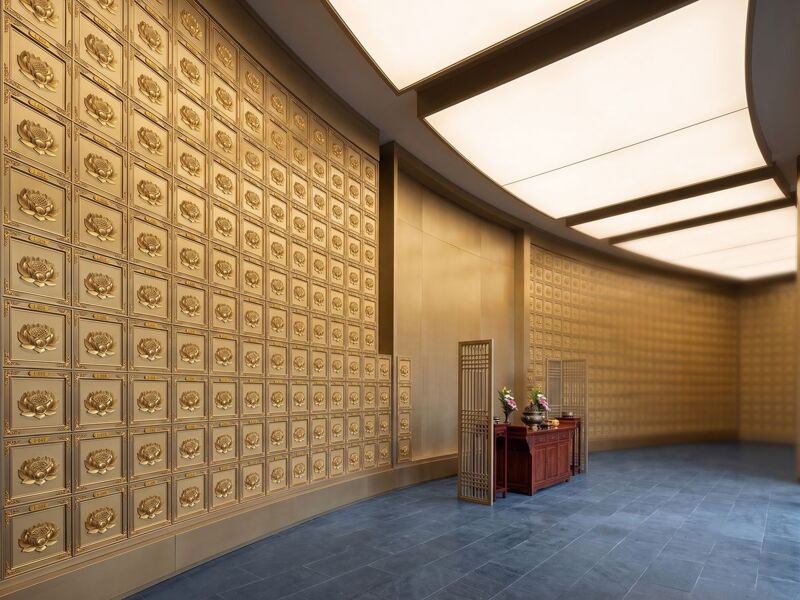
Most columbaria have a defined religious identity: Buddhist practice hall, Christian, or multi-faith. That identity determines the interior, the form of ceremonies, and whether an individual niche can hold objects belonging to another tradition.
A Buddhist hall generally does not object to a cross inside a niche, but it cannot be displayed on the outside of the door or become a visual focus in the niche area. Conversely, a Christian hall usually applies the same "inside, not outside" requirement to Buddha images and sutra texts.
The question is simple: before interment ask "may religious items go inside the niche, and are there limits on material or quantity?" That one sentence saves all the trouble later.
Prayer beads are the most common grave good.
They can go in Keep them under 8 mm in diameter and 300 mm in strand length, and seal them in a small bag. Avoid bodhi seed, wooden beads and any seed material — these are organic and, in a constant 55–65% humidity, are the first thing to mould; within two years they grow a layer of white fuzz.
Suitable materials: agate, crystal, jade coloured glass metal. None of these absorb water, and twenty years produces only a loss of surface lustre.
If the beads are the strand the deceased used daily their emotional value is highest. In that case do one thing: put them in a small acrylic box with a 2 g silica gel pack inside, and label the outside "used by the deceased". Change the desiccant every year — almost nobody does this, and it determines what the beads look like in fifty years.
A cross can go into a niche at no more than 80 × 50 mm, in treated timber, stone or metal.
Three cautions.
- Do not attach it to the inside of the niche door. Every opening and closing is a flex; an adhered item lifts at the edges within three years. - Not a large three-dimensional piece. A standing cross over 100 mm high gets in the way when the urn is handled. - Do not place it in the primary position alongside a Buddha image. Mixing is not taboo, but it leaves later family members with a great deal of explaining to do.
Where a family spans two faiths — one parent Buddhist, one Christian — the usual practice is to separate them: the Buddha image towards the back of the niche, the cross towards the side, neither facing nor stacked on the other.
A small Buddha image (under 80 mm), a Buddha plaque, a sutra card — all can go in.
Do not put paper originals of sutras in. Paper sticks and yellows in constant humidity, and after five years you open the niche to a block of fused sheets. Use an etched metal plate or a ceramic tile instead — the same process as the number plate, and it lasts twenty years.
Avoid timber and painted clay for the image. Timber deforms and splits; the painted layer lifts under humidity swings.
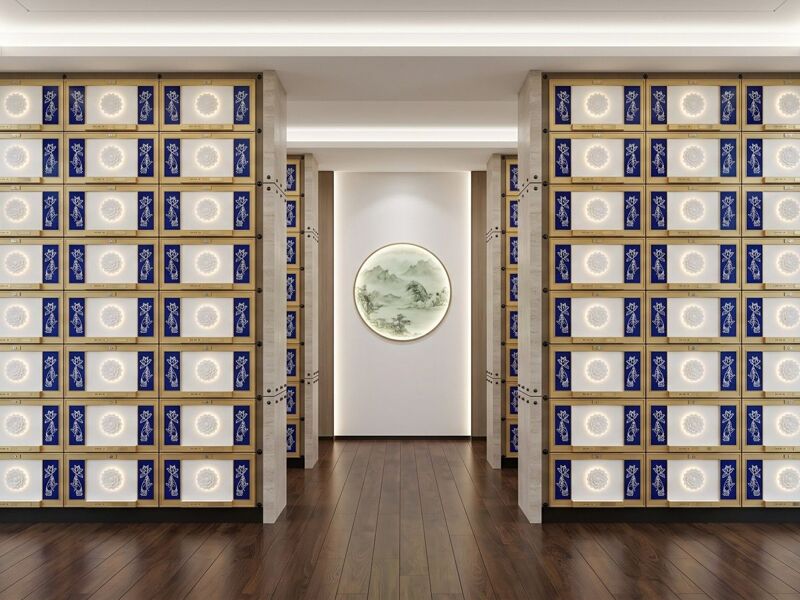
Whatever the faith, keep religious objects to three or fewer.
Two hard rules on position: against the back, never against the door (by the door, they are swept off when it opens); never on top of the urn (the lid is the seal, and weight accelerates wax failure).
The usual good position is to the left or right of the urn alongside it, 20 mm or more apart.
One reality has to be accepted: a niche is semi-public space Open the door and the neighbouring family can see in.
So the placement of religious objects has to consider, beyond your own belief, how visible they are. A niche lined with images and covered in sutra texts is no problem in a Buddhist hall; in a multi-faith hall the management will usually ask that the part visible when the door is open stays neutral.
This is not suppression of belief; it is the basic rule of coexisting. In a columbarium religious objects ultimately need to be visible to the family, not to everyone else.
Most halls complete a contents register at interment, with religious objects listed on a separate line giving name, material and quantity.
The value of that register appears at relocation. To open the urn or move out, the hall will check against the register. Without one, an object lost in transit cannot be traced.
Q: Can a cross go in a Buddhist columbarium?
A: Mostly yes, but usually confined to the inside of the niche, not on the outside of the door or in public positions in the area. Asking before interment is safest.
Q: Must the prayer beads go in? Can they stay at home?
A: They can stay at home. Beads kept at home are more likely to be used — the family can hold them, can take them out on the anniversary Placing them or not does not affect propriety.
Q: Do religious objects affect the seal of the niche?
A: Yes Anything thicker than 10 mm placed inside the door presses on the gasket and stops the door closing properly. All objects should sit behind or beside the urn, out of the door's travel.
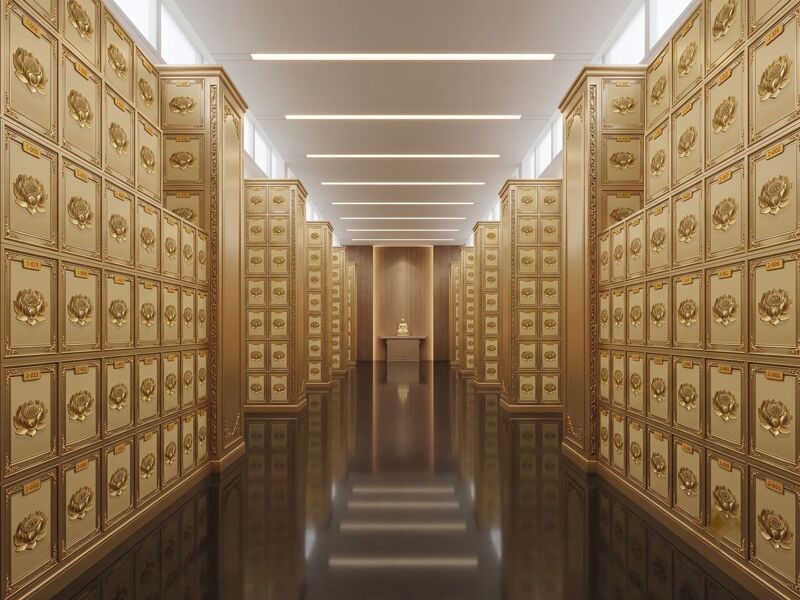
The five rules for religious objects in a columbarium: confirm the hall's religious identity choose non-absorbent materials for beads, keep the cross small and off the door, keep images and sutras to one, and hold the total to three placed against the back rather than the door. A sign of belief placed in a niche does not need to be much; it needs to still be recognisable in twenty years — and that depends on material, not on feeling.






