
WeChat: (+86)13978873330 Email: 381784025@qq.com

WeChat: (+86)13978873330 Email: 381784025@qq.com

Visit a handful of columbaria and the number plates are almost always gold with red characters, occasionally black with gold, and rarely anything else. This is not aesthetic preference. It is the answer forced by three hard conditions: low illuminance, long viewing distance, and twenty years without replacement.
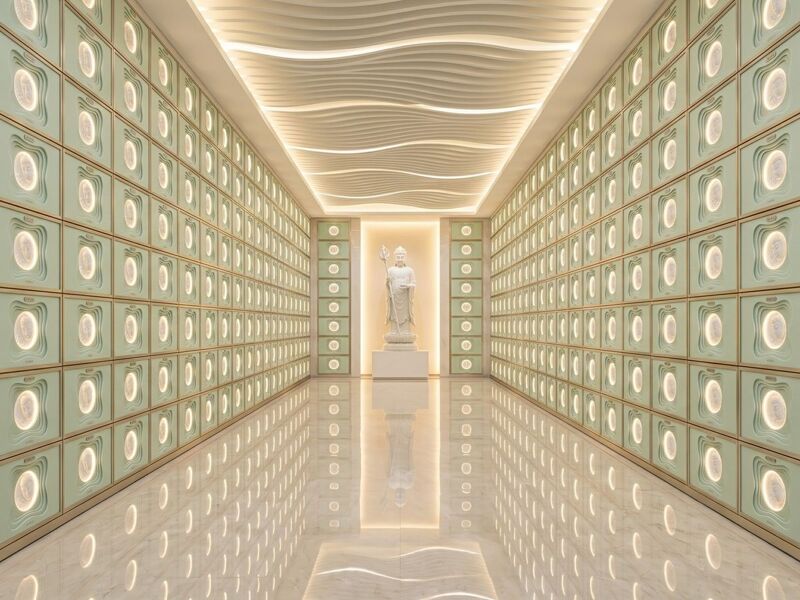
Illuminance in a columbarium is typically only 150–300 lux, lower in the aisles, and around 100 lux at niches against a wall. That is roughly a third of an office and a tenth of an overcast day outdoors.
At low illuminance the eye shifts from cone to rod vision, colour discrimination drops, but sensitivity to luminance contrast remains. So the first requirement of a number plate is not beauty, it is contrast.
A gold ground — champagne anodised or brushed brass — has a diffuse reflectance around 55%–65%, while red lettering reflects about 15%, giving a lightness difference close to 4:1. Black ground with white letters has higher contrast still, but white lettering glows slightly at low light and the strokes merge.
Black on gold actually has higher contrast and reads best in daylight The problem is the lamp.
Niche downlights are mostly 2700–3000 K warm white, with a spectrum strong in red and weak in blue. Under warm light, blue goes dark and grey while red's relative luminance is pushed up. So gold ground with red lettering becomes bright ground, bright letters — visually both calm and legible.
Black lettering, by contrast, looks inert under warm light, especially on gold: it reads as printed matter rather than as a tablet.
There is a cultural layer as well: gold ground with red is the combination in Chinese usage where festivity and solemnity coexist Ancestral halls, spirit tablets and door plaques all use it. The columbarium inherits the pairing rather than designing it.
This is the most practical point. A number plate is a twenty-year component, and its surface will be wiped, knocked and dusted with incense ash.
On mirror-polished metal one scratch destroys the whole reflection and it reads as "broken". On brushed or matte anodised gold, scratches hide in the grain, and unless they are deep grooves the eye barely registers them. Gold also has wide hue tolerance — yellowing, dulling, light oxidation all remain within the range of "gold".
Silver-white or bright chrome does not. It greys as it oxidises, scratches show white, and it looks old in two years.
Screen printing: ink 10–20 microns thick, lowest cost Fades in three to five years under UV, red turning pink first. Indoors the degradation is slower, but ten years will show.
Laser marking: burns through the anodic layer to reveal the substrate. Durable, but contrast depends on the base — on gold it comes out pale grey and reads weakly at distance.
Etch and paint fill: etch a 0.1 mm deep character, then fill with red paint. The letter has depth the paint is protected by the groove walls, and it does not fade in twenty years. This is the process a columbarium should be using, and the only one that survives twenty years.
On cost, roughly: screen print 1, laser 2, etch and fill 3.5. Across a row of several dozen plates the difference is a few yuan each There is no reason to save it.

A 60 × 30 mm plate with 10–12 mm characters and 3 mm leading fits two lines at most.
Any larger and the strokes crowd; any smaller and they vanish at 3 m. A niche number is usually five to eight characters, which exactly fills one line at 60 mm width.
If the number is longer, widen the plate — do not compress the spacing. At less than half a stroke width, the spacing reads as a red band from a distance.
One: red ground with gold letters. Inverted. The red goes dark under warm light while the gold reflects, so from a distance it is a bright blob with no readable number.
Two: white ground with black letters. In a columbarium it reads as a label, not a tablet. White also greys at low illuminance and looks soiled within a year.
Three: colour-coded zone plates. Different ground colours to mark zones look convenient but break the continuity of the row. Zone by shape or position, not by colour. Visual order in a columbarium matters more than zoning convenience.
Stand three metres away. Turn off your phone light and rely on the hall's own lighting: can you read the number at a glance? If not, contrast is insufficient.
Look at 45 degrees. Does the plate flare into a white card? If so it is mirror-polished; change to matte.
Scratch with a fingernail. At an inconspicuous corner, see whether the colour comes off or only a mark remains. Screen print comes off; etch and fill does not.
Shine a UV torch. Ten seconds under a banknote checker: screen-printed red darkens noticeably, filled paint barely changes. This is the quickest way to identify the process on site.
Q: Is the gold actually gold-plated?
A: No. Most niche plates are anodised aluminium or brushed brass. Real gold plating is unrealistic in both cost and maintenance.
Q: Will the red fade to pink?
A: Screen print will; etch and fill will not. On a west-facing wall with direct sun, fading accelerates noticeably.
Q: Can acrylic replace metal?
A: It can, but it yellows in five years and warps at the edges from thermal expansion. For a long-life component like a niche plate, metal is more stable.
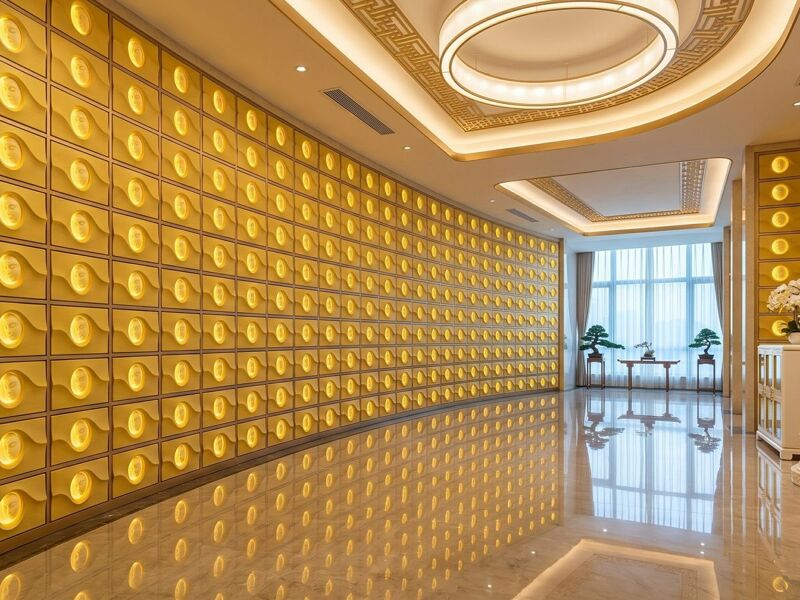
Gold with red on a niche number plate is the answer selected by three conditions together: low light, long distance, no replacement. Gold hides scratches, red does not blur under warm light, and etch-and-fill survives twenty years. Most of what looks "obvious" in a columbarium has a calculation behind it.






