
WeChat: (+86)13978873330 Email: 381784025@qq.com

WeChat: (+86)13978873330 Email: 381784025@qq.com

0.5 and 0.8 are two millimetre figures and two cost levels. In the same door panel 0.5 mm is light, cheap and easy to swing; 0.8 mm is stable and resists denting, but the hinges have to carry more. That sub-millimetre difference after five years becomes the difference between a door that is still flat and one that is not. A columbarium door panel carries no load, but it is opened and closed every day, and thickness is the one variable you can control in advance.

At a niche you can run a small test: press your thumb into the centre of the panel and add force slowly. A 0.5 mm panel shows visible elastic deflection at around 20 kg of force and springs back when released; a 0.8 mm panel deflects roughly half as much.
The deflection itself is not fatal. The problem is whether the springback is complete. Repeated elastic deformation fatigues the folded edge, and after a few years the panel no longer returns fully — it stays permanently slightly dished. Most of the "looks a bit off" door panels in a columbarium come from exactly this.
Panel stiffness scales with the cube of thickness. Going from 0.5 to 0.8 is a thickness ratio of 1.6 and a stiffness ratio of about four. On a small panel that gap is invisible; on a large one it is decisive.
Practical guidance for columbarium panels, banded by area:
Under 0.15 m² (about 400 × 380): 0.5 is usable.
0.15–0.4 m²: 0.6 is steadier.
Above 0.4 m² (family niche doors): 0.8 is required, plus a mid-span stiffener.
Above about 0.6 m² even 0.8 mm shows the diaphragm effect — it dents at the centre, lifts at the corners, and the door gap becomes uneven Family niche doors in a columbarium need a vertical stiffener welded to the back as well as the thicker sheet.
Thicken the panel and the weight rises with it. A 400 × 450 door in 0.5 mm weighs about 1.2 kg; in 0.8 mm about 1.9 kg; with the glazed viewing window and the lock, the real figure reaches 2.5–3 kg.
That weight sets the requirement for niche door hinges: each hinge rated at no less than 5 kg, and no fewer than two hinges per door. Put ordinary small hinges on a 0.8 mm panel and nothing happens in year one; by year three the door sags and the bottom edge catches the frame first.
How to check: open the door to 90 degrees and let go. A sound door holds or returns slowly; a sagging door travels downward on its own, and the gap at the bottom edge is smaller than at the top.
Twist the top corner of the panel by hand. A 0.5 panel shows slight torsion; 0.8 barely moves.
Feel the self-weight. Open to 45 degrees and release; the 0.8 door drops faster.
Listen. Tap the centre of the panel: 0.5 sounds dull with a short tail, 0.8 sounds more solid.
Ask about the hinges. A thick door should have thick hinges. Thin hinges on a thick door means mismatched parts assembled together.
The most reliable method is still the specification sheet. Door panel thickness is a declared parameter, and a proper manufacturer will state it. If they will not, assume 0.5.
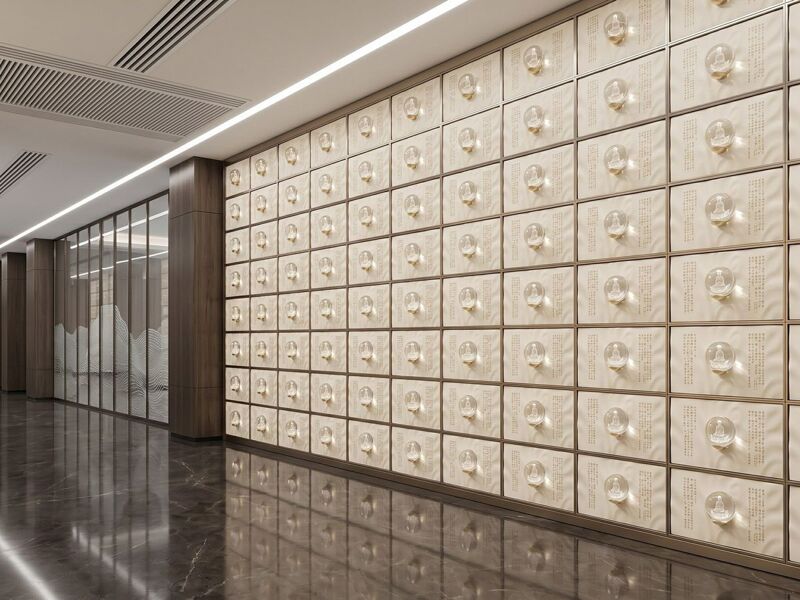
Where 0.5 works: high tiers (sixth layer and above, rarely opened), corner and edge positions, and inner rows of budget products. Opening frequency is low there and fatigue accumulates slowly.
Where 0.8 is required: the two or three tiers at eye level (opened most), family niche doors, and doors along the aisle that get knocked.
A pragmatic allocation: within the same row, use 0.8 for the middle tiers and 0.5 for the top and bottom. The cost increase stays limited and the panels opened most often last longest. Door panels in a columbarium are replaced piece by piece, so one millimetre spent up front saves a whole-row replacement later.
From 0.5 to 0.8 the material cost rises about 30%–40%, which usually works out to a few dozen to a little over a hundred yuan per door. Against the total price of a niche, that is a small share.
The real problem is the reverse: a quotation that is vague about panel thickness, or that charges 0.8 prices for 0.5 panels. A columbarium quotation should state three things explicitly — panel thickness, hinge count, and lock model.
Q: How many years will a 0.5 mm panel last?
A: With normal use, visible dishing appears at 8–10 years. On the frequently opened middle tiers, around five.
Q: Can a dished panel be hammered flat?
A: No. Once sheet metal takes a plastic set, hammering leaves a wavy surface. The whole panel has to be replaced.
Q: Is a 0.8 mm door too heavy for an elderly visitor?
A: Under 3 kg per leaf, an adult can open and close it normally. For heavier family niche doors, use double leaves or add a gas strut.

The difference between 0.5 and 0.8 in a columbarium door panel is not a millimetre; it is whether the door is still flat after five years. A niche is opened and closed for decades, and the panel is the only part that is touched by hand every time and most easily overlooked. Go to 0.8 if the budget allows; if it is tight, reserve 0.8 for the tiers that get opened most Money spent here is the least likely to be regretted.






