WeChat: (+86)13978873330 Email: 381784025@qq.com

WeChat: (+86)13978873330 Email: 381784025@qq.com

The answer first: in most cases no, and it should not. A tablet and an urn are two different things — one carries status and name, the other holds the ashes. Putting both into the same niche is a minority practice, and it costs you twice: space and damp.

Function differs. A niche is closed; shut the door and it is dark inside. A tablet has to be seen — the family must find it and bow to it. That is exactly why a columbarium sets aside a separate tablet section, at eye level with its own lighting.
Space conflicts. The cavity is designed around the urn: 400 × 400 × 450 mm holding a 260 mm urn leaves only enough room to get a hand in. Stand a tablet in there and the urn loses a third of its working space.
Damp. Tablets are mostly timber or acrylic. Timber in a closed, humid niche absorbs moisture and warps, and the cut edges of the lettering lift. A tablet section has its own air supply, which is a better environment than the inside of a niche.
So the industry norm is: the niche holds the urn, the tablet goes in a separate section, the two linked by the same family number. At a visit the family bows in the tablet section first, then pays respects at the niche. The route runs name first, remains second — which is the order the rite requires.
A tablet hall. A separate hall, divided by surname or lineage, with tablet cells numbered apart from niche cells. This is the most formal arrangement and is common in large columbaria.
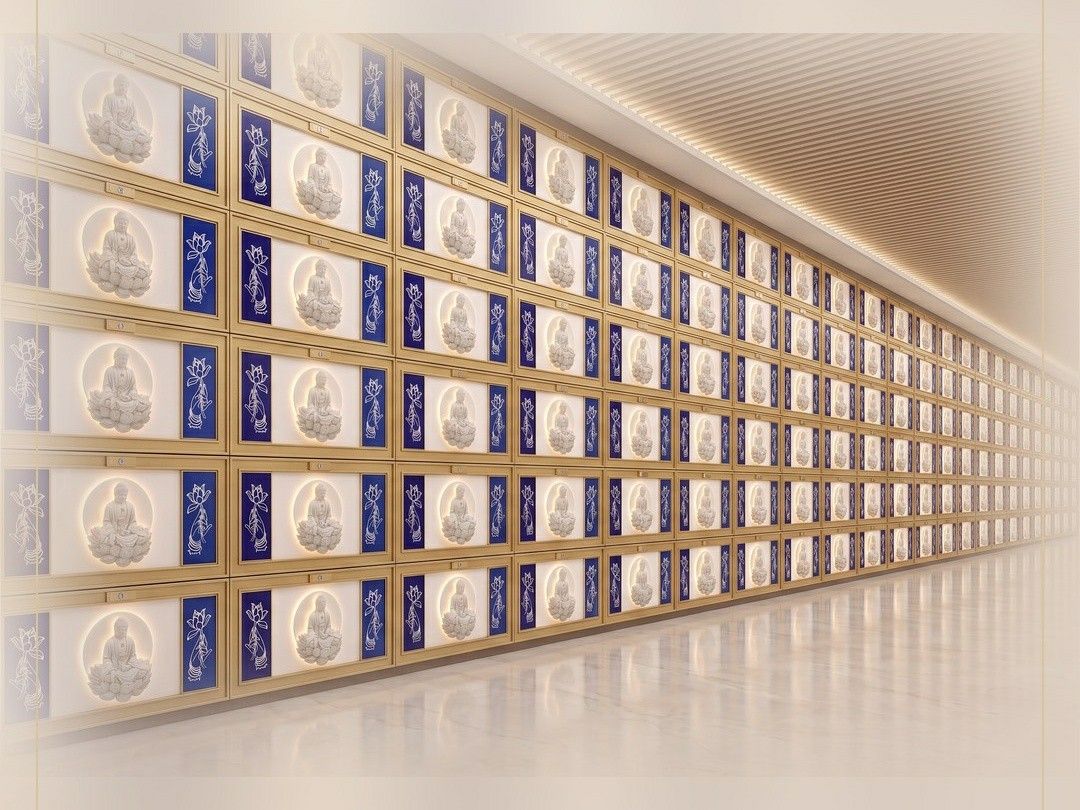
Zoned within one hall. In the same building, niche racks on one side and a tablet wall on the other, with families passing the tablet wall on the way in. The advantage is a short route; the drawback is that incense in the tablet zone affects humidity along that row.
A family tablet shrine. A small shrine beside the family niche, holding only that lineage's tablets. It suits family niches of six cells or more, and it expresses "one place to pay respects" better than anything else.
Of the three I recommend the third — provided the family niche is genuinely large. At family scale, a tablet shrine adds more value than two extra cells.
Some families insist on keeping tablet and urn together, usually because the ancestors were enshrined in the old home and visiting twice is impractical; they want one door opened and everything done.
The minimum then is cavity depth ≥ 250 mm and clear height ≥ 200 mm for the tablet's share. The tablet itself is made small: 90–120 mm wide 150–200 mm high, 15–20 mm thick, in acrylic or thin aluminium, not solid timber.
Two ways to place it: stand the tablet behind the urn (moving the urn forward 50 mm), or mount the tablet on the inside of the door panel (which requires the panel to have a mounting position). The first complicates handling; the second compromises the door seal.
With a 400 mm deep cavity, the urn takes 260 and the tablet 20, plus clearance both sides — it is genuinely cramped. Only from 450 mm deep can you call it comfortable.

Damp. Tablet and urn share one cell, and dehumidification works by air supplied along the row — the air does not reach the back of the tablet. A timber tablet can warp within two years and the lettering can split. Acrylic does not fear damp but attracts dust by static.
Knocks. When taking the urn in or out, the tablet is the part most easily knocked over. It may not break, but it shifts — and once it has shifted the family cannot find "the place it used to be", which is a greater loss than the physical damage.
The fix: fix the tablet with magnets or a clip, never by leaning it; take the tablet out before handling the urn, and put it back afterwards.
Three conditions together: cavity depth of 450 mm or more, a non-timber tablet, and a family that visits every year with a settled routine.
Conversely, three situations to avoid: a cavity under 400 mm (it will not fit), a family niche shared by many households (tablets only accumulate), and a humid region with no independent dehumidification in the niche.
My advice: design on the basis of a separate tablet section, and share a niche only where the space is generous and the family explicitly asks for it. Once a columbarium's layout is fixed it cannot be changed, so count the tablet requirement in at the start; it is cheaper than retrofitting.
Q: If the tablet is not in the niche, will the family "not find the person" at a visit?
A: No. Tablet section and niche share one number, and most parks mark the cell number on the tablet and the tablet number on the niche.
Q: Is there an extra charge for sharing a niche?
A: Most parks do not charge extra, but may require the tablet to meet a size rule. Ask before buying whether a tablet may be placed inside the niche.
Q: Can the tablet be acrylic?
A: Yes, and acrylic suits the inside of a niche better: it does not fear damp, it is light, and it can be laser-engraved. The drawback is that it feels less substantial than timber or stone.

Whether tablet size should match niche size depends on where the tablet goes. In a columbarium the two are normally separate, and that is also the more sensible arrangement; if they must share a cell, accept that the cavity has to be deep, the material has to resist damp, and handling takes an extra step. The design logic of a columbarium has always been that name and remains each keep their own place — not that they be squeezed together.