WeChat: (+86)13978873330 Email: 381784025@qq.com

WeChat: (+86)13978873330 Email: 381784025@qq.com

Walk into a columbarium and the first thing you see is racks stacked to the top. How many tiers and how tall directly determines how many niches you can sell, and also whether a person of seventy can reach their own. Taller is not automatically better value — three things cap it: how high a hand reaches, how stable a ladder is, and how much room the sprinklers need.
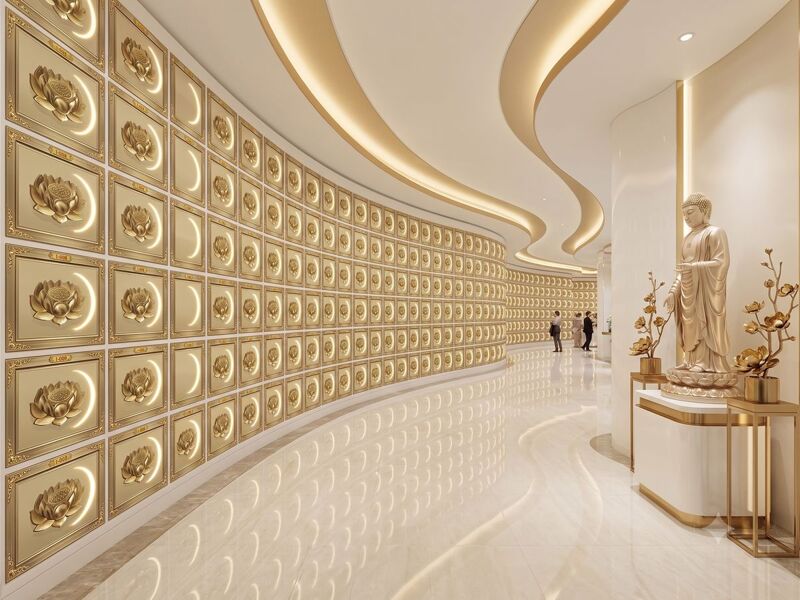
At a tier height of 280–320 mm: eight tiers is about 2.2–2.6 m, twelve tiers about 3.4–3.8 m.
Eight tiers is the "all within reach" option. The top surface sits near 2.2 m, so a person 1.6 m tall can handle it from the third step of a stool without a ladder.
Ten tiers is the mainstream. Overall height 2.6–2.8 m, with the top two tiers needing a stool or a small ladder.
Twelve tiers and above is the "space first" option. Above 3.4 m overall, a mobile ladder or a two-level arrangement with an intermediate access catwalk is mandatory Common in land-constrained urban halls.
Tier count is not a free choice — it is settled together with clear height, fire requirements and circulation In a hall with 3.2 m clear height, twelve tiers is the maximum, because sprinklers and light fittings need room above.
2.6 m is a threshold. Below it, the rack stands on its own weight plus wall ties; above it, the top must be fixed to the structure, or lateral stiffness is insufficient.
From a user's point of view, 2.6 m is also a psychological line: standing in front of the rack, the top tier is visible without tilting the head past 30 degrees. Beyond that angle people instinctively feel it is "high, far, out of reach".
That is why many halls stop at 2.6 m and build a decorative band or leave the space empty above — not because they cannot go higher, but because it does not sell.
The comfortable handling zone is 0.6–1.8 m. At 300 mm tier height, tiers three to seven are the golden band; above tier eight, tools are needed.
Three kinds of tool:
Two-step stool: 400 mm high, reaches tiers up to 2.2 m.
Three-step stool or small ladder: 600–900 mm high, reaches up to 2.6 m.
Mobile platform ladder: with handrail and brake, reaches up to 3.4 m.
All three must be stored inside the hall, and the distance from storage to the farthest rack must not exceed 15 m Some halls lock the ladder in a store room and a family must find an administrator to use it — which effectively turns the upper tiers into "inconvenient" niches.
Tier height is not arbitrary. The formula is: tier height = urn height + base + handling allowance.
Urn 230 + base 20 + allowance 50 gives 300 mm. Below 40 mm of allowance, the back of your hand scrapes the shelf above, and with gloves it is worse.
Some halls squeeze tier height to 260 to add two more tiers. That only accepts small urns: a standard urn goes in at an angle and has to be dug out Once tier height drops below 280, a columbarium has locked in its future applicability.
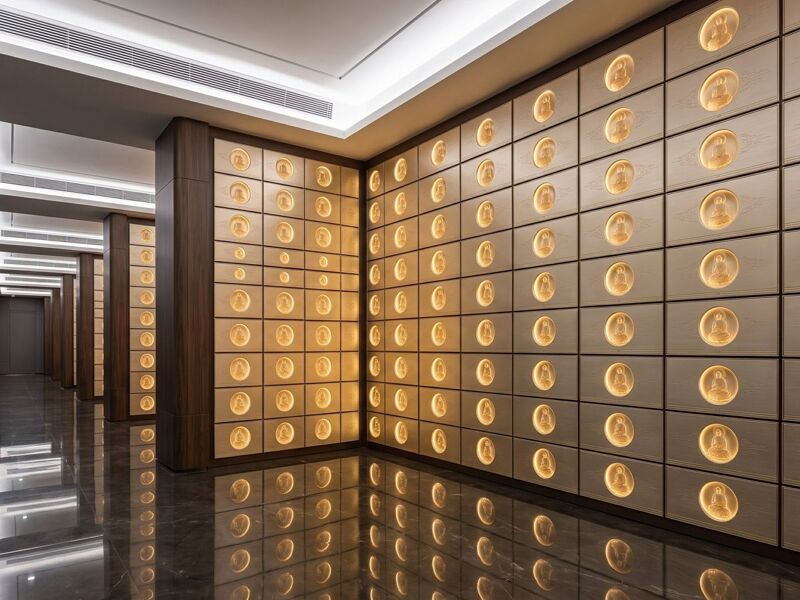
Clear height. Rack height + sprinkler allowance (at least 300 mm) + light fittings (100 mm) ≤ clear height.
Fire requirements. Where upper tiers fall outside sprinkler coverage, sidewall sprinklers must be added. This is often overlooked until inspection.
Structural load. A twelve-tier rack full of urns can impose 400–600 kg/m². Any retrofit in an old building needs a structural check first.
Circulation. The taller the rack, the more access catwalk and ladder positions are needed, which eats into the sellable floor area.
The hardest of the four is clear height. Fix it and the tier count is fixed with it.
Top tier: usually built as a "memorial tier" for tablets photographs and keepsakes rather than standard niches. It is the least convenient to reach but the best visually, so what it sells is visibility.
Bottom tier: after skirting and base, clear height is often only 160–200 mm, too little for a standard urn, so it becomes a drawer for keepsakes or ash containers — in most columbaria it counts as a non-standard niche.
The niches that actually sell cluster in tiers four to seven: within reach, at eye level, no bending and no looking up. That is also why they cost most.
Stand in front of the rack and do three things:
1. Count the tiers measure the overall height calculate the actual tier height. 2. Check whether tiers above eight have a ladder, where it is kept, and whether someone has to unlock it. 3. Look up: how much height do sprinkler heads, light fittings and access hatches take, and can the top tier door open properly?
The third most often exposes a problem. In many halls the top door opens, but hits a sprinkler pipe at 60 degrees and the urn cannot come out.
Q: More tiers means more niches on the same floor area — isn't that better value?
A: More units means a lower unit price. Twelve-tier upper niches usually need a discount to sell, so the overall return may not beat eight tiers Management cost is also higher — ladders and staff.
Q: My parents are elderly — can we only choose a low tier?
A: Tiers three to five are the best fit. Too low means bending and crouching, hard on the knees; too high is out of reach. Neither extreme suits older visitors.
Q: Can I buy only an upper tier since it is much cheaper?
A: Yes, but do two sums: the extra time on every visit, and the smaller pool of buyers when you resell. Upper-tier niches in a columbarium typically take more than twice as long to sell as middle tiers.
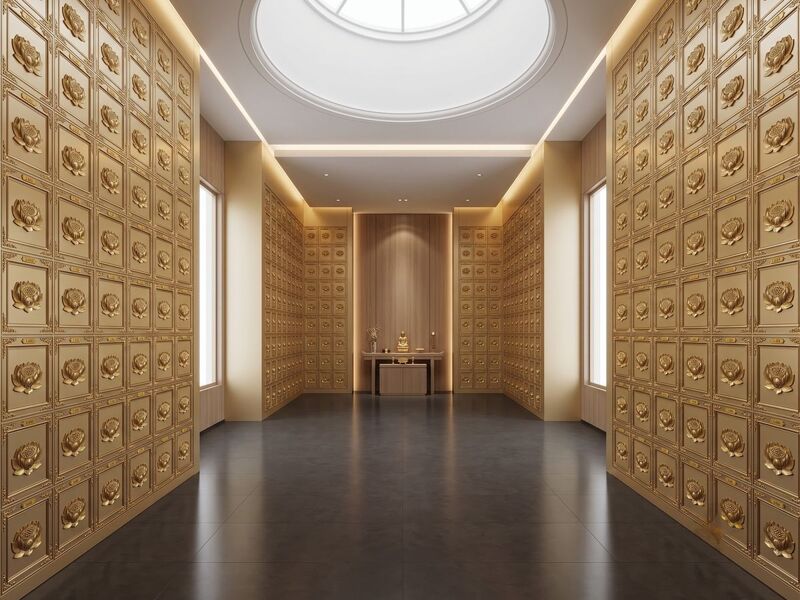
The answer to how many tiers is not "how high can we build" but "who can reach it". Eight tiers, all within reach; ten, a stool; twelve, a ladder; and 2.6 m is both a structural and a psychological divide. Tier count is really selling a ratio between convenience and quantity — and in a columbarium the tiers that hold their value are always the ones you can touch without stretching.