
WeChat: (+86)13978873330 Email: 381784025@qq.com

WeChat: (+86)13978873330 Email: 381784025@qq.com

Air conditioning and ventilation in a columbarium hall are the hardest things to assess from photographs, and among the most influential on the experience of using the place.

Unlike door panels, they cannot be touched; unlike dimensions, they cannot be measured. But four actions on site give you a rough verdict in ten minutes.
Walk into the hall and find the return grilles on the walls or ceiling.
Look at the dust. If the louvre blades carry obvious black deposits, the filter has not been cleaned in a long time. Dirty return air means the whole hall is recirculating dust.
Look at the position. If a return grille faces a few particular rows, urn faces in those rows collect dust faster than elsewhere. Avoid those positions when choosing.
Listen. Stand under the grille — can you hear a distinct rush of air? Loud airflow means ample volume but high velocity, which lifts dust off the floor.
Where the diffusers point determines where the cool air goes.
Good practice: supply along the ceiling and let it drop down the wall surface, so neither people nor niches sit in a direct draught.
Poor practice: diffusers aimed straight down the aisle or at a particular row. The result is localised overcooling, which readily produces condensation.
How to test: stand in front of the target niche, back of hand upward, and feel for a continuous draught. If there is one, the niche is being blown on directly.
Your nose is faster than an instrument.
A stuffy smell. Insufficient air change and high CO₂. Sitting in such a hall for long makes you dizzy.
A musty smell. Localised damp, possibly from wall corners, carpet, or a blocked dehumidifier drain.
Residual incense smoke. Insufficient exhaust; smoke from the burner is not being carried away promptly.
Of the three, the musty smell is the one to worry about most — it means humidity somewhere has already gone out of control.
Whether air conditioning and ventilation are done well ultimately shows in two places.
Wall corners. Any blackening, blistering or efflorescence at internal corners means condensation on the wall.
Lower edge of door panels. Run a hand along it: any water marks, any tackiness? That indicates high humidity near floor level.
Top surface of the shelf. Wipe with a finger and see how thick the dust is. Thick dust means poor air circulation and inadequate filtration.

If the hall feels right, ask one technical figure: what is the air change rate?
A reasonable rate for a columbarium hall is one to two air changes per hour. Below one, smells do not clear. Above three, energy use is high and humidity becomes hard to control.
Some salespeople cannot answer. That inability is itself a signal — it means the building services are outsourced and the facility does not track its own operating condition.
This distinction matters: air conditioning handles temperature, dehumidification handles humidity.
Many halls have air conditioning but no independent dehumidification, so in the plum-rain season the temperature comes down while humidity stays high. Niches in such halls carry a markedly higher mould risk.
How to check: ask "where are the dehumidifiers?" If they point at the air conditioners, there is no independent dehumidification. If they can take you to the plant room to see the units, they are professional.
Q: Without windows, is ventilation poor?
Not necessarily. A windowless hall relies on mechanical fresh air; provided the air change rate is adequate and filtration is in place, the air is more stable than in a hall with openable windows.
Q: Is colder air conditioning better?
No. Excessive cooling makes niche surfaces condense more readily and makes visitors uncomfortable. 24 to 26 degrees is appropriate.
Q: How do I know whether the dehumidifiers are running?
Look at the drainage. A running dehumidifier discharges continuously; check whether there is flow in the drain pipe and whether the floor is wet.
Q: Is a new hall's air conditioning always better than an old one's?
Not necessarily. New halls have new equipment, but an old hall that has had its services upgraded may run more steadily.
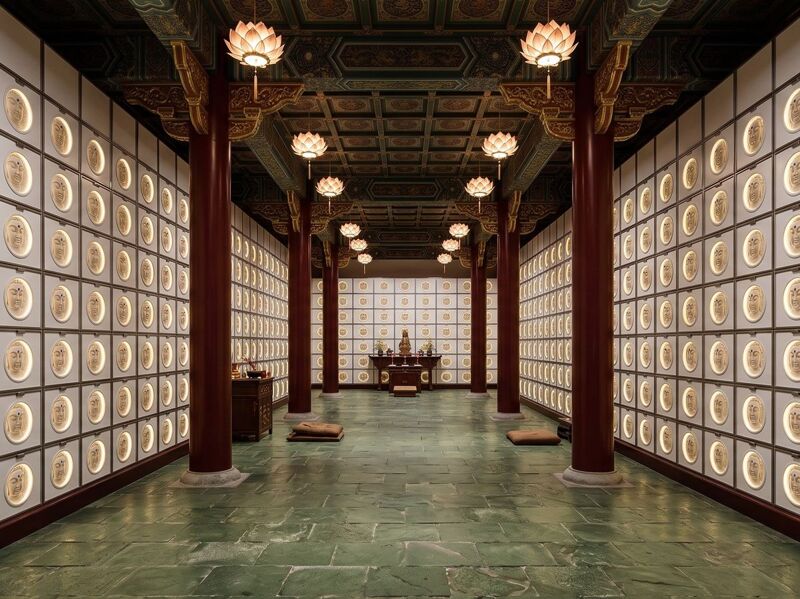
You do not need instruments to judge air conditioning and ventilation on site. Look at the return grilles, look at the supply, smell the air, touch the lower edge of a door panel — four steps. The air in a columbarium hall is invisible, but every day it affects the sealing of the urn, the life of the door panels, and how families feel. Ten minutes on these matters more than two thousand yuan off the price.






