WeChat: (+86)13978873330 Email: 381784025@qq.com

WeChat: (+86)13978873330 Email: 381784025@qq.com

The altar is the only piece of furniture in a columbarium that is touched every day. Too shallow and the offerings do not fit; too deep and you cannot reach the incense burner; too low and stooping hurts; too high and elderly visitors cannot see what is on it.
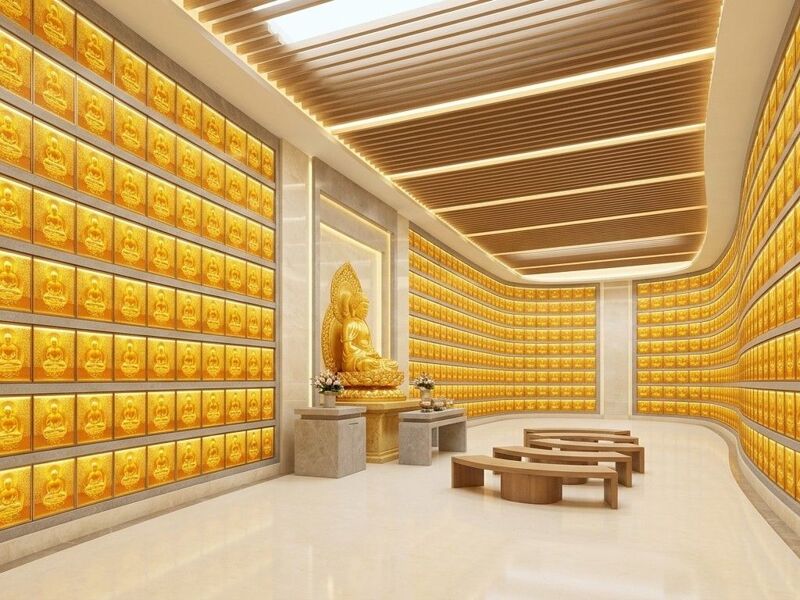
Columbarium altar depth depends on what goes on it.
For an incense burner and two plates of fruit, 600 is enough. For three-meat offerings, five fruits, or a whole basket of flowers, you need 800. I suggest 700 as the middle value with the best compatibility.
Beyond 900 it stops being an altar and becomes a counter — you cannot reach the back edge from the front, and setting offerings means walking round.
A 850 counter is standard; 900 suits a columbarium where most worship is done standing. Below 800 and an elderly person stoops to offer incense; above 950 and the arm is held up to light it, which aches within a minute.
Recess the underside by 100 so feet can go in 100 and people naturally stand closer. Very few do this, but over half an hour of standing the difference is obvious.
Columbarium altar length is usually 1.5–2 times the width of the Buddha image. For a 3 m wide shrine, an altar of 4.5–6 m.
Do not run the altar the full width of the wall. Do that and there is no margin either side, the image is boxed in on the counter, and it looks less solemn rather than more. Leave 600–900 clear either side of a columbarium altar so the composition can breathe.
A 20 mm upstand at the front edge stops offering water running onto the floor; a 50 mm lip at the back stops offerings being pushed back into the shrine.
Neither is conspicuous, but with dozens of offerings set out daily in a columbarium, without them water runs down the front onto people's feet and ash falls into the shrine joints.
Put the burner in the centre of the counter, 200 from the front edge. Too close and ash falls to the floor; too far and you have to lean in to offer incense.
Under the burner, set a 300 × 300 stone or metal tray to catch ash and embers. Put a burner directly on a timber counter in a columbarium and within two or three years there is a scorch ring.
For a three-legged censer, allow 400 diameter. A vertical-incense burner takes less space than a horizontal one, but the smoke rises straight up and yellows the top of the shrine.
Design the altar counter for 200 kg per m². A full basket of fruit, a bronze censer and stone offering vessels routinely exceed 100 kg.
Use a 25 mm artificial stone or 30 mm granite top over a steel frame or masonry. If a columbarium altar is a hollow cabinet, add cross-bearers under the top at no more than 600 spacing.
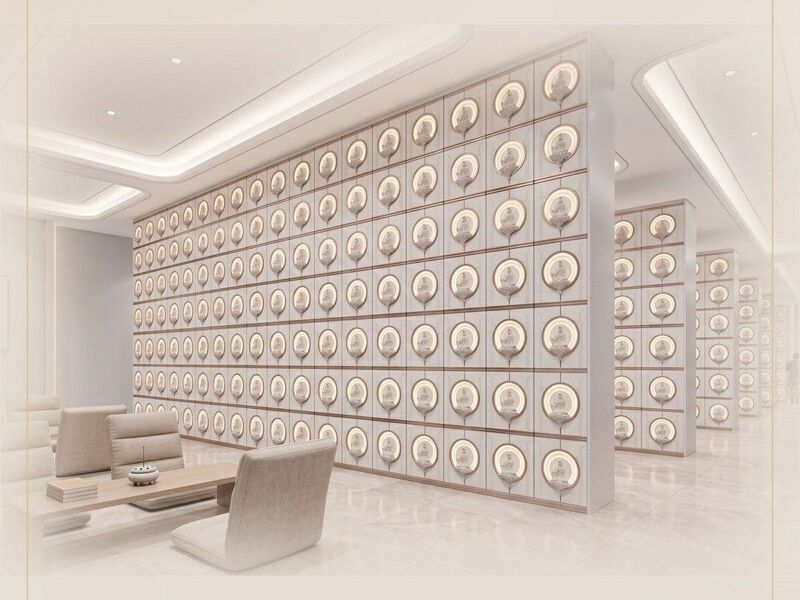
From the front edge of the altar to the centre of the first row of cushions, 900–1,200. Under 900 and a kneeling person's head meets the counter; over 1,200 and they have to get up and step forward to offer incense.
With three rows at 800 spacing, the back row has half its sightline blocked. Keep the cushion area depth within 2.4 m (three rows) in a columbarium; beyond that split it to both sides.
The columbarium altar stands before the main Buddha: large, fixed, for collective worship. The ledge in front of a niche serves a single position: 350–400 deep and 600 wide is enough.
Confusing the two is a common error: build the niche ledge 700 deep and the aisle instantly loses 300, so two people cannot pass. Columbarium main aisles are tight to begin with, and this mistake usually means demolition and rework.
A niche ledge can be made fold-down, stowed when not in use — the most practical version.
Wipe the counter twice a day. Sweep ash off dry with a soft brush; do not go straight to a wet wipe, which smears ash into a grey film that soaks into the stone's pores.
Wipe the bronze censer monthly with a soft cloth and bronze oil. Left alone, verdigris in a columbarium transfers onto the counter and will not wash off.
Three options for the top: granite (heat and stain resistant, heavy), artificial stone (easy to work, sensitive to heat) stainless steel (durable, cold).
For a columbarium I recommend an artificial stone front face with a granite top. The front face should look good; the top has to survive.
Do not use timber veneer on an altar top. Burner heat, water marks and candle wax together will destroy it within a year.
Q: Can the altar be two-tiered?
A: Yes. A 600 high lower tier as a small platform for kneeling, an 850 upper tier for offerings. But leave a 300 tread between them or it is unstable to stand on.
Q: Should there be cupboards under the altar?
A: Yes, for incense, candles and offering plates. But use louvred doors or leave gaps; a sealed cabinet moulds in columbarium humidity.
Q: Should there be power outlets?
A: Yes. Two at the rear side of the counter for electronic burners, audio and temporary lighting at 300 height under the counter.
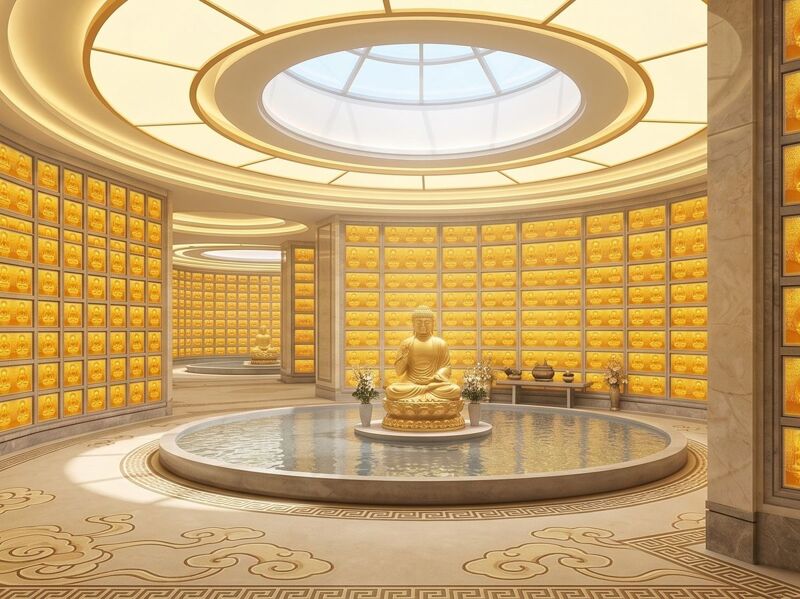
A columbarium altar: 700 deep (600–800), 850–900 high, length 1.5–2 times the image width, 20 mm upstand at the front, 50 mm lip at the back, burner 200 from the front edge, 200 kg/m² load capacity, 900–1,200 to the cushions. This counter is the plane where families linger longest — a 50 mm error in dimension lives inside a year of use.