
WeChat: (+86)13978873330 Email: 381784025@qq.com

WeChat: (+86)13978873330 Email: 381784025@qq.com

Handwashing here is not washing hands. Washing is a hygiene act; ritual handwashing is part of the ceremony Put it in the wrong place and the ceremony is broken — you finish bowing, then notice the basin, and the order in your mind is already off.
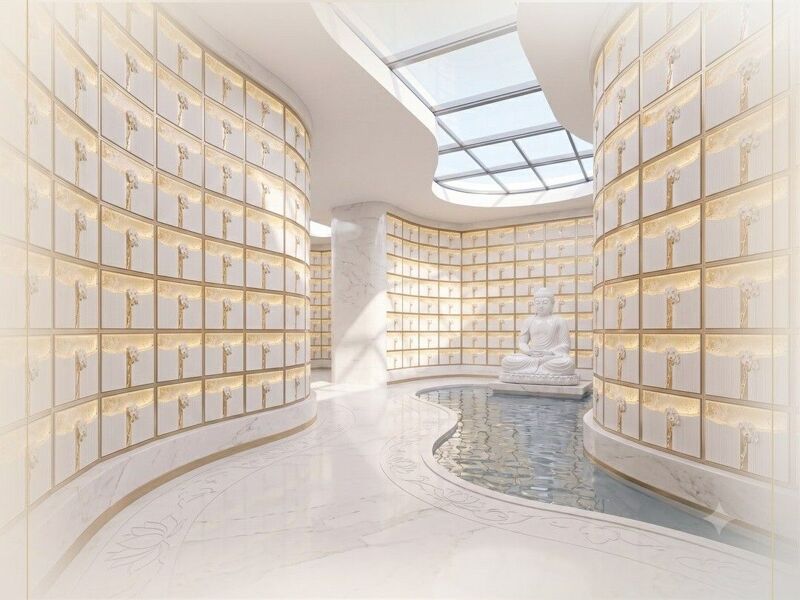
The handwashing area belongs inside the entrance before you enter the niche area. That is the only correct position.
It cannot come after the niche area — that makes the ritual run backwards. It cannot go inside the toilets; a toilet is an excretory space, and putting handwashing there strips the act of all its symbolic meaning. Nor can it go outside the door: the water freezes in winter, and nobody takes off their gloves to wash before going in.
The correct position: within 8 m of the columbarium entrance, parallel to the main aisle, so people can use it in passing. Keep at least 3 m from the first row of niches — splash and ash falling in front of a niche is the hardest kind of dirt to explain.
At a peak of 200 people, provide four taps Spacing 700, in a single row, or split into two groups of two.
Ritual handwashing is quick, 15–30 seconds faster than washing, so the count does not need to follow washroom standards. But drainage and splash control need to be better than a washroom, because the flow here never stops.
Counter height 800, a little above a domestic basin so you do not stoop. Basin depth 150; a shallow basin splashes less.
Use sensor taps rather than push-button. The reason is ash on the hands — press down and lift, and the handle is covered in ash, and the next person's hands are dirty too. Sensor taps make the columbarium handwashing area contact-free and the problem disappears. The weakness is batteries: specify mains power or long-life lithium, not the type you change every three months.
A 20 mm upstand at the front edge of the counter, sealed with silicone at the wall Floor falls 1% to the drain, trap depth 50 mm.
Do not enclose the space under the counter — columbarium handwashing areas often need to store buckets and cleaning tools, and an open frame with a cross rail is more practical and easier to service.
This is the core of columbarium circulation design. Four actions completed on one line, no crossing, no turning back.
The handwashing counter on the left of the aisle, the incense table 2 m ahead, the incense burner 2 m beyond that, the kneeling cushion before the Buddha. People walk through it in one movement.
The common mistake is putting the incense table behind the handwashing counter, so people turn around after washing and flick water on someone else. Or putting the burner beside the kneeling cushions, so smoke goes straight into the face of someone kneeling — that is exactly how the worst experience in a columbarium happens.
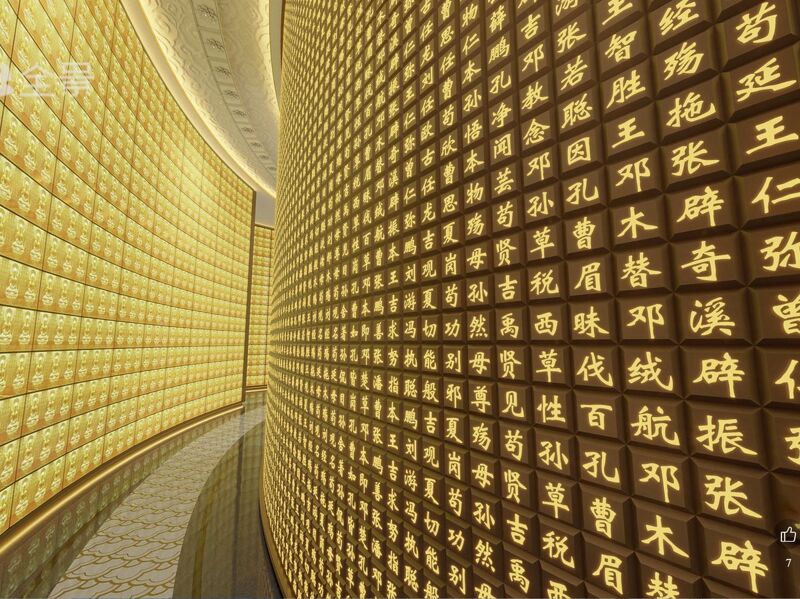
The floor of the handwashing area should be R11, one grade above the hall. This is the only place in the building that is permanently wet, and once the wet friction coefficient drops below 0.4, an elderly person turning will slip.
Drains no more than 6 m apart, pipe diameter 50 or above. Columbarium handwashing areas are constantly blocked by stems and ash, so fit stainless mesh baskets and clear them twice a day, or water pools and runs into the main aisle of the niche area.
Wipe the counter three times a day with a neutral cleaner. Do not use chlorine disinfectant on stainless long term — pitting starts within three months, and once a columbarium counter is pitted it never comes back.
Of the four taps, make the outermost one the accessible position: 650 clear under the counter, sensor tap, and 1.2 × 1.5 m of wheelchair space in front.
This costs no extra area — it only means omitting the cabinet under that section. Do it and a wheelchair user can perform the handwashing themselves; skip it and someone has to do it for them, and the sense of participation in the rite breaks right at the door.
Inlet water in winter can be as low as 5 °C. Without hot water, ritual handwashing is an ordeal. Fit a small instant heater, 3 kW, outlet at 38 °C, one per tap.
Do not use a storage heater — the capacity runs out and the second person gets nothing And do not set it too high: elderly people are less sensitive to temperature and above 42 °C scalding is easy.
Q: Can the handwashing area just be a stone bowl with a ladle?
A: Yes, but provide drainage and refill. A stone bowl is symbolically strong and practically hopeless — the water is cold in winter and needs changing a dozen times a morning.
Q: Can the water be recirculated?
A: Not advisable. The meaning of ritual handwashing lies in flow; recirculated water fails psychologically.
Q: Should there be paper towels?
A: Yes — a dispenser within 1.2 m at the side of the counter, with a lidded bin. No hand dryers: too loud, and jarring in a quiet place like a columbarium.
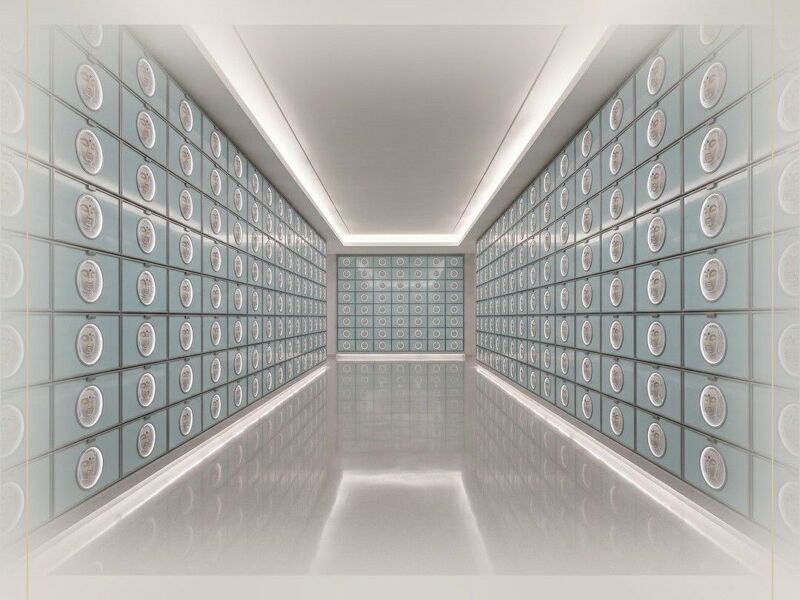
A columbarium handwashing area: 8 m inside the entrance, before the niche area, two taps per 100 people, 800 counter, sensor taps, 20 mm upstand, 1% fall, one accessible position, 38 °C water in winter. The sense of ritual in a columbarium is not built out of Buddha images and lighting — it is held up by this straight four-step line: wash, take incense, light incense, bow. Get the order right and the mind settles.






