WeChat: (+86)13978873330 Email: 381784025@qq.com

WeChat: (+86)13978873330 Email: 381784025@qq.com

"We used anti-slip tile" often means nothing in a columbarium because slip resistance is zoned: R10 is enough in dry areas, R11 is mandatory in wet areas, ramps need R12. One rule for the whole building means either not enough, or money wasted.
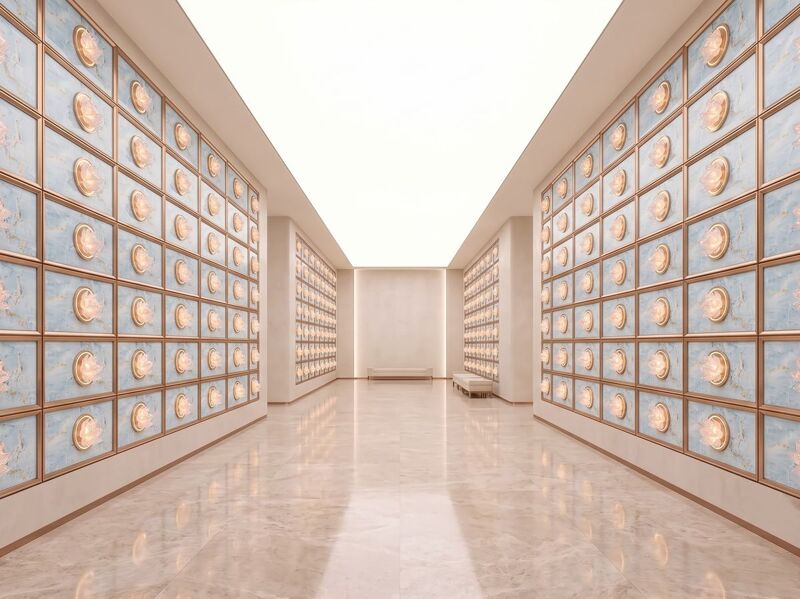
Dry areas in a columbarium (niche areas aisles) take R10. Wet areas (washrooms handwashing areas, flower preparation) take R11. Ramps external steps and showers (if any) take R12.
The split follows film thickness of water. Dry areas only see the occasional wet footprint, so R10 is enough. Wet areas carry a continuous film, and need deeper profiling to displace the water.
The R value comes from the German DIN 51130 ramp test: a person in standard footwear walks up an oiled incline, and R is the steepest angle at which they can still stand.
R10 is roughly no slip between 10 and 19 degrees, R11 between 19 and 27, R12 between 27 and 35. Higher numbers are more slip-resistant but also rougher and harder to clean.
A columbarium has to balance slip resistance against cleanability, which is the most practical trade-off in the design. Make the whole building R12 and the mop will not move; the floor ends up permanently dirty.
This is a number you can measure on site, and the one a columbarium should produce at handover. Use a pendulum tester (BPN) or a pull gauge; dry no less than 0.6, wet no less than 0.5.
At columbarium handover I would tip a bucket of water over the floor and walk it in flat shoes That is more convincing than a test report — the report is on a new tile, and the installed floor may have been waxed.
First, in front of the handwashing counter. Water drips off the counter and that square metre is permanently wet.
Second, at the washroom door. Wet soles carry water out and form a wet band within 1.5 m of the door.
Third, the entrance on a rainy day. Water from umbrellas and raincoats, plus a polished threshold stone, makes the most dangerous stretch in the building.
These three must be R11 with absorbent mats. The mats should be recessed into the floor (a 20 mm rebate), not laid loose — a loose mat slides, which is more dangerous than no mat.
If the wet areas cluster on the entrance side, the slip focus is that patch; if the washroom is deep inside the niche area, the wet band runs a dozen metres along the main aisle and the whole aisle has to be built to wet standard.
This is a planning choice: cluster the washroom, handwashing and flower areas within 15 m of the entrance and only that zone needs R11, with R10 elsewhere. Scatter them and the whole columbarium usually has to be upgraded, tripling the cost.
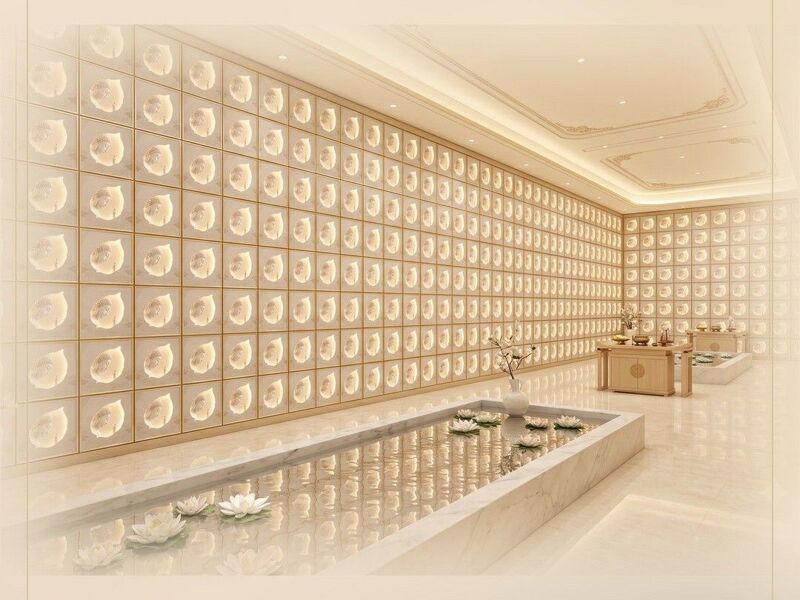
The "anti-slip coatings" on the market are essentially a resin with grit. Use one in a columbarium and it wears off in a year or two, and it yellows.
A yellowed coating looks worse than slipperiness. A columbarium floor has to last ten years; a coating only solves the problem on handover day.
The right approach is to solve it in the tile itself: fix the R value when you specify rather than choosing a gloss tile and looking for a fix afterwards.
First, the water walk. Pour 2 litres on the floor, walk 5 m at normal pace in flat shoes; no slip is a pass.
Second, pendulum BPN. A wet BPN of 45 or above corresponds to a friction coefficient around 0.5.
Third check the fall. Where the fall is under 0.5%, water will not drain and even the most slip-resistant tile will pond.
Six out of ten falls among elderly people happen at a level change, not from slipping. Keep level changes in a columbarium within 15 mm, and above that build a 1:12 slope.
15 mm is a height you feel but do not trip over. A 20 mm threshold stone is nothing to a young person and a wall to an elderly person with a walking frame.
A fall in a columbarium costs anywhere from tens of thousands to hundreds of thousands in medical bills and compensation, plus reputational damage.
Upgrading a wet area from R10 to R11 costs about 20–30 per m² in material difference — three thousand for 100 m². The arithmetic is obviously favourable; somebody just has to do it in advance.
Q: Is R11 tile hard to mop?
A: Harder than R10, but a scrubber-dryer solves it. Wet areas are small, so the impact is limited.
Q: Can stone be treated for slip resistance?
A: Yes, flamed or bush-hammered. Both are mechanical treatments and will not peel off like a coating.
Q: Do the mats have to be recessed?
A: At wet-area entrances, yes. A loose mat slides and curls, which is another fall hazard.
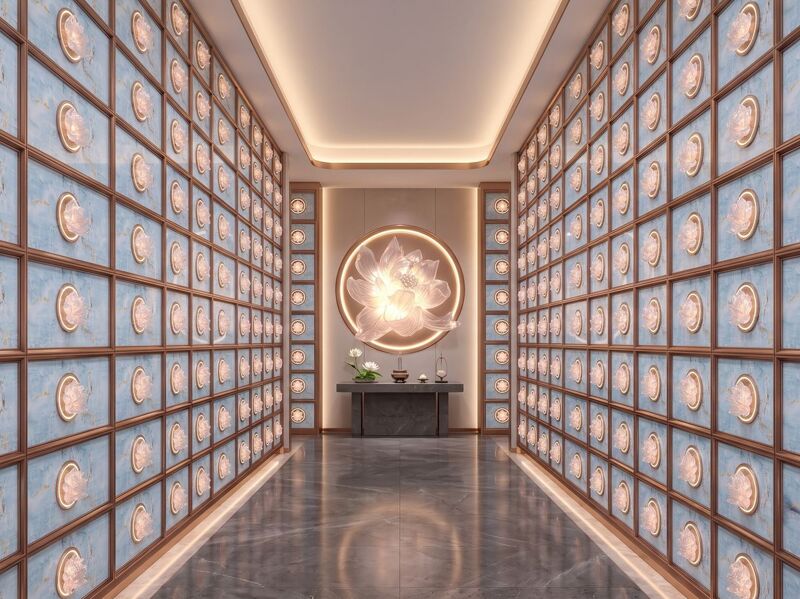
Slip resistance in a columbarium: R10 dry, R11 wet, R12 ramps, friction 0.6 dry and 0.5 wet, absorbent mats at the three critical points, level changes within 15 mm. Half the users are elderly, so slip resistance is not a finishing option — it is a precondition for the columbarium staying open. The money saved here will be spent again in another form.