
WeChat: (+86)13978873330 Email: 381784025@qq.com

WeChat: (+86)13978873330 Email: 381784025@qq.com

Door colour is the least technical line in a niche's cost yet it sets the first impression of the entire hall Light colours look generous and clean, and show dirt. Dark colours look settled and hide soiling, and weigh the space down. The real question is not which looks better, but which still stands up after twenty years several thousand openings and countless wipes.
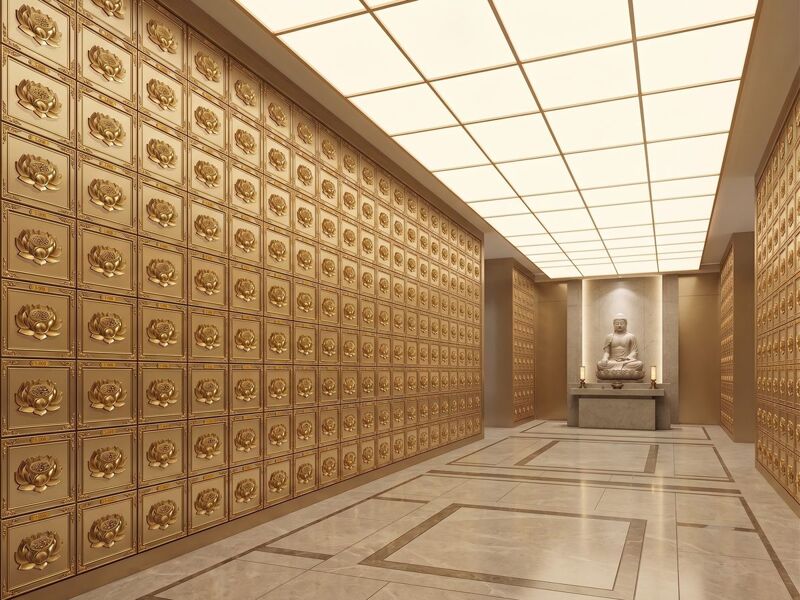
Light (off-white, pale grey, ivory): high reflectance, so the space reads brighter at the same illuminance, and a row shows as a continuous pale surface. The problem is that it shows dirt — fingerprints incense ash, mop splash, especially within 100 mm of the bottom edge.
Dark (walnut, deep brown, charcoal): reads settled, hides soiling, but absorbs light. A whole wall of dark niches at low illuminance merges into one black field, and even the number plates stop reading.
Neutral (champagne, titanium grey, warm grey): soil-hiding close to dark, reflectance close to light. The compromise. The drawback is that it can look characterless.
Choosing a niche colour is essentially positioning between bright and soil-tolerant. Neutral became the mainstream because it is not extreme at either end.
Choosing a colour from a swatch book alone is the most common mistake. The same off-white looks clean with a white porcelain urn and dirty with a dark jade one.
The right order is: urn tone first, then niche lining, then door panel The door is the outermost of the three layers, and its job is to frame what is inside not to compete with it.
A practical test: tape the swatch to a door and step back three metres. If the first thing you see is the swatch rather than the door, the colour is too strong.
Niche doors are powder-coated in batches, and batches vary visibly. The same "off-white" comes out yellow in one run and grey in the next, and on one wall that is two patches.
Control it with two numbers: ΔE as measured by a spectrophotometer, and the batch number. Below ΔE 1.5 the eye cannot tell; between 1.5 and 3 a trained eye can; above 3 everyone can.
So niche doors should be coated in one run, delivered in one shipment, with 5% held as spares. Doing it batch by batch, patching piece by piece, is the classic reason a columbarium wall ends up mottled.
They show dust. On an angled light, a dark surface reveals dust clearly, particularly along the top edge.
They show fingerprints. Matte dark shows prints more than gloss light, because the contrast is stronger.
They darken the space. A whole wall of dark niches reduces the perceived illuminance in an aisle by 20%–30%, and requires supplementary lighting.
Dark is not unusable, but it belongs in the background positions of a hall — the main wall, the wall behind a Buddha image, the family niche zone. Dark on both sides of an aisle is the combination most easily ruined.
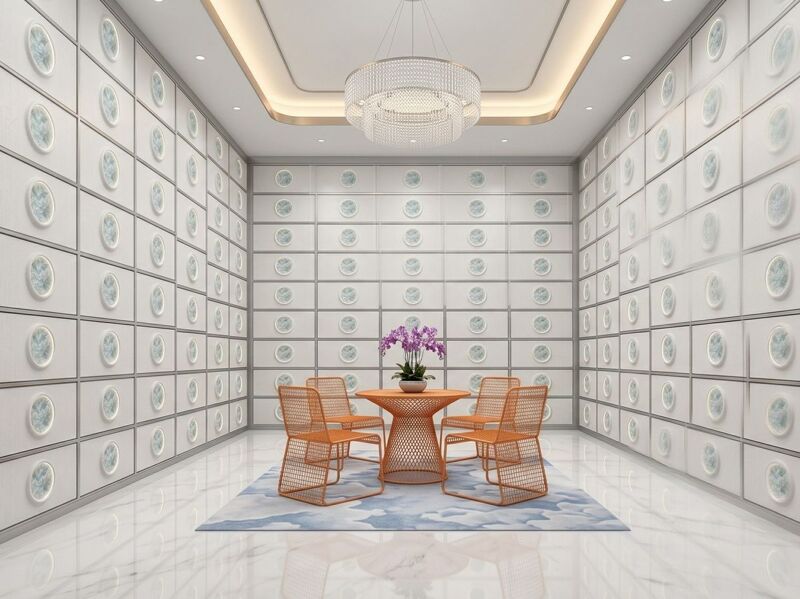
The same colour in matte and gloss are entirely different things.
Matte (gloss level 5–15): no reflection, reads as material holds fingerprints, but is the most durable-looking. The mainstream choice for niche doors.
Gloss (above 70): strongly reflective; a row becomes a sheet of highlights like a mirror wall, and looks cheap. Scratches on gloss are painfully obvious.
Fine texture: between the two, best scratch resistance, but dust settles into the grain.
A gold plate with red lettering reads most clearly on a light door; on a dark door it "floats" and competes for attention.
Colour temperature also changes how a door reads. 3000 K skews warm on off-white and cyan on cool grey. Choose the colour under the actual lighting, not under a fluorescent tube with a swatch book.
Standard zones: warm grey or off-white, matte, ΔE ≤ 1.5, coated in one operation.
Main walls and family niches: one step darker is fine, but the whole wall must match; do not interleave it with standard zones.
Not recommended: pure white, pure black, high gloss. Pure white greys at low illuminance, pure black crushes the space, and gloss turns the wall into a mirror. The closer a niche door colour comes to having no colour, the longer it wears well.
Q: Does door colour affect the price of a niche?
A: It does, but only marginally. Colour is part of the overall impression; what actually drives the price gap is position, size and hardware. Charging a premium for colour is a weak argument.
Q: Can each household choose its own colour?
A: No. The visual order of a hall depends on uniformity; one exception and the wall falls apart Distinguish family niches by frame or by size, never by colour.
Q: Can existing doors be recoloured?
A: They can be resprayed, but that means removing the door, stripping, respraying and baking — close to the cost of a new door, with colour matching hard to control. On a ten-year-old carcass replacing the face beats recolouring it.
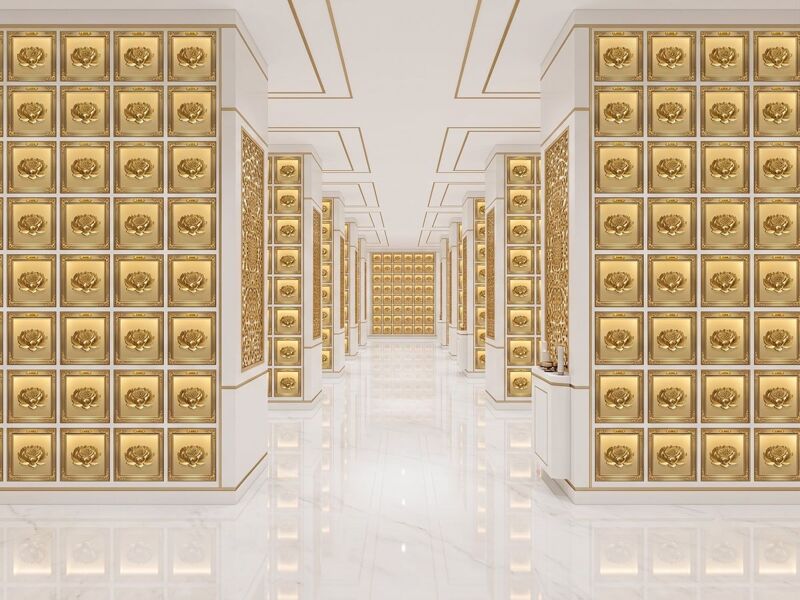
The colour of a niche door is a trade between first glance and twentieth year. Light looks good and is hard to keep dark hides soiling and eats light, neutral is extreme at neither end. What decides success is not the shade but colour-difference control, gloss level, and doing the whole batch at once The reason a columbarium wall wears well is rarely a clever colour choice — it is that not one panel was patched in later.






