
WeChat: (+86)13978873330 Email: 381784025@qq.com

WeChat: (+86)13978873330 Email: 381784025@qq.com

The line salespeople use most when showing you around is "this row is a view row". You follow their hand and indeed there is a window some trees, or a stretch of hillside.
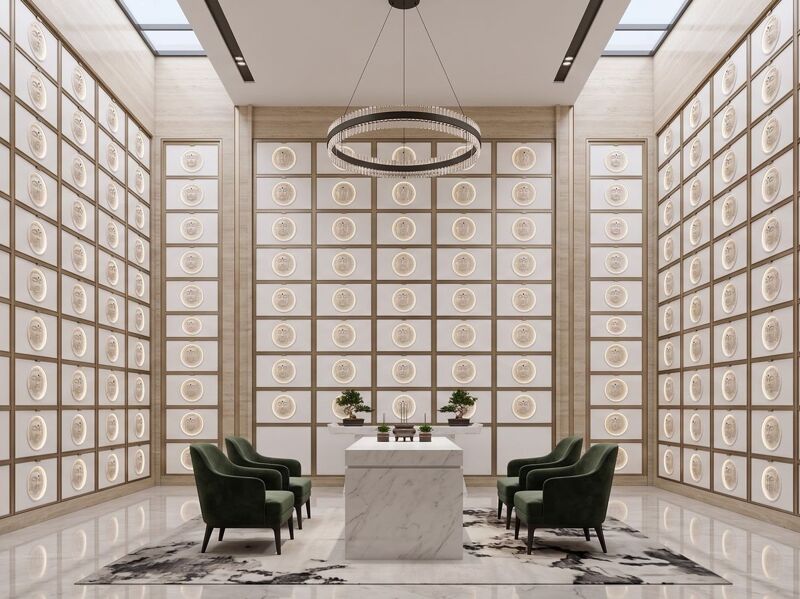
But a view from a columbarium niche is not the same as a view from a home You look at the home view every day; you look at the niche view four times a year. So the test for whether a view row is worth it has to change.
Three checks, two minutes.
Stand in front of the niche and look straight ahead. Does the sightline actually pass out through the window? Many so-called view niches let you see only the top edge of the frame when standing; you have to lower your head to see outside.
Check the window-to-floor ratio. Daylight area divided by floor area. Below 1:8 the view is effectively void — light comes in, the view does not.
Check for obstructions. Adjacent buildings, billboards, equipment platforms can all cut the view. Above the second floor the effect is smaller than at ground level, but billboards and tree canopies frequently sit at exactly this height.
If any one of the three fails, the "view row" is merely a "window row", and the premium should be priced as window, not as view.
First: something to look at while waiting. Families typically spend fifteen to forty minutes in a hall most of it waiting — for people to arrive, for the ceremony for incense to burn down. Having something to look at eases the restlessness of waiting.
Second: relieving enclosure. Most halls have no windows or very small ones, and people feel stuffy after a while. A view gives an "outlet", and that is real psychological value.
But note: both values depend on being able to stay. If the niche is on the main aisle with heavy traffic, the family cannot stand there at all, and no view will help.
West sun. On a west-facing view niche afternoon sun drives panel surface temperature 8 to 12 degrees above ambient. Under sustained direct sun, laminated panels visibly fade in five to eight years.
Condensation. On an exterior wall, the inner surface is cold in winter and moisture in the hall condenses there. If the back panel is against the wall with no 50 mm cavity mould starts from the inside of the panel.
Dust. Window sills and window joints collect dust; on window-side niches the upper edge of the door panel shows it most. In facilities that clean infrequently this is very visible.
These three do not mean "do not buy" They mean "if you buy, protect it": external shading, back panel cavity, window joint sealing — all three, no omissions.

From transactions I have seen, window-side niches commonly run 10 to 20 per cent above inner ones. Broken down:
- Pure daylight (window but no view): 5 to 10 per cent - View with clear sightline: 10 to 20 per cent - View, shading, and back panel cavity: 20 to 25 per cent
Above 25 per cent, you are being sold "feng shui" or "rarity". You are free to decline.
Conversely, if the niche faces west with no external shading, it should be cheaper than an inner niche, not dearer — because it carries higher maintenance cost.
Three kinds.
Those with short visits. Incense, fruit, a bow, ten minutes, done. The view goes unused.
Those where visitors are mainly elderly. Elders care more about "can I sit down" and "can I reach it" than about what is outside the window.
Families living far away. Coming back once or twice a year dilutes the psychological value of the view.
Conversely, if an elder needs to stay a long time — a full chanting session, for instance — or the family always sits for a while, the view is worth the money.
Q: Are view niches damper?
Exterior-wall ones are, depending on whether there is a back cavity and wall insulation. Establish the detailing; it matters more than the view.
Q: What is a "view" in a windowless hall?
Mostly interior landscaping or lighting effects. The value there depends entirely on design quality; judge it on site rather than from drawings.
Q: Will a view niche resell easily?
There are buyers who value it, but the premium will not be recovered in full — usually it reprices as a window niche.
Q: In one hall, which row has the best view?
The row at eye height, 1.4 to 1.6 m. Below that you look at a dado or shrubs; above it you see canopy or sky.

Whether a view niche is worth it depends on whether you can stand in front of it for twenty minutes. If you can, the view is real. If you cannot it is just a window. Before buying do one thing: stand quietly in front of that niche for ten minutes and see whether you feel like looking out. That answer is more accurate than any presentation.






