WeChat: (+86)13978873330 Email: 381784025@qq.com

WeChat: (+86)13978873330 Email: 381784025@qq.com

A QR code has exactly one use in a columbarium: sparing someone a walk back Placed well, one scan tells you where you stand and where to go; placed badly, it is a cluster of black squares nobody scans.

Columbarium codes come in three levels each in a different place.
The zone code goes at each zone entrance 200 × 200 mm, opening a plan of that zone. The row code goes at both ends of each row, 80 × 80, opening the position distribution for that row. The position code goes on the corner of the door panel 30 × 30, opening the details and visiting notes for that one niche.
The benefit of three tiers is that each works locally: scan the zone code at the zone entrance, the row code at the row end, the position code at the door. Nobody has to walk back to the master index.
The zone code should be centred 1.3–1.5 m above floor, scannable standing or seated. Lower and you stoop; higher and you raise the phone.
The row code goes on the side panel of the first position at the row end, at 1.2–1.4 m. The position code goes at the top left of the door panel, about 1.4 m — below 1.2 m it gets hidden by trolleys.
Do not put the position code in the centre of the door. The centre is the visual focus, and a black square there destroys the quality of the panel.
The minimum side length depends on scanning distance. A 30 × 30 position code in a columbarium is scannable within 30 cm; an 80 × 80 row code within 1 m; a 200 × 200 zone code within 3 m.
Codes under 25 mm are hard for a phone to focus on, especially in the dim light of a columbarium. Do not shrink the code to keep it inconspicuous — a shrunken code is a wasted code.
Basement columbaria often have no signal. What the code opens is a static page, and it must open with no network.
Package the plan and the position data into an H5 app deployed alongside the codes, cached locally on first open. The columbarium requirement is "on screen within 2 seconds"; past 3 seconds and people give up.
Three things after scanning: current location target location, and a walking route ("8 m ahead, turn right to the 3rd row").
No promotions, no panoramic tours, no video. The scanning context in a columbarium is "standing in an aisle hands full, someone waiting behind you" — any extra content is a burden.

The position code must not display the deceased's name or dates, only the code and the visiting notes.
The reason is concrete: a columbarium is semi-public, and anyone with a phone could read another family's information. That is a privacy incident. Showing names requires an authentication layer (family account login), which is costly and low-yield.
Use weather-resistant PVC, etched metal, or internally engraved acrylic A paper sticker lifts within three months in damp conditions.
Etched metal is the most durable and the most expensive; laminated PVC is the best value and lasts about five years Position codes in a columbarium number in the thousands, so a five-yuan unit difference is tens of thousands — choose by budget.
Once a columbarium code is applied, assume it stays for ten years. So the code carries only the position identifier — the content lives in the back end and changes take effect immediately.
This matters: if the route text is baked into the code, any layout change means reprinting every code in the building.
Beside the QR entry point there must be a plain-language line: "If you need help, please ask at the service desk."
Add a physical button or service bell that summons a person. Any technology in a columbarium must always keep a route back to a human.
Q: Does a QR code look undignified?
A: Position and colour decide that. Dark grey ground no border, placed unobtrusively, and the panel still reads as a whole.
Q: Should there be a mini program instead?
A: Possible, but a mini program needs authorisation and loading, so it is slower than H5. In a columbarium, prioritise H5.
Q: What if someone sticks advertising over the code?
A: Use tamper-evident plates that are destroyed on removal. Codes being covered over is a routine maintenance problem in columbaria.
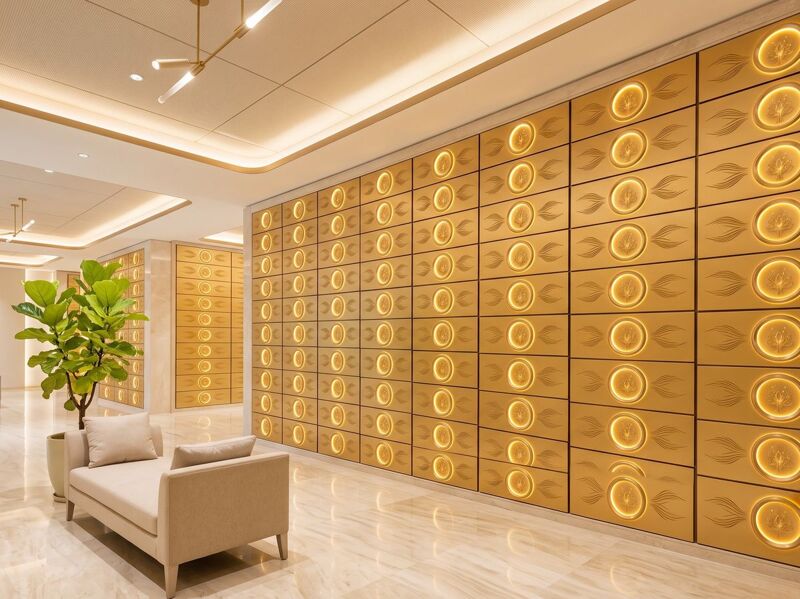
QR codes in a columbarium: three tiers (zone 200, row 80, position 30), zone codes at 1.3–1.5 m, position codes at the top left of the panel and never in the centre, offline with under 2 seconds to display, route only and no names, weather-resistant material fixed code with changeable content, and a line beside it saying "ask at the service desk." The last hundred metres of "findable" rest on that 30 mm square — provided it scans, opens, and explains.