WeChat: (+86)13978873330 Email: 381784025@qq.com

WeChat: (+86)13978873330 Email: 381784025@qq.com

In the same grounds, outdoor relative humidity reads 70 percent and inside the columbarium it measures 78. The instrument is not broken; the building is producing moisture itself. Moisture in a columbarium never arrives by one path — it comes in three at once and is then stored up by a sealed space.

People release moisture continuously indoors. A seated adult exhales and evaporates about 40 to 60 grams of water per hour, and over 100 grams when moving about.
Five hundred families on a Qingming day, at 2.5 people per group and an average stay of 40 minutes, brings in roughly 33 to 50 kilograms of water in a day.
Add cut flowers, fruit and liquid offerings A bunch of lilies in water evaporates 100 to 200 grams in a day; a bowl of hot soup gives off 50 grams in half an hour.
All of that water ends up standing in the aisles between niches and is slowly drawn into the gaps around niche doors.
Concrete is porous. Above the water table, moisture in the soil migrates indoors as vapour; for a 1,000 square metre columbarium, the transmission through walls and floor can reach 20 to 60 kilograms a day.
This path is the best hidden: the wall feels dry to the touch while its moisture content sits above 8 percent year round. By the time the wallpaper blisters and the skirting goes black, it has been infiltrating for two years.
The column of niches against the external wall is where problems appear first. Behind that column is usually backfill, with humidity above 85 percent all year.
Floor condensation is caused by temperature difference, not by leakage. When the floor temperature is 1 to 2 degrees Celsius below the dew point of the indoor air, water in the air condenses on the floor.
Columbarium floors are mostly stone, with high thermal inertia and slow warming. At the turn of spring into summer the outdoors warms quickly while the floor is still cold, and condensation is at its worst.
It is most obvious in first-floor and basement niche zones. Above the second floor the problem largely disappears, and that is the physical basis behind the saying "choose high, not low."
Three reasons.
First, sealing. A columbarium controls temperature and humidity, so doors and windows stay shut year round and the air change rate is low; moisture cannot get out.
Second, low temperature. Air conditioning set at 26 degrees Celsius in summer is 6 to 8 degrees below outdoors, and wall surface temperature is lower still, so condensation forms more readily.
Third materials. Niche carcasses are mostly galvanised steel or aluminium, metals conduct heat quickly, their surface temperature tracks the wall, and they are the first place to condense.
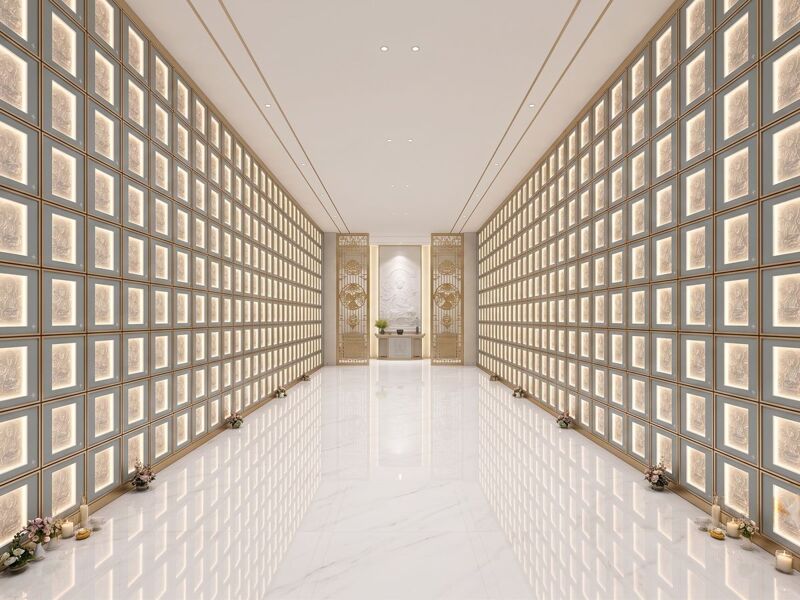
Three steps will locate it.
Step one, measure relative humidity at three points: outdoors, the centre of the hall, and in front of the niches against the external wall. If the centre is high and the external-wall side is higher, it is wall transmission; if the two are close, it is moisture carried in the air.
Step two, feel the floor. A floor that gleams with fine beads of water in the early morning is condensation; a floor that is dry while the wall base is wet is wall transmission.
Step three, look inside the niche. Beads on the inner face of the door panel and whitening at the seal mean condensation inside the niche; water marks only on the outer face mean the external environment.
Step four, watch the timing. Worst before ten in the morning and easing in the afternoon is condensation; heavy all day and not receding after the rain stops is the wall; heavy only on the crowded days is water brought by people.
My recommendation is this: block first, dehumidify second. Blocking means waterproofing, a damp-proof membrane and sealed door gaps; dehumidifying means the plant. Get the order wrong and the dehumidifier will pull water in from outside twenty-four hours a day.
Here is a verifiable acceptance criterion: after three consecutive days of rain, relative humidity inside the columbarium does not exceed 65 percent, and there are no beads on the inner face of the door panels in the row against the external wall. If it fails, the blocking was not done properly.
Keep the data. Record temperature and humidity once a day at nine in the morning, for a whole plum-rain season, and it becomes obvious which column is dampest and which hours are worst. Treating damp by feel means permanent rework.
Count the cost too. A 30 kilowatt dehumidifier running continuously for a month costs 15,000 to 20,000 yuan in electricity, and that money lands in the management fee.
Q: We installed a high-capacity dehumidifier — why is it still damp?
A: Because the water is still coming in. Dehumidification only means something when it exceeds the infiltration rate. Block first, then extract.
Q: Do desiccant packs inside a niche help?
A: In the short term, yes; they saturate within three months. It is a remedy, not a solution.
Q: How much damper is the first floor than the third?
A: Measured, usually 8 to 15 percentage points higher. That is one reason first-floor niches are cheaper.
Q: Can flowers come into the hall without water?
A: Better to strip the water at the entrance and wrap in absorbent paper. That alone removes a large part of the moisture brought by offerings.

Damp in a columbarium is 40 to 60 grams of human moisture, 20 to 60 kilograms of wall infiltration and 1 to 2 degrees of floor temperature difference three paths stacked. What a niche fears is not one flood but the little that seeps in every day — it makes no sound, but ten years on the niche door panel will speak for it.