WeChat: (+86)13978873330 Email: 381784025@qq.com

WeChat: (+86)13978873330 Email: 381784025@qq.com

Many people turn away from a niche with red eyes, disordered hair and incense ash on their hems. Before walking out of the columbarium they need somewhere to pull themselves back together. That act is called making good, and it needs no more than two or three square metres.
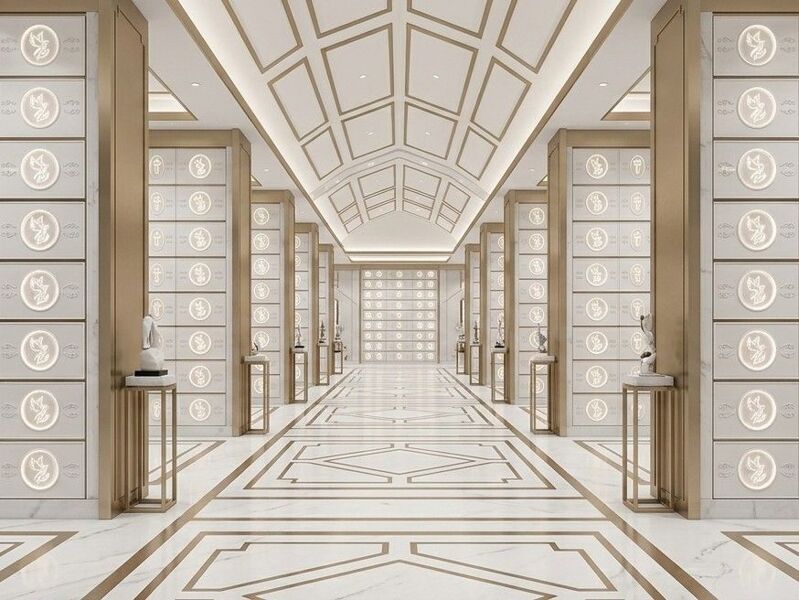
The function of a making-good area is "tidy yourself before you leave," so it can only be on the exit side.
Put it at the entrance and nobody has anything to tidy yet; put it at the entrance and a family does their make-up before observing, then comes out rumpled anyway.
Within five metres of the exit is best. Beyond ten metres, people walk straight past because they are rushing for transport, and the clothes they just set right in front of the niche are disordered again.
The bottom edge sits 0.9 metres above the floor and the top edge at 1.9 metres, covering a standing person from upper body to face.
Do not use a full-length mirror. A full-length mirror at a columbarium exit makes people stop unconsciously to adjust their clothes; five minutes per stop and the exit jams.
Set illuminance in front of the mirror at 300 lux, with a light source of CRI 90 or above. The lighting in the niche zone is warm and dim, and people look tired to themselves under it; the light at the mirror has to be accurate.
Yes, especially in the south.
Columbarium basins are usually next to the mirror, and once hot water runs, the mirror fogs within thirty seconds. Anti-fog film or a heating element behind the glass both solve it, at 100 to 200 yuan per mirror.
One more rule: the mirror should not face the toilet door. It is the most commonly made basic error in a columbarium, and expensive to correct later.
Basin bowl depth should be no less than 180 millimetres A shallow bowl splashes water onto the counter and clothes, and families end up washing while dodging.
Use sensor taps. Incense ash gets on the hands in a columbarium, and turning a tap handle soils the handle so the next person will not touch it.
Counter height 800 to 850 millimetres, with 650 millimetres of knee space underneath so a wheelchair user can pull in.
Drainage needs a trap plus a strainer basket. Incense ash, petals and paper scraps go down mixed with water and block the pipe within three months. Once a columbarium basin starts to smell back, the whole exit passage is affected.
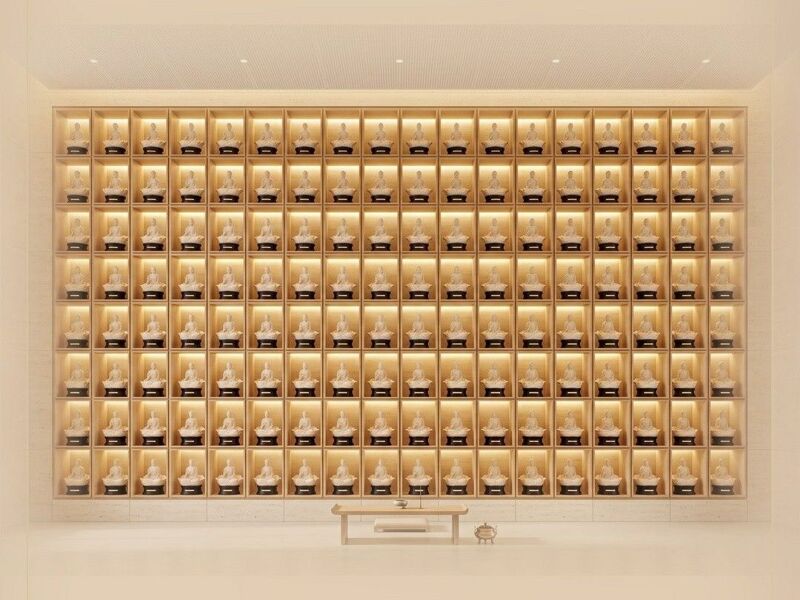
Provide one basin position per 100 people present at the same time, split evenly between men and women. Almost everyone using them has just risen from a niche, with incense ash on their hands.
A columbarium peaking at 500 people on Qingming needs five basin positions, one of them at low height — bowl rim at 750 millimetres.
Counter length at 600 millimetres per basin position: five positions make three metres. Those three metres are best as one straight run, not an L. The corner of an L is where queues form most readily.
Do not put tissue boxes, diffusers or plants on the counter. All three become dirty and messy very quickly at a columbarium exit.
Put out two things instead: a lidded bin (600 millimetres high, foot-operated), and a shelf (400 millimetres wide) for bags and umbrellas. Leave 200 millimetres of clear counter for people to set down flowers from a niche temporarily.
Add a narrow 100 millimetre shelf in front of the mirror for glasses and phones. Glasses taken off to kneel in front of a niche all end up lost here.
Schedule cleaning hourly. At the Qingming peak, every thirty minutes, focusing on standing water on the counter and the bin. Once a making-good area is dirty, families walk around it, and all the mirror and lighting work in front of it is wasted.
My recommendation is this: build a two to three square metre making-good area within five metres of the exit, with a 1.2 metre mirror, two basins and one bin, at 300 lux.
I do not recommend turning it into a luxurious powder room. The making-good area in a columbarium is not for touching up make-up; it is for wiping away tears and pulling clothes straight. The simpler the function, the more at ease people are using it.
If the exit genuinely has no three square metres, fall back to a minimum configuration: a 0.8 metre mirror, one basin and one bin, built against the wall, occupying 1.2 square metres. The farewell in front of a niche only needs thirty seconds of tidying; it need not wait for a complete room.
Q: Can the making-good area be merged with the washroom?
A: Yes, but move the basins to the outside of the washroom to form a semi-open anteroom.
Q: Should the mirror be a large joined panel?
A: Not advisable. A large mirror makes the space feel bigger and also makes people linger. A single 1.2 metre mirror is enough.
Q: What if there is no room at the exit?
A: Convert one row of niches on the exit side into the making-good area. Two niches traded for three square metres is usually worthwhile.
Q: Does the area need a chair?
A: Put in a bench 400 millimetres high Elderly visitors need to sit to put shoes on and tie laces, and standing they fall easily.
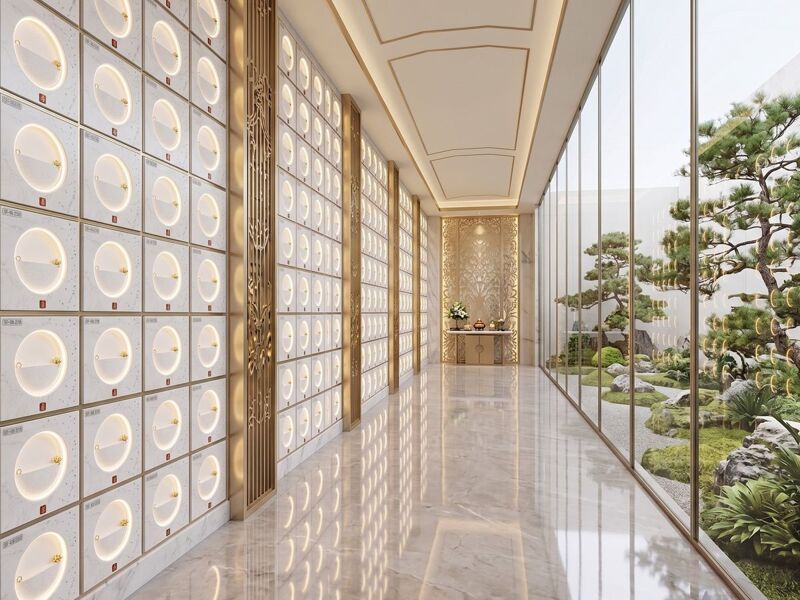
The making-good area comes down to five numbers: within five metres of the exit, a mirror 1.6 to 1.8 metres high, 300 lux, a bowl depth of 180 millimetres, and one basin per 100 people. The niches in a columbarium carry the farewell; the making-good area carries the dignity after it — it says nothing, but everyone who has used it remembers.