
WeChat: (+86)13978873330 Email: 381784025@qq.com

WeChat: (+86)13978873330 Email: 381784025@qq.com

The contemplation corner is the easiest thing in a columbarium to turn into an ornament: a bench, a framed piece of calligraphy, a pot of orchids, and it looks deeply ceremonial — and nobody sits there. The reason is nearly always the same: it was put in the wrong place.
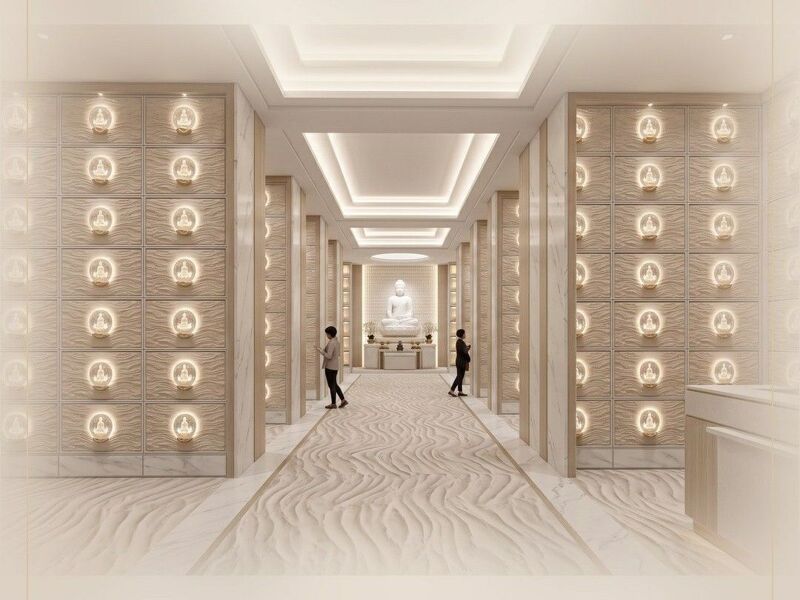
People visiting a columbarium carry three moods: bereaved, observing, passing through. A contemplation corner serves the share of the first two who want to sit for a while.
That share is small. In a columbarium of 5,000 niches, three to five people on an ordinary day stay in the hall more than 20 minutes; at Qingming it rises above fifty.
So the corner need not be large. One or two settings, each with two or three seats, six seats in total, is enough.
The worst place for a contemplation corner is against the main circulation With people passing, the person sitting becomes more tense, not less.
The right location is more than 8 m from the main route, with a glimpse of greenery or sky, and outside the direct sightline of any row of niches.
The best spots are the end of a block or a corner. An end has traffic on one side only; a corner forms a partial enclosure, and a person feels held.
The worst spot is the centre of the hall. An island arrangement looks generous, but people pass on all four sides and sitting there feels like being on display.
Bench dimensions matter. Seat width not less than 600 mm, seat depth 450 mm, seat height 420–450 mm.
Leave 900 mm of circulation behind. Below that, whoever sits has to keep getting up to let people squeeze past.
Leave 600 mm in front for the feet. Add the two and a three-seat contemplation corner occupies about 3.6 m².
Keep illuminance at 150–200 lux — a notch below the 150–200 lux in front of the niches, close to a room at dusk.
The source must not shine into faces. Use indirect lighting: concealed behind the low wall at the back of the seat, or washed onto a wall and reflected down.
Corners with daylight are the most popular. If the columbarium has a light well, put the corner beside it; by day almost no lamps are needed and dwell time doubles.
Columbaria tend to have hard floors and hard walls, with long reverberation. A contemplation corner in that kind of space amplifies other people's footsteps.
Two remedies: 10–20 mm of soft upholstery or perforated timber panel on the wall behind the seat to absorb mid and high frequencies; and a 2 × 3 m rug on the floor to tame footfall.
These two small moves do far more than a background music system. In a columbarium background music usually becomes the noise source.
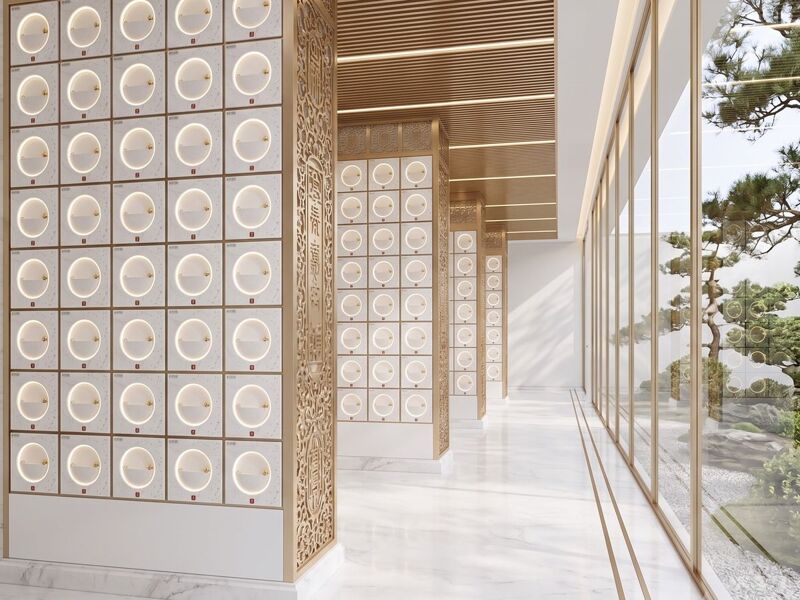
A contemplation corner is not a chapel. Put a Buddha image and an incense burner in it and the place becomes a second observance area: people come to offer incense, people come to kneel, and the contemplative function disappears.
The right form is: a bench, a plain wall, a plant that does not shed, and a lamp that can be switched off.
If a line of text is wanted, keep it under twelve characters. More than that and the reader is reading, not settling.
My advice: provide one contemplation corner per 3,000 niches, fewer rather than more; site them at the ends of blocks and beside light wells, never in the middle of the hall; no incense burner, no donation box.
If area is tight, fold the corner into a part of the rest area rather than partitioning off a small dark room — partitioned contemplation rooms mostly become store rooms.
Plants are good, too many are a nuisance. Light in a columbarium is usually insufficient, so choose shade-tolerant species: a 1.2–1.5 m moss pole, a monstera, or a podocarpus in a pot, rotated every three months. Use clay pebbles or hydroculture: light, clean, no insects.
Keep the air clean. No incense in the corner, and no diffuser either — the two smells mix with the niche zone and go stale. If air needs treatment, use fresh air, not scent.
Put the contemplation corner at the edge of a niche zone, not in the middle.
There is a practical benefit to the edge: from the niches it is a dozen steps away, so people will actually go. In the middle, with niches on both sides, the person sitting feels like a guest in someone's home.
Do not put it at the exit either. Exit traffic is the most hurried, the seated person is interrupted repeatedly and does not last three minutes.
The right distance: 5–10 m from the nearest niches, more than 15 m from the exit, with a low wall or a run of cabinets in between. When the seated person looks up, they should see a wall or a plant, not a whole row of niche numbers.
Q: Does a contemplation corner need its own area calculation?
A: It needs no separate room, but it counts as public area. Allow 3.6 m² per setting and provide one or two.
Q: Can music be played?
A: Very low-level natural sound, not above 40 dB. Music with voices or melody is not advisable.
Q: How can an existing columbarium add one?
A: The cheapest way is to take the position of two niches at the end of a block and convert it to seating and a low wall. It costs less than building a room.
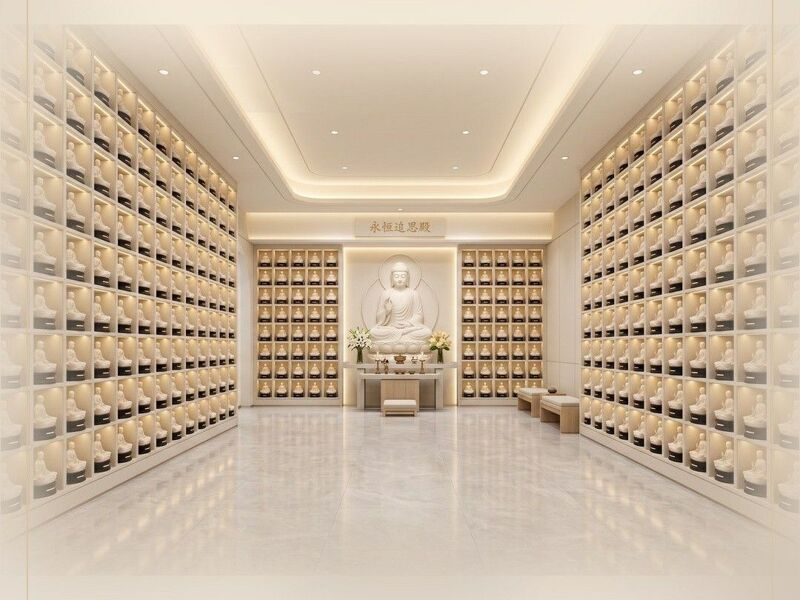
The contemplation corner comes down to four numbers: one or two settings, 3.6 m² each, 8 m from the main route, 150–200 lux. It costs very little, and the price of getting it wrong is also small — it is simply never used. The most expensive thing in a columbarium is never the material; it is the corner that was built and never occupied.


