WeChat: (+86)13978873330 Email: 381784025@qq.com

WeChat: (+86)13978873330 Email: 381784025@qq.com

In an open columbarium someone is always walking past while a family observes. For most families that is fine. For three groups it is a hard requirement: the recently bereaved, families whose elders weep openly, and those performing specific rites. A private room exists for those three situations.
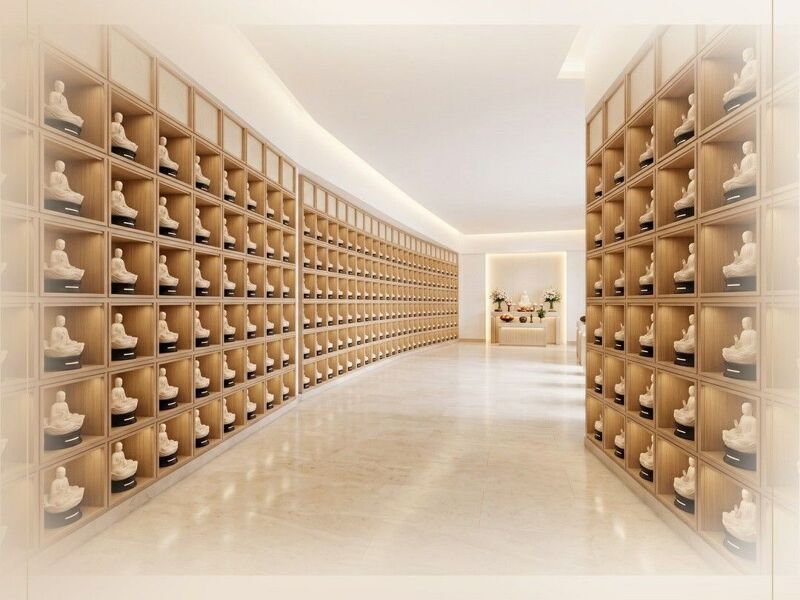
Below 6 m², standing up from kneeling hits the wall. Above 10 m², utilisation falls.
Six square metres takes an offering table 900 mm wide, two kneeling cushions, and a 1.2 m aisle. Eight adds two stools and a basin. Ten or more allows a shrine wall, but it also means the room is used two hours a day and empty the rest.
Provision against total niche count: one room per 1,000 niches is not enough around Qingming; two per 1,000 turns over adequately.
Half the value of a private room is not hearing what is outside.
A 200 mm aerated concrete block wall, plastered both sides, gives about 45 dB airborne sound reduction; a twin-leaf stud wall with insulation reaches 50 dB or more, but the door is the weak point.
Use acoustic doors and hold the internal level below 35 dB with the door closed. That figure is not arbitrary: 35 dB is close to a quiet bedroom, so speech inside is not heard outside, and weeping inside does not carry into the niche zone.
Provide two lighting levels: 150–200 lux at the shrine, around 100 lux at the offering table, each on its own switch.
A single ceiling light is the commonest error. Switch it on and faces go pale and families do not linger; switch it off and nobody can find anything Fit a spotlight at the shrine and a dimmable downlight overhead, on two circuits.
A window is not essential. If there is one, fit a blackout blind at 90% or better — sunlight falling across the room halfway through a rite breaks the moment.
Some columbaria offer "inviting the niche into the private room", meaning the urn is temporarily removed. This can be done, with two limits.
First, the movement is not more than 30 m, with a member of staff carrying it throughout, never laid flat, never set on the floor.
Second, no more than two such transfers a day. Niche seals and linings age quickly with repeated opening; each wax seal is thinner than the last.
My advice: put a tablet or a photograph in the private room, not the urn. That satisfies the rite without disturbing the niche itself.
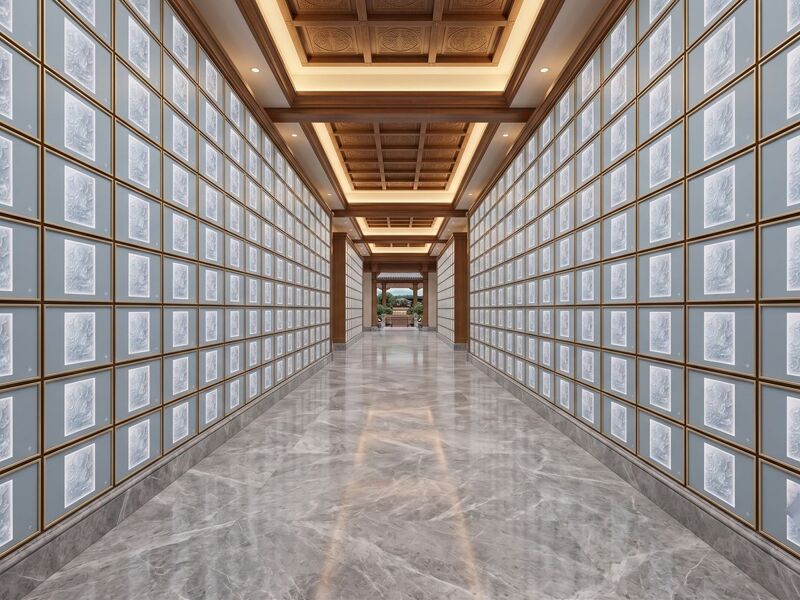
Private rooms must be booked and time-limited. Forty-five minutes is the industry norm: 30 minutes of rite, 10 minutes to tidy, 5 minutes buffer.
With 500 families on Qingming day and 10% needing a private room, that is 50 sessions. At eight sessions a day per room, you need seven rooms. That usually exceeds the owner's expectation, which is why provision must be calculated on peak, not on an ordinary day.
Use matt tiles on the floor with narrow joints. Once incense ash lands, timber floor joints never come clean and go black within three months.
Make the offering table top in solid surface or timber with a laminate face, with a 20 mm upstand at the edge. Candle wax on the top lifts off with a plastic scraper once cold; wax on fabric ruins the fabric.
Allow 10 minutes of cleaning between sessions. Write it into the cleaning rota, or the next family walks in to the previous family's ash.
A private room should not be against the main circulation nor too far away.
Against the circulation, and no amount of acoustic treatment stops the footfall. More than 60 m from the niche zone, and the family must carry the tablet across the whole columbarium, and the sense of rite is diluted by the walk. Twenty to 40 m is the comfortable range: a minute's walk, enough for the mood to shift, without leaving the floor.
Keep the entrance out of the main sightline. Put it at a corner of the niche zone so people entering and leaving are not watched from rows of niches. That is the first step to privacy.
On a floor with no lift, put a private room at ground level. When elders cannot manage stairs, one ground-floor room saves an entire ceremony.
Q: Should private rooms be charged separately?
A: Most columbaria charge per session; some include it in the management fee. Charging controls turnover; free rooms are often occupied for long periods.
Q: Can two rooms be made combinable?
A: Yes, with a movable partition between them. Open it for a large family, keep them separate day to day. This is the most area-efficient solution.
Q: Should a private room have a basin?
A: Above 8 m², yes. Washing hands after the rite is a genuine need, and sending a family across a floor of niches to find a washroom breaks the experience.
Q: How can a columbarium without private rooms add them?
A: Convert a 10 m² store. The three essentials are the door, the acoustic separation and independent lighting.

Private rooms come down to five numbers: 6–10 m², 35 dB, 150–200 lux, 45 minutes per session, and two rooms per 1,000 niches. They generate no direct income, but they decide whether a columbarium can hold a family together on its hardest days.