WeChat: (+86)13978873330 Email: 381784025@qq.com

WeChat: (+86)13978873330 Email: 381784025@qq.com

They are the same thing. The underground crypt fuyi is a mainland Chinese term, while the columbarium niche and nagu niche are more common among Southeast Asian Chinese communities; all refer to a systematic rack of compartments for cremated remains, known in mainland industry as an urn storage rack. The difference lies in the name, not the product. On first use, it is worth stating plainly that a columbarium niche, an urn storage rack, a nagu niche, a fuyi and a lotus niche all describe one category of compartment for remains or memorial tablets.
Each pair of terms describes half of the same object. The underground crypt (digong) names the building — an underground or semi-underground placement space — while fuyi names the unit, one compartment within it. Likewise, linggu ta and nagu ta name the building form, a tower or hall-style structure of several placement levels, and tawei names the unit. Once this is clear, the vocabularies map onto one another.
Mainland 'digong' or crypt zone corresponds to Southeast Asian linggu ta, nagu ta or nagu hall: the building space.
Mainland fuyi or fuyi compartment corresponds to columbarium niche, nagu niche, lotus niche or urn alcove: the individual compartment.
Mainland fuyi rack or urn storage rack corresponds to lotus-niche rack, urn cabinet or niche pavilion: the frame carrying the compartments.
Mainland tablet zone or ancestral hall corresponds to the ancestral tablet hall: the area for worshipping tablets.
A buyer who looks only at names can easily imagine two different products on the table. Set out a mapping like the one above and the two sides usually align within a few sentences.
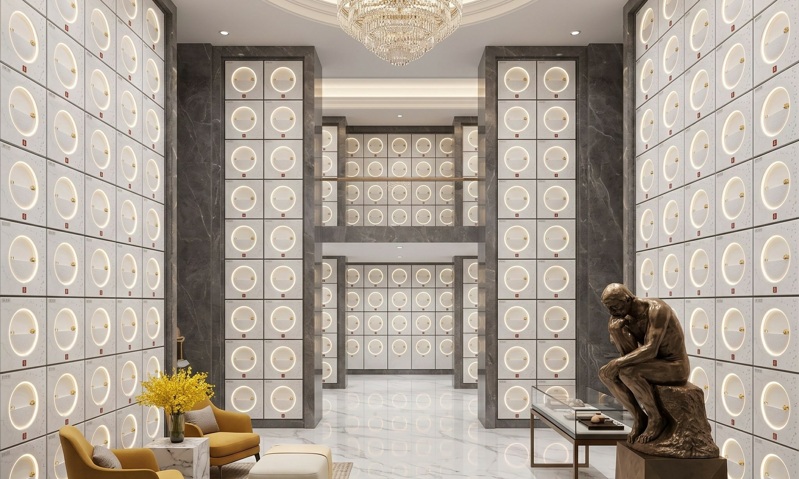
There are roughly three layers of explanation. The first is building form. Mainland crypt projects frequently convert a temple's existing basement, air-raid shelter or newly built underground level — low spaces, many columns, no natural light, with a design that must work around structural columns. Southeast Asian linggu towers are more often freestanding buildings or annex floors of a guardian hall, with generous height and racks that can line all four sides, which naturally produces a different layout.
The second is language habit. As mainland funeral services became commercialized, the industry favoured elegant terms such as fuyi and fudi, hiding the function inside auspicious words. Southeast Asian Chinese communities more often use direct functional terms: nagu means receiving remains, and tawei means a position in the tower. The third is industry origin. Much of the mainland storage-rack trade grew out of metal furniture, archive compact shelving and warehouse racking, so its vocabulary is built on uprights, beams, shelves and load ratings. The niche tradition in Southeast Asia comes from stonework and temple construction, with a vocabulary of niches, pavilions and door panels. Two sets of words reflect two different craft backgrounds.
Whatever name is attached to it, a niche drawing must fix four things. First, the internal clear dimensions of each compartment, enlarged with margin from the outline of the urn box rather than waved through with the phrase standard unit. Second, the load rating of a single compartment, which directly determines the cross-section of uprights and the specification of connectors. Third, the material of the box and panel — galvanized sheet, aluminum profile or wood veneer — where price and durability differ substantially. Fourth, numbering, marking and door-opening method, including single or double doors, viewing glass and electronic tags, all of which affect long-term management cost. Once these four are settled, the difference between calling it a fuyi and calling it a columbarium niche stops mattering.

Quotation bases drift apart. One manufacturer quotes a whole unit including box, panel, lock, marking and installation; another quotes a bare rack per niche, with panel and installation charged separately. Two figures placed side by side may differ by nearly a factor of two without either party being more expensive Decide what one unit includes before signing. Modular measures also drift. Crypt projects are often laid out to the net dimensions of the building on site, producing non-standard compartments at the end of a run; tower projects use a fixed module and prize uniformity. The same drawing moved into a different building yields a different count and therefore a new quote.
The third problem is packaging and acceptance standards, especially across borders. Exports to Southeast Asia travel by sea and need moisture-proof, impact-resistant packing; boxes and panels are generally shipped apart and assembled on arrival, whereas mainland projects mostly go by direct truck. Standards for judging transit damage and responsibility for replacement parts should be written into a contract appendix. These details are easy to overlook precisely because the product behind a columbarium niche is identical in both settings.

Prepare the net height, column spacing and usable wall length of the placement building; the planned number of units and the ratio of single to double compartments; the maximum outside dimensions of the urn box, which determine the internal clear space; whether a tablet area and a public worship area should be designed together; and the local regulations of the project's country, which follow the local authority. With those answers in hand, the vocabulary on either side ceases to be an obstacle.
Are lotus niches and fuyi two different things? In most settings they are the same compartment. Lotus niche leans toward a Buddhist context and fuyi toward the commercial funeral context, but both refer to a unit that can hold cremated remains or a memorial tablet.
Can a mainland urn storage rack be used directly in a Southeast Asian tower? The structural principle is the same, but the layout module, door direction moisture treatment and packaging must be redesigned for local building conditions Copying the drawings unchanged is not advisable.
How long does a crypt project normally take? It depends on the number of compartments and the site. With Huahheng's capacity of 30,000 niches a month on five automated lines, regular batch orders can be delivered in as little as seven days, with on-site installation time counted separately.