
WeChat: (+86)13978873330 Email: 381784025@qq.com

WeChat: (+86)13978873330 Email: 381784025@qq.com

Push open the door from the car park and see straight through to the farthest row of niches — that is a common problem in many columbariums. It is not disrespect; it is that the space has not given anyone a few steps to change gear. Putting one turn into the vestibule solves exactly those few steps.
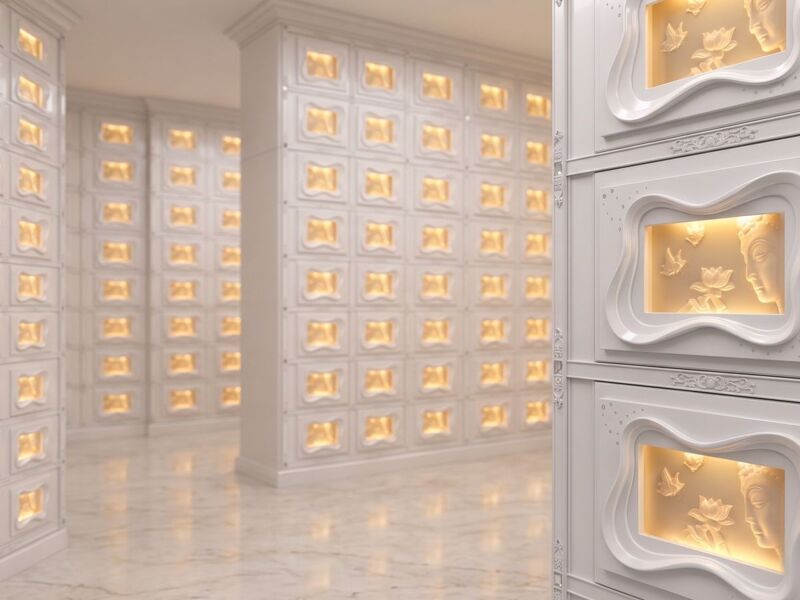
First, a family kneeling in front of a niche least wants to be seen whole by whoever is coming through the door. A space with a straight sightline has no "behind," and a person standing there cannot settle.
Second, the light environment jumps. Outdoors on a clear day it is 8,000 to 10,000 lux; in front of the niches indoors it is 150 to 200 lux. The eye needs three to five seconds to adapt. With a straight sightline that adaptation period falls entirely on the walkway, and people instinctively squint and look down.
Third, there is no emotional transition. Coming in off traffic, umbrellas and ringing phones, a person needs a stretch of dimness and a stretch of quiet before they can arrive at the state of observance.
The standard move is 90 degrees: enter and walk toward the side-front, then turn into the main hall. A 45-degree angled screen only blocks half the sightline; the remaining oblique angle still sweeps across the distant niches.
Where there is not enough floor area, use an offset instead of a turn: face a solid wall 1.5 metres wide on entry, with a 1.5-metre passage left on each side. It takes less area and blocks almost as well as a 90-degree turn.
To judge whether it has been done properly, stand still at the door and see whether you can see the door panel of any single niche. If you can, it is not blocked.
The vestibule should be no less than 2.4 metres deep. At an adult walking speed of 1.2 metres per second, that is exactly two steps and a pause.
Three metres is more comfortable, and leaves room for a direction sign, an umbrella stand and a mirror to check yourself.
Beyond four metres it is waste. Every square metre of a columbarium is ultimately priced into the niches, so an oversized vestibule amounts to building a corridor with the money from niche sales.
Width cannot be economised either. The clear width of the vestibule should be 2.4 metres so two people can pass without turning sideways. If the doorway is only 1.2 metres wheelchairs and prams will queue — and among the people who come to visit niches, the proportion arriving with a wheelchair is higher than most people assume.
Any partition meant to block sightlines should be no lower than 1.5 metres. Below that, a standing adult's line of sight passes over the partition and still sweeps the niches in the main hall.
At 1.8 metres it blocks completely, but it feels oppressive. The compromise is 1.5 metres of solid work plus 0.4 metres of grille: block the view, let the light through.
Do not use glass for the partition. Glass passes light and passes sightlines, which amounts to not doing it at all. Use timber grille or stone inlay and hold light transmittance at around 30 percent.
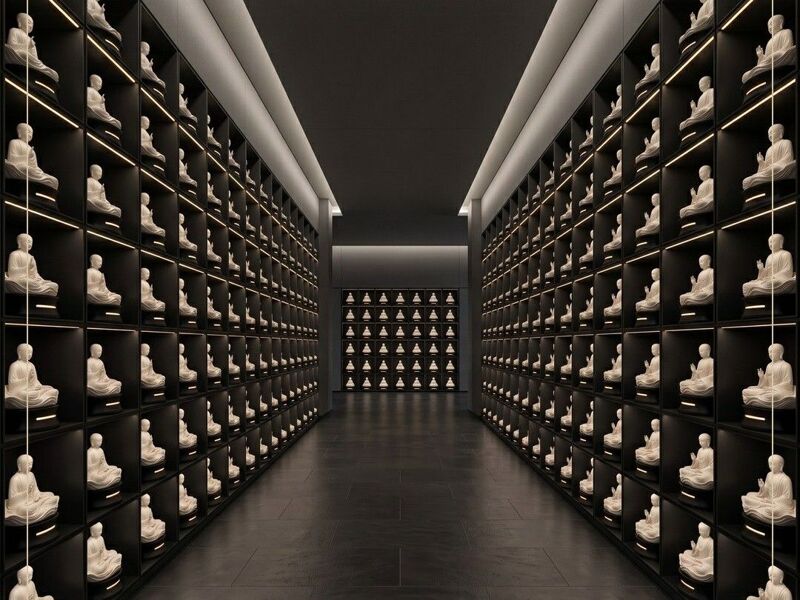
Set vestibule illuminance at 100 to 150 lux — one step below the niche zone in the main hall.
The order from dark to bright matters. Coming from bright into dark, the eye relaxes; then entering the bright again, the main hall feels larger.
Do not use occupancy sensors. Lights that snap fully on the moment someone enters break the transition. Use continuous lighting with dimming, held at around 120 lux.
If conditions allow, build two doors with a 1.5 to 2 metre buffer between them. That buffer stops cold air, rain and outside noise.
The problem with a single door is direct infiltration. In the plum-rain season in the south, the moment the door opens moisture goes straight into the niche zone and the dehumidification load jumps immediately.
Lay a 1.2 by 2 metre slip-resistant mat between the two doors. That mat takes seventy percent of the water off shoe soles and saves more electricity than any dehumidifier.
My recommendation is this: always build a vestibule, but do not build it large. A 90-degree turn, 2.4 to 3 metres of depth, 1.5 metres of screening and 120 lux of illuminance — those four numbers are enough.
I do not recommend turning the vestibule into a shopfront. A columbarium is not a hotel; the silence of that first moment inside matters more than marble and crystal chandeliers. A niche sells decades of peace of mind, and the vestibule is only responsible for the first impression.
Q: If area is tight, can we use just one screen?
A: Yes. A screen 1.8 metres wide and 1.5 metres high, set off-axis, blocks almost as well as a 90-degree turn.
Q: Can the service desk sit in the vestibule?
A: Better to put it after the turn. Facing the main door, a person is asked "buying a niche or visiting?" the moment they walk in — too much pressure.
Q: Can the vestibule double as a rest area?
A: Not advisable. A vestibule has through-draught, people cannot sit still, and seating blocks the coming and going.
Q: An existing columbarium is too "straight" — how do we fix it?
A: Add a free-standing partition 1.5 metres high two metres inside the door. It costs a few thousand and the effect is immediate. The niche zone does not need to be touched.
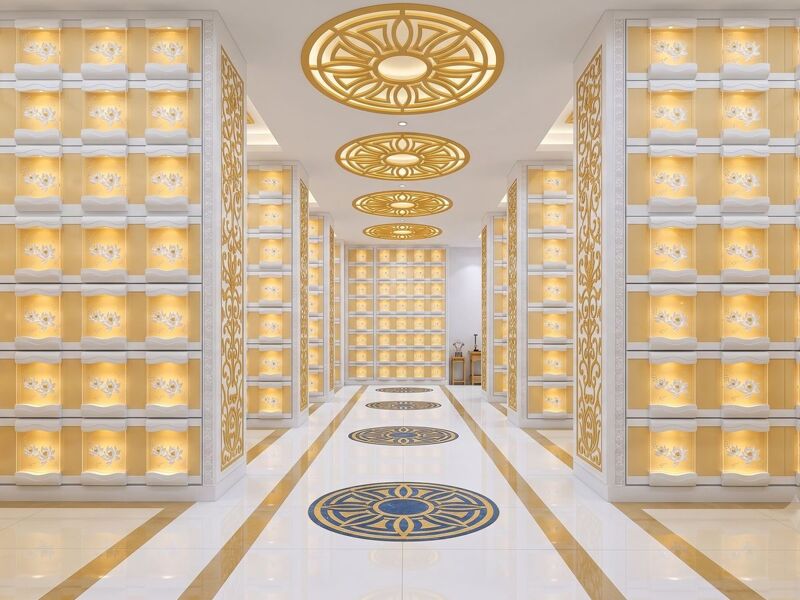
The vestibule comes down to five numbers: a 90-degree turn, 2.4 to 3 metres of depth, 1.5 metres of screening, 120 lux, two doors. The niches in a columbarium depend on one idea — concealment — and the vestibule is the first concealment: hold people back for three seconds, and the feelings can catch up.


