WeChat: (+86)13978873330 Email: 381784025@qq.com

WeChat: (+86)13978873330 Email: 381784025@qq.com

The return-south spell and the plum-rain season are often treated as the same thing, but they are two different weather patterns. In the plum-rain season the air simply holds more water; in the return-south spell the objects are too cold — the cold air has just gone and warm moist air floods in, and the floor tiles are still at 15 degrees while the air has reached 22 degrees and 90 percent. It need not rain at all; the floor produces water on its own.
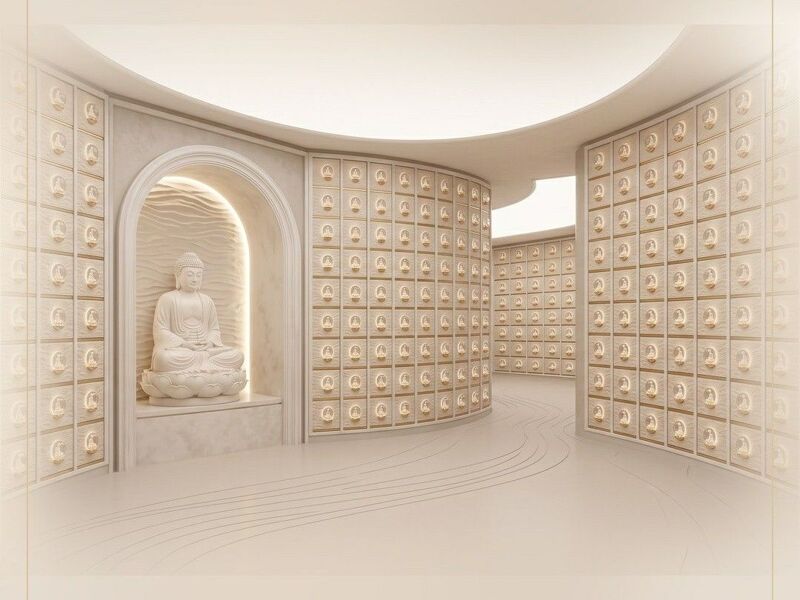
That is exactly what a columbarium fears: the water does not flow in through the door gap, it grows out of the floor, the walls and the door panels.
At 22 degrees Celsius and 90 percent relative humidity the dew point is about 20.4 degrees. Any surface below 20.4 degrees will collect condensation.
During a return-south spell columbarium floor tiles, stone wall faces and stainless steel door panels are often still at 14 to 17 degrees — 3 to 6 degrees below the dew point. Past 3 degrees of difference condensation is clearly visible; past 5, a continuous film of water forms on the floor.
That one fact sets the direction of every measure: what must be dealt with is not the air but the surface temperature.
Opening windows in the plum-rain season is wrong; in a return-south spell it is more thoroughly wrong.
Outdoors 95 percent, indoors 70: an hour with the windows open and the columbarium climbs above 88. Worse, the incoming warm moist air immediately strikes the cold floor and niche door panels and condenses on those cold faces. Opening a window is actively delivering water to the cold surfaces.
The correct move is to keep doors and windows shut, and wait until the outdoor temperature rises, the indoor-outdoor difference falls below 2 degrees and the wall and floor temperatures catch up. That usually takes two to three days.
A cleaner's first reaction on seeing water on the floor is to mop, and it is the costliest action during a return-south spell.
The mop water is near room temperature and therefore warmer than the floor; mopping does not remove water, it adds it. The floor is already cold, the spread water evaporates even more slowly, and one square metre takes two to three hours to dry. Mop three times in a morning and the floor is effectively wet all day.
The correct method is to absorb the water with a dry absorbent mop or cloth, wring it into a bucket, and keep the bucket out of the columbarium. Frequency depends on footfall: hourly at peak.
You have to start before condensation begins. Once the floor is already beaded, the machine must first evaporate that layer before it can work on the air, at half the efficiency.
Watch the forecast: on the morning the cold air leaves and the temperature rises, switch on, and prepare for 48 hours of continuous running — a return-south spell usually lasts two to four days.
Size the load by volume at 0.008 to 0.01 kilograms per hour per cubic metre. A one thousand cubic metre columbarium needs 8 to 10 kilograms per hour to hold near 60 percent.
Metal has low specific heat and conducts quickly, so during a return-south spell stainless steel niche door panels are often colder than the walls and are the first place beads appear.
Three things: wipe the door panels with a dry cloth once a day; check the gaskets in the niche door gaps one by one and add a thin strip where the seal is not tight — eight out of ten water entries come through the door gap; and put desiccant inside the niche, 50 grams of calcium chloride per compartment, replaced every two weeks. Humidity inside a niche runs higher than in the hall, because the carcass does not ventilate.
During a return-south spell, six tenths of the damp in a columbarium comes from the air and four tenths from inside.
Cut wet mopping to a minimum; absorb rather than mop. Turn the taps off tight in the handwashing area and wipe up standing water at once. Flowers brought in with water release two to three hundred grams of vapour per bunch — dewater at the entrance wrap in absorbent paper, then bring them in.
Do not leave liquid offerings in front of a niche uncovered for more than two hours; keep bins lidded and empty them twice a day. Incense ash absorbs moisture and cakes; clean weekly during a return-south spell.
Return-south spells are when electrical faults cluster in a columbarium. Walls bead, sockets, switches and luminaire junction boxes take on moisture, earth leakage protection trips, and LED strip connectors oxidise and flicker.
Before the spell, check: are faceplates tight, are junction boxes sealed, are strip connectors heat-shrunk. Put a packet of desiccant inside the distribution board; it costs a few yuan.
Also, do not run the spotlights in the niche zone at full brightness. Lamp heat drives air movement and makes condensation on cold faces more obvious.
My recommendation is to manage the columbarium as a sealed box: doors and windows shut tight, floor absorbed dry, machines running three days straight, door panels wiped once a day. Do those four things and eight out of ten problems never happen.
I do not recommend using air conditioning to dehumidify during a return-south spell. Cooling makes the metal niche door panels colder and condensation worse. A columbarium fears cold faces, and has never feared heat.
Q: Can extract fans be used during a return-south spell?
A: Yes, but at low volume and extract only, no supply. Extraction removes indoor moist air; it must not bring outdoor air in.
Q: How long until the floor water clears?
A: Two to three days after the temperature rises steadily. During that time the floor warms 1 to 2 degrees a day, and once it catches up with the dew point it dries on its own.
Q: Where does the dehumidifier water go?
A: Pipe it to a floor drain; do not use a collection tank. Over three days of continuous running, a tank fills in a day.
Q: Can quicklime be placed inside a niche?
A: Not advisable. Quicklime turns to powder as it absorbs moisture and will contaminate the urn surface. Use calcium chloride desiccant of the type with a collection bag.

The return-south spell comes down to three numbers: a surface 3 degrees below the dew point will bead, doors and windows shut tight, machines running 48 hours. The niches in a columbarium do not fear abundant moisture; they fear someone seeing water on the floor and reaching for a mop — with that mop, the water travels on shoe soles into every row.