WeChat: (+86)13978873330 Email: 381784025@qq.com

WeChat: (+86)13978873330 Email: 381784025@qq.com

Night lighting in a columbarium is not for looks. It does three things: it lets people walk without fear, it lets the cameras see, and it keeps the neighbours from complaining. Three goals, three brightness levels — put it all on one level and at least one of them fails.

Entrance and foyer 50 lux, main circulation 30 lux, niche zones 15 lux.
The entrance is brightest because that is where people judge whether this place is safe. The route comes next: enough to see the surface and the steps. The niche zones are darkest, because nobody is walking there at night; lighting them is both wasteful and intrusive.
A columbarium lit uniformly at 30 lux ends up with an entrance that is too dim and niche zones that are too bright — wrong at both ends.
Use 3000 K warm light at night. Cool white (5000 K and above) reads hard after dark, and stone turns blue-green.
Keep the colour rendering index at 80 or above or stone and timber finishes go untrue. Niche door colours collapse into grey under low-CRI lamps: warm brown by day, dirty grey by night.
Garden lights. 3–4 m high, spaced 8–10 m, lighting the forecourt and drive.
Wall lights. On the external wall at 2.4 m, lighting both sides of the entrance and the route.
In-ground uplights. Set in the paving, aimed up at trees or wall, for atmosphere. Use them sparingly; too many produce glare.
Wall-washers. On the main façade so the building has a shape at night. This is the single most worthwhile item in a columbarium.
Specify fully cut-off fittings with an upward light ratio not exceeding 3%. This is both a code requirement and a matter of neighbourliness.
Never use unshielded floodlights aimed at the sky. A columbarium near housing can draw a complaint from a single uplight beam.
Keep the shielding angle at 30° or more so nobody standing beneath a fitting is dazzled.
Split night lighting into three circuits: continuous (entrance, evacuation), timed (façade, garden), and sensor-driven (niche zone routes).
The continuous circuit never switches off, so the entrance and exits are legible at any hour. The timed circuit follows seasonal sunrise and sunset. The sensor circuit comes on when someone passes and holds for 3 minutes.
With a single switch for the whole building, the person on duty either turns everything on (wasteful) or everything off (unsafe).
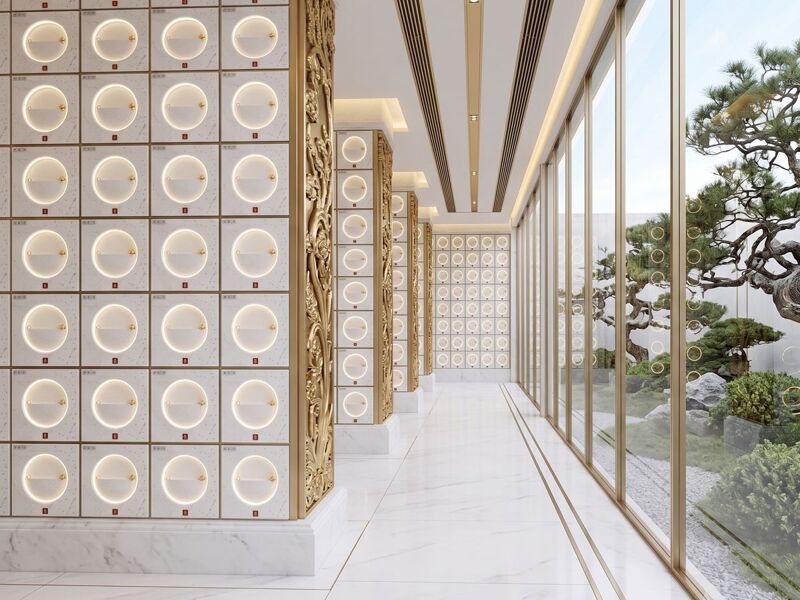
Camera fill light — infrared or white strobe — goes on a separate circuit from ceremonial lighting.
Cameras relying on ambient light at night produce a frame full of noise. Fit a 20 W white fill light beside each camera, triggered by person detection.
Ceremonial lighting does not need every corner lit; security lighting does. Mix the two and you get a building that is uniformly blazing.
Outdoor fittings not less than IP65; in-ground uplights IP67.
Fit surge protective devices in the distribution board. Columbaria often stand on open ground with high lightning risk; one strike can take out a whole circuit.
Run cabling in buried conduit at not less than 0.7 m depth, with waterproofed joints.
Rate fitting life at 30,000 hours; at 10 hours a night that is about 8 years. In practice output drops and colour shifts by year five.
Keep 10% spares of each type, and replace in whole runs rather than one fitting at a time — piecemeal replacement produces visible colour temperature banding along a single route.
Everything bright. In pursuit of a sense of safety, the niche zones are pushed to 50 lux. The result is light pollution, doubled electricity, and a building that looks like a warehouse from outside at night.
Everything dark. To save power, only the foyer light is left on. The result is cameras that see nothing elderly people afraid to walk, and staff patrolling with a torch.
The right approach is layered: bright where people walk, dim but not black where they do not.
Q: Can solar lamps be used?
A: On the forecourt and drive, yes. Not at the main entrance — solar lamps fail during consecutive overcast days, and the entrance cannot fail.
Q: Should the façade be floodlit at night?
A: Yes, but timed off at 22:00. A façade with a shape at night tells people this place is being looked after.
Q: Does too much light spoil the atmosphere of observance?
A: Yes. That is why niche zones sit at 15 lux, lit indirectly — wall-washing and floor-level fittings — never straight down from above.
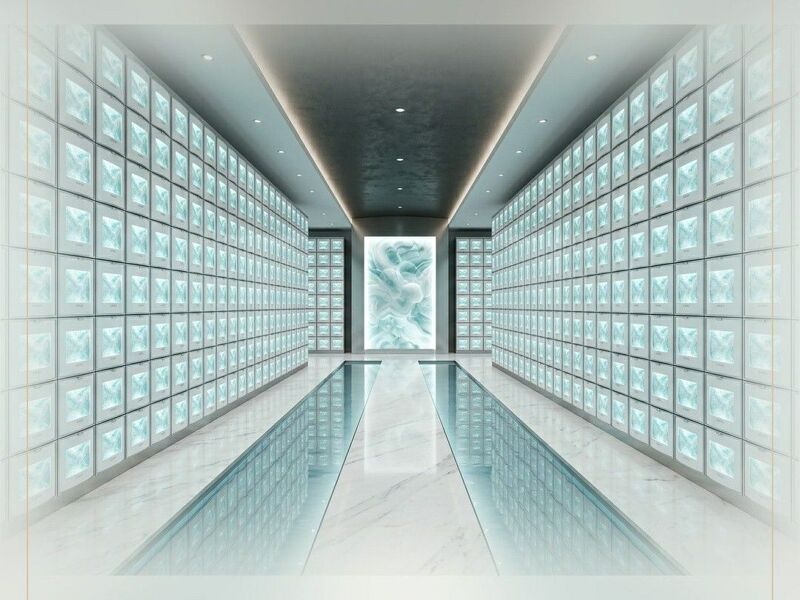
Night lighting in a columbarium: 50 at the entrance, 30 on the routes, 15 in the niche zones; 3000 K at CRI 80; four fitting types (garden, wall, in-ground, wall-wash); uplight at or below 3%; three control circuits (continuous, timed, sensor); security lighting separate from ceremonial; IP65 with surge arrest; 10% spares. The night in a columbarium does not need brightness; it needs to be legible, unalarming and unobtrusive.